Chromosome Evolution
Evolutionary constraints from structure of DNA
Telomeres
- Repetitive nucleotide sequence at ends of chromosomes
- Shorten at each cell division
- Protect genes near ends of chromosomes from
deterioration
- Telomere length is inversely correlated with age
(Hayflick limit, though cells rarely reach the limit in cell
divisions)
Centromeres
- No defined sequence
- Links sister chromatids
- Attaches to spindle fibres during meiosis
- Acts in chromosome segregation
- Position of centromere defines type of
centrosome (also influences evolution)
Genes and chromosomes
- Gene action is usually independent of chromosomal location
Except for position effects – gene regulation is affected by chromosomal
location, especially true in developmental genes (eg. hox genes found in clusters
in linear orders that correspond to order of segments of the body they control)
- In general there is little effect of chromosomal location (due to genetic
engineering successes) – providing the gene and its cis-acting regulatory
machinery are transplanted together
Except – tight linkage of several genes
together may also influence evolution.
With tight linkage, epistasis or certain
forms of migration, this may lead to
linkage disequilibrium – one of the ways in
which genes do not act independently
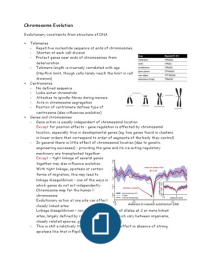
Chromosome map for the human X
chromosome
Evolutionary action at one site can affect
closely linked sites
Linkage disequilibrium – non-random association of alleles at 2 or more linked
sites, largely defined by recombination rates (which vary between organisms,
closely related species, gender and chromosomes)
- This is still a relatively trivial effect – has little effect in absence of strong
epistasis like that in Papilio
, - Significant linkage disequilibria and therefore dependencies between genes are
present overy tiny distances and most eukaryotes (eg. 1Mb in humans, 100kb
Drosophila) – both distances are essentially intragenic, perhaps rarely may
affect adjacent genes
However, the fact that genes lie on chromosome influences evolution far beyond
minor effects of position effects and linkage disequilibria: gene are arranged on
long strings – chromosomes themselves can act as genetic elements
- May be holistic selective effects that act on 100s to 1000s of genes at one time
- Evolutionary effect depends on chromosome size – larger chromsomes typically
carry more genes (though not always)
- Drosophila – 4 pairs of chromosomes, one pair is a microchromosome (~80
genes), one pair sex chromosomes, 2 pairs of autosomes
- Across the whole Lepidoptera, a group of similar age to the mammals, there is a
high variability of chromosome number, but there is a strong modal number
which many species in different groups of Lepidoptera actually have (n=31)
- Not entirely clear why there is such a pattern
Usually ~1 chiasma/crossing over per chromosome arm – chromosome number
(like sex) is an adaptation which affects the general level of recombination in
the genome
Many chromosomes means lots of recombination (50% recombination between
chromosomes, plus a lot of chiasmata) – few chromosomes means little
recombination
Karyotype: chromosomal genotypes, number of chromosomes in a haploid (1n) or diploid
(2n) cell, varies a great deal
Chromosomal Mutations
Polyploidisation: changes in number of chromosome sets more than 2 multiples of
haploid chromosome set
Condition infrequent in many animal species (only one known event in fungi), very
common in plants, amphibians, lizards and fish – usually lethal in humans
Odd numbers of chromosome sets – cannot produce genetically balanced gametes –
cannot pair during meiosis: associated with infertility
Autopolyploidy: additional set of chromosomes is identical to parent species
Result of non-disjunction: an error in cell division in which homologous chromosomes
fail to separate and migrate to opposite poles; responsible to trisomy and monosomy
Autotriploids
- Failure of all chromosomes to segregate during meiosis producing diploid gamete
- Haploid and diploid gametes = triploid zygote
Evolutionary constraints from structure of DNA
Telomeres
- Repetitive nucleotide sequence at ends of chromosomes
- Shorten at each cell division
- Protect genes near ends of chromosomes from
deterioration
- Telomere length is inversely correlated with age
(Hayflick limit, though cells rarely reach the limit in cell
divisions)
Centromeres
- No defined sequence
- Links sister chromatids
- Attaches to spindle fibres during meiosis
- Acts in chromosome segregation
- Position of centromere defines type of
centrosome (also influences evolution)
Genes and chromosomes
- Gene action is usually independent of chromosomal location
Except for position effects – gene regulation is affected by chromosomal
location, especially true in developmental genes (eg. hox genes found in clusters
in linear orders that correspond to order of segments of the body they control)
- In general there is little effect of chromosomal location (due to genetic
engineering successes) – providing the gene and its cis-acting regulatory
machinery are transplanted together
Except – tight linkage of several genes
together may also influence evolution.
With tight linkage, epistasis or certain
forms of migration, this may lead to
linkage disequilibrium – one of the ways in
which genes do not act independently
Chromosome map for the human X
chromosome
Evolutionary action at one site can affect
closely linked sites
Linkage disequilibrium – non-random association of alleles at 2 or more linked
sites, largely defined by recombination rates (which vary between organisms,
closely related species, gender and chromosomes)
- This is still a relatively trivial effect – has little effect in absence of strong
epistasis like that in Papilio
, - Significant linkage disequilibria and therefore dependencies between genes are
present overy tiny distances and most eukaryotes (eg. 1Mb in humans, 100kb
Drosophila) – both distances are essentially intragenic, perhaps rarely may
affect adjacent genes
However, the fact that genes lie on chromosome influences evolution far beyond
minor effects of position effects and linkage disequilibria: gene are arranged on
long strings – chromosomes themselves can act as genetic elements
- May be holistic selective effects that act on 100s to 1000s of genes at one time
- Evolutionary effect depends on chromosome size – larger chromsomes typically
carry more genes (though not always)
- Drosophila – 4 pairs of chromosomes, one pair is a microchromosome (~80
genes), one pair sex chromosomes, 2 pairs of autosomes
- Across the whole Lepidoptera, a group of similar age to the mammals, there is a
high variability of chromosome number, but there is a strong modal number
which many species in different groups of Lepidoptera actually have (n=31)
- Not entirely clear why there is such a pattern
Usually ~1 chiasma/crossing over per chromosome arm – chromosome number
(like sex) is an adaptation which affects the general level of recombination in
the genome
Many chromosomes means lots of recombination (50% recombination between
chromosomes, plus a lot of chiasmata) – few chromosomes means little
recombination
Karyotype: chromosomal genotypes, number of chromosomes in a haploid (1n) or diploid
(2n) cell, varies a great deal
Chromosomal Mutations
Polyploidisation: changes in number of chromosome sets more than 2 multiples of
haploid chromosome set
Condition infrequent in many animal species (only one known event in fungi), very
common in plants, amphibians, lizards and fish – usually lethal in humans
Odd numbers of chromosome sets – cannot produce genetically balanced gametes –
cannot pair during meiosis: associated with infertility
Autopolyploidy: additional set of chromosomes is identical to parent species
Result of non-disjunction: an error in cell division in which homologous chromosomes
fail to separate and migrate to opposite poles; responsible to trisomy and monosomy
Autotriploids
- Failure of all chromosomes to segregate during meiosis producing diploid gamete
- Haploid and diploid gametes = triploid zygote