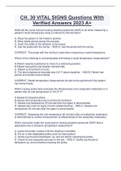
CH. 30 VITAL SIGNS Questions With Verified Answers 2023 A+
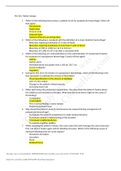
What will the nurse instruct nursing assistive personnel (NAP) to do when measuring a patient's rectal temperature using an electronic thermometer? A. Place the patient in the Fowler's position. B. Wear sterile gloves during the process. C. Insert the probe in the direction of the knees. D. Use the probe with the red tip. - ANS-D. Use the probe with the red tip. CORRECT. The probe with the red tip is used when measuring a rectal temperature. Which of the following is contraindicated with taking a rectal temperature measurement? A.Patient requires assistance to move to a side-lying position. B.Patient has painful and swollen hemorrhoids. C. Patient is incontinent of urine. D. The last temperature recorded was 0.2° F above baseline. - ANS-B. Patient has painful and swollen hemorrhoids. CORRECT. Rectal temperature measurement should not be performed if the patient has hemorrhoids. Which nursing action best evaluates the effectiveness of an antipyretic medication in a patient with an oral temperature of 101.6° F? A.Assess for physical aches. B.Assess skin temperature by touching the forehead. C. Assess oral temperature 30 minutes after the agent is administered. D. Assess skin color for signs of fever-related flushing. - ANS-C. Assess oral temperature 30 minutes after the agent is administered. CORRECT. Assessing the oral temperature 30 minutes after an antipyretic medication is administered is a direct measurement of effectiveness of the antipyretic medication. Which instruction might the nurse give to nursing assistive personnel (NAP) that is applicable only to tympanic temperature assessment? A. Leave the probe in place until the reading is complete. B. Put on a new disposable probe cover for each patient. C. Gently tug the pinna backward, up, and out before inserting the probe. D. Check for any impacted cerumen in the ear. - ANS-C. Gently tug the pinna backward, up, and out before inserting the probe. CORRECT. Placement of the tympanic thermometer probe is fundamental to the effective measurement of tympanic temperature in an adult patient. Which instruction might the nurse give to nursing assistive personnel (NAP) that is applicable only to temporal artery temperature assessment? A. An accurate temperature reading is obtained with moisture on the forehead. B. Put on a disposable sensor cover before taking the temporal artery temperature. C. Place the sensor flush on the patient's forehead. D. Obtain the temperature reading on the lower neck. - ANS-C. Place the sensor flush on the patient's forehead. CORRECT. Placement of the sensor on a temporal artery thermometer is flush on the patient's forehead. The thermometer remains flush on the skin as the NAP slides it across the forehead. During the admissions process, the nurse initially assesses the patient's radial pulse primarily for what purpose? A. Assessment of peripheral blood perfusion B. Establishment of a baseline as part of the patient's vital signs C. Assessment of the patient's cardiovascular disease risk D. Determination of oxygen saturation - ANS-B. Establishment of a baseline as part of the patient's vital signs CORRECT. It is essential to establish a point of reference against which future radial pulse rate measurements can be compared. What will the nurse instruct nursing assistive personal (NAP) to do when measuring an adult patient's radial pulse? A. Place the patient in the lateral (side-lying) position before measuring the pulse. B. Apply gloves with each patient before measuring the pulse. C. Document whether the patient's pulse is bounding or has diminished. D. Palpate the patient's inner wrist on the thumb side with the fingertips of your two middle fingers. - ANS-D. Palpate the patient's inner wrist on the thumb side with the fingertips of your two middle fingers. CORRECT. The thumb side of the wrist easily accesses the radial artery for the radial pulse. The ulnar artery is on the little finger side of wrist. The nurse's thumb has pulsation that will interfere with accuracy; therefore the fingertips are the most sensitive parts of the hand to palpate arterial pulsation. What is the nurse's priority action if a patient's radial pulse has an irregular rhythm? CONTINUES...
Written for
- Institution
-
Walden University
- Course
-
CH. 30 VITAL SIGNS (EXAM)
Document information
- Uploaded on
- January 7, 2023
- Number of pages
- 19
- Written in
- 2022/2023
- Type
- Exam (elaborations)
- Contains
- Questions & answers
Subjects
-
ch 30 vital signs
-
ch 30 vital signs questions with verified answers 2023 a
-
what will the nurse instruct nursing assistive personnel nap to do when measuring a patients rectal temperature us

Also available in package deal