Fish – Living Underwater
Fish is a paraphyletic group/term
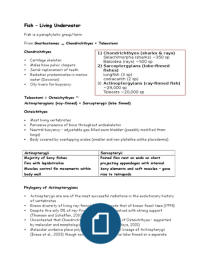
From Gnathostomes Chondrichthyes + Teleostomi
Chondrichthyes 1) Chondrichthyes (sharks & rays)
Selachimorpha (sharks) ~350 sp
Cartilage skeleton Batoidea (rays) ~500 sp
Males have pelvic claspers 2) Sarcoptergyians (lobe-finned
Serial replacement of teeth fishes)
Radiation predominates in marine lungfish (3 sp)
water (Devonian) coelacanth (2 sp)
Oily livers for buoyancy 3) Actinoptergyians (ray-finned fish)
~29,000 sp
Teleosts ~20,000 sp
Teleostomi = Osteichythyes
Actinopterygians (ray-finned) + Sarcopterygii (lobe finned)
Osteichthyes
Most living vertebrates
Pervasive presence of bone throughout endoskeleton
Neutral buoyancy – adjustable gas-filled swim bladder (possibly modified from
lungs)
Body covered by overlapping scales (smaller and non-platelike unlike placoderms)
Actinopterygii Sarcopteryii
Majority of bony fishes Paired fins rest on ends on short
Fins with lepidotrichia projecting appendages with internal
Muscles control fin movements within bony elements and soft muscles – gave
body wall rise to tetrapods
Phylogeny of Actinopterygians
Actinopterygii are one of the most successful radiations in the evolutionary history
of vertebrates
Known diversity of living ray-finned fishes exceeds that of known fossil taxa (1994)
Despite this only 5% of ray-finned phylogeny is resolved with strong support
(Thomson and Schaffer, 2010)
Uncontested that Chondrichthyes is the sistergroup of Osteichthyes – supported
by molecular and morphological data (Meyer and Zardoya, 2001)
Molecular evidence place polypteriforms as the basal lineage of Actinopterygii
(Inoue et al., 2003) though some have classified it as lobe-finned or a separate
, group
Phylogeny of teleosts and actinopterygii using molecular data has given mixed
results – particularly important for teleosts to time their diversification
Near et al., 2012 used 9 unlinked protein-coding nuclear genes from 232 species to
investigate phylogenetic relationships and divergence times
Polypteriforms are sistergroup to teleosts – not a basal lineage
Strong support for major lineages of ray-finned fishes and teleosts
Provided a molecular time scale more consistent with ages implied by fossil record
Living Underwater
73% of Earth’s surface is freshwater or saltwater – most water held in ocean basins
Freshwater – 0.01% of water, but habitats
are biologically rich – nearly 40% of bony
fishes live in freshwater
Water and air are fluids at biologically
relevant temperatures and pressures but
their physical properties make them
drastically different environments
Gravity negligible in water but fluid
resistance is a major factor (fish are
hence streamlined)
Higher density, viscosity
Low oxygen content
High SHC and conductivity
High electrical conductivity
Obtaining oxygen in water – Respiration
Gills
Most aquatic vertebrates gills –
specialised structures for gaseous
exchange
Ray-finned fish = opercular gills
Teleosts (derived ray-finned fishes –
includes freshwater and marine fishes)
Gills of teleosts enclosed in pharyngeal
pockets (opercular cavities)
Sharks = septal gills
Agnathans = pouched gills
Flow of water is usually unidirectional –
through mouth and out through gills
Flaps inside the mouth and flaps at
, margins of gill covers (opercula) of bony fishes act as valves to prevent backflow
Respiratory surfaces of gills are delicate projections from lateral side of each gill
arch
2 columns of gill filaments (primary and secondary lamellae) extend from each gill
arch – tips of filaments from adjacent arches meet when filaments are extended
As water leaves buccal cavity, it passes over filaments
Gas exchange takes place at microscopic projections from filaments (secondary
lamellae) – large surface area
Filaments have 2 arteries (afferent and efferent vessel)
Each secondary lamellae is a blood space connecting these 2 blood vesselsDirection
of blood flow through lamellae is opposite to direction of water flow across the gill
= countercurrent exchange
Ensures as much oxygen as possible diffuses into the blood
Pelagic fishes (eg, tunas) sustain high levels of activity for long periods – skeletal
tissue reinforcing gill filaments, large gill exhchange areas, have high oxygen-
carrying capacity per ml of blood compared with bottom-dwelling fishes (eg.
toadfishes, flatfishes) (Pough et al., 2013)
Gills also have additional functions of acid-base regulation, excretion of nitrogenous
waste (Evans et al., 2005)
Respiration
Buccal pumping: Pumping action of the mouth and opercular cavities creates positive
pressure across gills so that the respiratory current is only slightly interrupted
during each pumping cycle
Ram ventilation: create respiratory current by swimming with mouths open – must
swim continuously
Some filter-feeding fishes and many pelagic fishes (eg, mackerel, certain sharks,
tunas, swordfishes) use ram ventilation exclusively
Have lost abilitu to pump water across gills
Many other fishes rely on buccal pumping when at rest and switch to ram ventilation
when swimming
Obtaining oxygen from Air
Fishes that live in water with low oxygen levels need to supplement oxygen from
additional oxygen supplied from airs via lungs of accessory air respiratory
structures (facultative air breathers)
Accessry surfaces: enlarged lips extended just above water surfaces
Anabantid fishes of tropical Asia (obligate) have vascularised chambers in rear of
head – labyrinths
Other obligate breathers – electric eel (Electrophorus electricus), some
snakeheads, lungfish
Lungs used for gas exchange need a large s/a – provided by ridges or pockets in the
wall
Fish is a paraphyletic group/term
From Gnathostomes Chondrichthyes + Teleostomi
Chondrichthyes 1) Chondrichthyes (sharks & rays)
Selachimorpha (sharks) ~350 sp
Cartilage skeleton Batoidea (rays) ~500 sp
Males have pelvic claspers 2) Sarcoptergyians (lobe-finned
Serial replacement of teeth fishes)
Radiation predominates in marine lungfish (3 sp)
water (Devonian) coelacanth (2 sp)
Oily livers for buoyancy 3) Actinoptergyians (ray-finned fish)
~29,000 sp
Teleosts ~20,000 sp
Teleostomi = Osteichythyes
Actinopterygians (ray-finned) + Sarcopterygii (lobe finned)
Osteichthyes
Most living vertebrates
Pervasive presence of bone throughout endoskeleton
Neutral buoyancy – adjustable gas-filled swim bladder (possibly modified from
lungs)
Body covered by overlapping scales (smaller and non-platelike unlike placoderms)
Actinopterygii Sarcopteryii
Majority of bony fishes Paired fins rest on ends on short
Fins with lepidotrichia projecting appendages with internal
Muscles control fin movements within bony elements and soft muscles – gave
body wall rise to tetrapods
Phylogeny of Actinopterygians
Actinopterygii are one of the most successful radiations in the evolutionary history
of vertebrates
Known diversity of living ray-finned fishes exceeds that of known fossil taxa (1994)
Despite this only 5% of ray-finned phylogeny is resolved with strong support
(Thomson and Schaffer, 2010)
Uncontested that Chondrichthyes is the sistergroup of Osteichthyes – supported
by molecular and morphological data (Meyer and Zardoya, 2001)
Molecular evidence place polypteriforms as the basal lineage of Actinopterygii
(Inoue et al., 2003) though some have classified it as lobe-finned or a separate
, group
Phylogeny of teleosts and actinopterygii using molecular data has given mixed
results – particularly important for teleosts to time their diversification
Near et al., 2012 used 9 unlinked protein-coding nuclear genes from 232 species to
investigate phylogenetic relationships and divergence times
Polypteriforms are sistergroup to teleosts – not a basal lineage
Strong support for major lineages of ray-finned fishes and teleosts
Provided a molecular time scale more consistent with ages implied by fossil record
Living Underwater
73% of Earth’s surface is freshwater or saltwater – most water held in ocean basins
Freshwater – 0.01% of water, but habitats
are biologically rich – nearly 40% of bony
fishes live in freshwater
Water and air are fluids at biologically
relevant temperatures and pressures but
their physical properties make them
drastically different environments
Gravity negligible in water but fluid
resistance is a major factor (fish are
hence streamlined)
Higher density, viscosity
Low oxygen content
High SHC and conductivity
High electrical conductivity
Obtaining oxygen in water – Respiration
Gills
Most aquatic vertebrates gills –
specialised structures for gaseous
exchange
Ray-finned fish = opercular gills
Teleosts (derived ray-finned fishes –
includes freshwater and marine fishes)
Gills of teleosts enclosed in pharyngeal
pockets (opercular cavities)
Sharks = septal gills
Agnathans = pouched gills
Flow of water is usually unidirectional –
through mouth and out through gills
Flaps inside the mouth and flaps at
, margins of gill covers (opercula) of bony fishes act as valves to prevent backflow
Respiratory surfaces of gills are delicate projections from lateral side of each gill
arch
2 columns of gill filaments (primary and secondary lamellae) extend from each gill
arch – tips of filaments from adjacent arches meet when filaments are extended
As water leaves buccal cavity, it passes over filaments
Gas exchange takes place at microscopic projections from filaments (secondary
lamellae) – large surface area
Filaments have 2 arteries (afferent and efferent vessel)
Each secondary lamellae is a blood space connecting these 2 blood vesselsDirection
of blood flow through lamellae is opposite to direction of water flow across the gill
= countercurrent exchange
Ensures as much oxygen as possible diffuses into the blood
Pelagic fishes (eg, tunas) sustain high levels of activity for long periods – skeletal
tissue reinforcing gill filaments, large gill exhchange areas, have high oxygen-
carrying capacity per ml of blood compared with bottom-dwelling fishes (eg.
toadfishes, flatfishes) (Pough et al., 2013)
Gills also have additional functions of acid-base regulation, excretion of nitrogenous
waste (Evans et al., 2005)
Respiration
Buccal pumping: Pumping action of the mouth and opercular cavities creates positive
pressure across gills so that the respiratory current is only slightly interrupted
during each pumping cycle
Ram ventilation: create respiratory current by swimming with mouths open – must
swim continuously
Some filter-feeding fishes and many pelagic fishes (eg, mackerel, certain sharks,
tunas, swordfishes) use ram ventilation exclusively
Have lost abilitu to pump water across gills
Many other fishes rely on buccal pumping when at rest and switch to ram ventilation
when swimming
Obtaining oxygen from Air
Fishes that live in water with low oxygen levels need to supplement oxygen from
additional oxygen supplied from airs via lungs of accessory air respiratory
structures (facultative air breathers)
Accessry surfaces: enlarged lips extended just above water surfaces
Anabantid fishes of tropical Asia (obligate) have vascularised chambers in rear of
head – labyrinths
Other obligate breathers – electric eel (Electrophorus electricus), some
snakeheads, lungfish
Lungs used for gas exchange need a large s/a – provided by ridges or pockets in the
wall