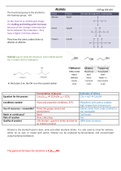
Alcohols CGP pg 102-104
The functional group in the alcohols is
the hydroxyl group, –OH.
As the chain of an alcohol gets longer,
the melting and boiling point increases
because of the stronger intermolecular
forces between the molecules – they
have a higher m+b than alkanes.
They have the same carbon chain as
alkanes or alkenes.
Skeletal way to show the structure. Each nodule (point)
has a carbon and its hydrogens.
In the butan-2-ol, the OH is on the second carbon
Fermentation of glucose Hydration of ethene
Equation for the process C6H12O6 (aq) à 2C2H5OH (aq) + 2CO2 C2H4 + H2O à C2H5OH
Conditions needed Yeast and anaerobic conditions, 37oC
Phosphoric acid used as catalyst
High temperature and pressure
Use of resources – renewable? Plants like grapes (wine) and Ethene comes from crude oil which is
barely (beer) non-renewable
Batch or continuous? Batch Continuous
Rate of reaction Slow, takes days Fast
Quality of product 15% alcohol – good for drinks but bad for 100% atom economy
an industry product
Ethanol is the alcohol found in beer, wine and other alcoholic drinks. It is also used as a fuel for vehicles,
either on its own or mixed with petrol. Ethanol can be produced by fermentation and concentrated
using fractional distillation.
The general formula for alcohols is CnH2n+1OH
The functional group in the alcohols is
the hydroxyl group, –OH.
As the chain of an alcohol gets longer,
the melting and boiling point increases
because of the stronger intermolecular
forces between the molecules – they
have a higher m+b than alkanes.
They have the same carbon chain as
alkanes or alkenes.
Skeletal way to show the structure. Each nodule (point)
has a carbon and its hydrogens.
In the butan-2-ol, the OH is on the second carbon
Fermentation of glucose Hydration of ethene
Equation for the process C6H12O6 (aq) à 2C2H5OH (aq) + 2CO2 C2H4 + H2O à C2H5OH
Conditions needed Yeast and anaerobic conditions, 37oC
Phosphoric acid used as catalyst
High temperature and pressure
Use of resources – renewable? Plants like grapes (wine) and Ethene comes from crude oil which is
barely (beer) non-renewable
Batch or continuous? Batch Continuous
Rate of reaction Slow, takes days Fast
Quality of product 15% alcohol – good for drinks but bad for 100% atom economy
an industry product
Ethanol is the alcohol found in beer, wine and other alcoholic drinks. It is also used as a fuel for vehicles,
either on its own or mixed with petrol. Ethanol can be produced by fermentation and concentrated
using fractional distillation.
The general formula for alcohols is CnH2n+1OH