International sales & procurement
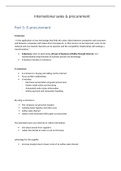
Part 5: E-procurement
E-business
= is the application of new technology that links the value chains between companies and consumers
and between companies and makes them transparent, so that service can be improved, costs can be
reduced and new market channels can be opened, and the competitive relationships will undergo a
transformation.”
E-Business refers to performing all type of business activities through internet, incl
transformation/improvement of business process via technology
E-business includes E-commerce
E-commerce
E-commerce is buying and selling via the internet
Focus on B2C relationships
It includes:
- Electronic presentation of goods and services
- Orders made online and invoicing
- Automated order status information
- Online payment and transaction handling
By using e-commerce:
The company can grow the margins
realizing lower logistics and sales costs
online sales channel
reduce costs associated with paper use processes.
The potential buyer uses internet to collect information:
info about stocks from suppliers
makes him decide to order or not on this basis
advantage for the supplier:
increase margins due to lower costs of an online sales channel
, what is E-procurement?
• = the term used to describe the use of electronic methods in every stage of the procurement
process from identifications of requirement through to payment, and potentially to contract
management.
OR
- the electronic purchase and sale of goods and services, usually through an Internet-
based platform.
- a tool designed to improve the purchasing process transparency and efficiency and help
companies capture savings.
E-procurement facilitates interactions between preferred suppliers and customers through bids,
purchase orders and invoices.
E-procurement started in the 1980s, following the development of Electronic Data Interchange
(EDI).
Why? Goals?
facilitates and accelerates communication between purchasing and sales.
makes professionalization of purchasing possible so that ultimately a competitive advantage can
be achieved
increase (buyers’) productivity and efficiency
reduce the turnaround time of the process (purchasing cycle time)
save costs
Additional benefits
- Eliminating administrative errors
- Enhancing budgetary control
- Lowering prices through product standardization and consolidations of purchasing power
- Better information management.
- Enables Purchasing intelligence
converting data into purchasing information to reflect and improve the performance of the
purchasing function.
the determination and measurement of kpi, including target goods
based on purchasing intelligence these decisions can be made faster and desired actions can be
started
an example of E-procurement
e-ordering
employees in an organization can electronically request, order and receive goods and services
using an e-catalog system
Part 5: E-procurement
E-business
= is the application of new technology that links the value chains between companies and consumers
and between companies and makes them transparent, so that service can be improved, costs can be
reduced and new market channels can be opened, and the competitive relationships will undergo a
transformation.”
E-Business refers to performing all type of business activities through internet, incl
transformation/improvement of business process via technology
E-business includes E-commerce
E-commerce
E-commerce is buying and selling via the internet
Focus on B2C relationships
It includes:
- Electronic presentation of goods and services
- Orders made online and invoicing
- Automated order status information
- Online payment and transaction handling
By using e-commerce:
The company can grow the margins
realizing lower logistics and sales costs
online sales channel
reduce costs associated with paper use processes.
The potential buyer uses internet to collect information:
info about stocks from suppliers
makes him decide to order or not on this basis
advantage for the supplier:
increase margins due to lower costs of an online sales channel
, what is E-procurement?
• = the term used to describe the use of electronic methods in every stage of the procurement
process from identifications of requirement through to payment, and potentially to contract
management.
OR
- the electronic purchase and sale of goods and services, usually through an Internet-
based platform.
- a tool designed to improve the purchasing process transparency and efficiency and help
companies capture savings.
E-procurement facilitates interactions between preferred suppliers and customers through bids,
purchase orders and invoices.
E-procurement started in the 1980s, following the development of Electronic Data Interchange
(EDI).
Why? Goals?
facilitates and accelerates communication between purchasing and sales.
makes professionalization of purchasing possible so that ultimately a competitive advantage can
be achieved
increase (buyers’) productivity and efficiency
reduce the turnaround time of the process (purchasing cycle time)
save costs
Additional benefits
- Eliminating administrative errors
- Enhancing budgetary control
- Lowering prices through product standardization and consolidations of purchasing power
- Better information management.
- Enables Purchasing intelligence
converting data into purchasing information to reflect and improve the performance of the
purchasing function.
the determination and measurement of kpi, including target goods
based on purchasing intelligence these decisions can be made faster and desired actions can be
started
an example of E-procurement
e-ordering
employees in an organization can electronically request, order and receive goods and services
using an e-catalog system