

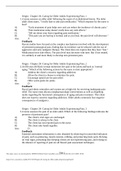
Chapter 28- Caring for Older Adults Experiencing Pain Complete Solution Q&A 2023.
Origin: Chapter 28- Caring for Older Adults Experiencing Pain, 1 1.A nurse assesses an older adult following the repair of an abdominal hernia. The older adult client states, "I really hate to take pain medication." Which response by the nurse is best? A) "Early treatment of pain helps now and can reduce the incidence of chronic pain." B) "Pain medication today doesn't really have any side effects." C) "Tell me about your fears regarding pain medication." D) "This pain you are having is normal, and as you heal, the pain level will decrease." Ans: A Feedback: Recent studies have focused on the complex mechanisms involved with the development of persistent postsurgical pain, finding that its incidence can be reduced with the use of aggressive and early analgesic therapy. The client does not express that they have "fear." Medications have side effects. The pain level may decrease with time. But if not treated, it is unlikely to and more likely to develop into persistent pain. Origin: Chapter 28- Caring for Older Adults Experiencing Pain, 2 2.An 80-year-old black woman minimizes her pain in the joints and back as "normal aging." Which of the following actions by the nurse is most appropriate? A) Address the client's concerns regarding addiction. B) Allow the client to choose to minimize the pain. C) Encourage opioid use for pain relief. D) Offer warm packs for joints. Ans: D Feedback: Racial and ethnic minorities and women are at high risk for receiving inadequate pain relief. The nurse must discuss nonpharmacologic interventions as well as dispelling myths regarding the functional consequences of aging and pain treatment. This client does not express concerns regarding addiction. Older adults commonly fear negative consequences of analgesics. Origin: Chapter 28- Caring for Older Adults Experiencing Pain, 3 3.A nurse assesses the pain of an older adult. Which of the following findings indicates the presence of persistent pain? A) The client's vital signs are unchanged. B) The client is asleep in the chair. C) The client has not reported pain to the nurse. D) The client rubs hands together. Ans: D Feedback: Essential assessment information is also obtained by observing for nonverbal indicators of pain, such as grimacing, muscle tension, rubbing, and protecting body parts. Relying on vital signs, presuming that sleeping clients are not experiencing pain, and relying on the absence of reporting of pain are all flawed pain assessment techniques.
Document information
- Uploaded on
- December 30, 2022
- Number of pages
- 6
- Written in
- 2022/2023
- Type
- Exam (elaborations)
- Contains
- Questions & answers


