Unit 2: Learning Aim A: undertake titration and calorimetry to determine
concentration of solutions.
Learning aim: Undertake titration and colorimetry to determine the concentration of
solutions
P1: Correctly prepare and standardise a solution for titration or colorimetry
Calibrate the equipment: weighing balance
Equipment:
➔ Calibration weights of 10g,50g,100g and 500g.
➔ Balance Precisa XB 1600C
My method:
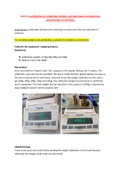
Press and hold the T-button until “CAL” appears in the display. Release the T- button. The
calibration cycle will now be activated. The zero is confirmed (the display flashes) As soon as
the zero measurement is confirmed, I proceed to put the weight calibration on the scale, I
put 500g, 200g, 100g, 100g and 2x50g. The calibration weight measurement is confirmed,
and is completed. The total weight that we calculate in this practice is 1000g, I obtained an
exact 1000g for which I did the practice well.
OBSERVATIONS:
I have to be quick and careful when putting the weight calibration on the scale because
otherwise the weight could come out incorrectly.
, Also the classroom temperature can be affected by measuring the weight calibration
CALIBRATION OF 25.0cm3 VOLUMETRIC PIPETTE
Equipment:
➔ Distilled water.
➔ 2 Beaker
➔ Volumetric pipette
My method:
At first I weigh the empty beaker and record the mass of that beaker in grams(m1). Then I
put some distilled water into the empty beaker. Then with the volumetric pipette we
carefully measure out 25.0cm3 of distilled water. I carefully transfer the measure of 25.0cm3
to another beaker of 100ml. Then I reweigh the beaker with the distilled water in, and
record the mass in grams (m2).
Finally I calculate the mass of water added using the m2-m1
Estimate: 75.37-50.41= 24.96g
P1: Calibration the pH meter
My method:
For the calibration metre I use an electric metre for the ph. This ph metre has instructions,
so I follow the instructions to calibrate the metre. I press the black button that is present in
concentration of solutions.
Learning aim: Undertake titration and colorimetry to determine the concentration of
solutions
P1: Correctly prepare and standardise a solution for titration or colorimetry
Calibrate the equipment: weighing balance
Equipment:
➔ Calibration weights of 10g,50g,100g and 500g.
➔ Balance Precisa XB 1600C
My method:
Press and hold the T-button until “CAL” appears in the display. Release the T- button. The
calibration cycle will now be activated. The zero is confirmed (the display flashes) As soon as
the zero measurement is confirmed, I proceed to put the weight calibration on the scale, I
put 500g, 200g, 100g, 100g and 2x50g. The calibration weight measurement is confirmed,
and is completed. The total weight that we calculate in this practice is 1000g, I obtained an
exact 1000g for which I did the practice well.
OBSERVATIONS:
I have to be quick and careful when putting the weight calibration on the scale because
otherwise the weight could come out incorrectly.
, Also the classroom temperature can be affected by measuring the weight calibration
CALIBRATION OF 25.0cm3 VOLUMETRIC PIPETTE
Equipment:
➔ Distilled water.
➔ 2 Beaker
➔ Volumetric pipette
My method:
At first I weigh the empty beaker and record the mass of that beaker in grams(m1). Then I
put some distilled water into the empty beaker. Then with the volumetric pipette we
carefully measure out 25.0cm3 of distilled water. I carefully transfer the measure of 25.0cm3
to another beaker of 100ml. Then I reweigh the beaker with the distilled water in, and
record the mass in grams (m2).
Finally I calculate the mass of water added using the m2-m1
Estimate: 75.37-50.41= 24.96g
P1: Calibration the pH meter
My method:
For the calibration metre I use an electric metre for the ph. This ph metre has instructions,
so I follow the instructions to calibrate the metre. I press the black button that is present in