Unit 2 Learning Aim C - Chromatography
Learning aim: Undertake chromatographic techniques to identify components in mixtures.
P5: Correctly use chromatography techniques to procedure chromatograms.
Chromatography, technique for separating the components, or solutes, of a mixture on the
basis of the relative amounts of each solute distributed between a moving fluid stream,
called the mobile phase, and a contiguous stationary phase. The mobile phase may be either
a liquid or a gas, while the stationary phase is either a solid or a liquid.
Paper chromatography
Equipment:
● Water
● Paper
● Markers different colours
● Beaker
My method:
For this practical I used chromatography paper which is the stationary phase because it does
not mine and tap water which is the solvent the mobile phase because it does move, and
the colour markers. I start to draw a pencil line near the bottom. Next I put a dot of our first
colour on the pencil line, and next to it I put two more dots of different colours. Then I place
the paper into the beaker and I fill the beaker with tap water (solvent) under the pencil line.
So the solvent went up the paper and dissolved the inks, separating the mixture of different
substances.
I used the same brand of markers in the first paper chromatography, I used dark blue, purple
and green. For the second two paper chromatography I used different markers for different
brands, for the second chromatography paper a brown colour and for the third one I use
black.
Results:
, Observations:
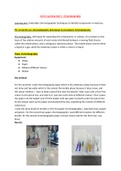
For the first paper chromatography I appreciate the separation of the 2 spots of the paper,
the green and dark blue. In the separation of the green I appreciate the different substances
which are blue and yellow. For the dark blue I can only appreciate a small amount of pink.
For the purple I don’t get any results so this means it is a pure colour.
For the second chromatography I used a brown marker, and I got an orange colour, but it is
the only colour I got so this means the brown was a pure colour.
For the last paper chromatography I used a black marker and I got a light blue and a little
amount of red (is not really visible on the photo), so the black is used different substances to
get his colour.
Thin layer chromatography (TLC)
Thin layer chromatography, or TLC, is a method for analysing mixtures by separating the
compounds in the mixture. TLC can be used to help determine the number of components in
a mixture, the identity of compounds, and the purity of a compound.
Equipment:
● Spinach
● TLC paper
● Solution A
● Solution B
● Mortar
● Pipette
● Trousers
● Pencil
● Bottle to place tlc paper
● Ruler
Risk assessment
Equipment/chemical Risk Prevention treatment
hazard
Propane (solvent B) Flammable and Wear correct lab Wash the burned
Learning aim: Undertake chromatographic techniques to identify components in mixtures.
P5: Correctly use chromatography techniques to procedure chromatograms.
Chromatography, technique for separating the components, or solutes, of a mixture on the
basis of the relative amounts of each solute distributed between a moving fluid stream,
called the mobile phase, and a contiguous stationary phase. The mobile phase may be either
a liquid or a gas, while the stationary phase is either a solid or a liquid.
Paper chromatography
Equipment:
● Water
● Paper
● Markers different colours
● Beaker
My method:
For this practical I used chromatography paper which is the stationary phase because it does
not mine and tap water which is the solvent the mobile phase because it does move, and
the colour markers. I start to draw a pencil line near the bottom. Next I put a dot of our first
colour on the pencil line, and next to it I put two more dots of different colours. Then I place
the paper into the beaker and I fill the beaker with tap water (solvent) under the pencil line.
So the solvent went up the paper and dissolved the inks, separating the mixture of different
substances.
I used the same brand of markers in the first paper chromatography, I used dark blue, purple
and green. For the second two paper chromatography I used different markers for different
brands, for the second chromatography paper a brown colour and for the third one I use
black.
Results:
, Observations:
For the first paper chromatography I appreciate the separation of the 2 spots of the paper,
the green and dark blue. In the separation of the green I appreciate the different substances
which are blue and yellow. For the dark blue I can only appreciate a small amount of pink.
For the purple I don’t get any results so this means it is a pure colour.
For the second chromatography I used a brown marker, and I got an orange colour, but it is
the only colour I got so this means the brown was a pure colour.
For the last paper chromatography I used a black marker and I got a light blue and a little
amount of red (is not really visible on the photo), so the black is used different substances to
get his colour.
Thin layer chromatography (TLC)
Thin layer chromatography, or TLC, is a method for analysing mixtures by separating the
compounds in the mixture. TLC can be used to help determine the number of components in
a mixture, the identity of compounds, and the purity of a compound.
Equipment:
● Spinach
● TLC paper
● Solution A
● Solution B
● Mortar
● Pipette
● Trousers
● Pencil
● Bottle to place tlc paper
● Ruler
Risk assessment
Equipment/chemical Risk Prevention treatment
hazard
Propane (solvent B) Flammable and Wear correct lab Wash the burned