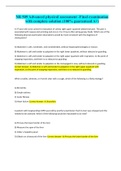
NR 509 Advanced physical assessment -Final examination with complete solution (100% guaranteed A+)
NR 509 Advanced physical assessment -Final examination with complete solution (100% guaranteed A+) A 37-year-old nurse comes for evaluation of colicky right upper quadrant abdominal pain. The pain is associated with nausea and vomiting and occurs 1 to 2 hours after eating greasy foods. Which one of the following physical examination descriptions would be most consistent with the diagnosis of cholecystitis? A) Abdomen is soft, nontender, and nondistended, without hepatosplenomegaly or masses. B) Abdomen is soft and tender to palpation in the right lower quadrant, without rebound or guarding. C) Abdomen is soft and tender to palpation in the right upper quadrant with inspiration, to the point of stopping inspiration, and there is no rebound or guarding. D) Abdomen is soft and tender to palpation in the mid-epigastric area, without rebound or guarding. Correct Answer- C) Abdomen is soft and tender to palpation in the right upper quadrant with inspiration, to the point of stopping inspiration, and there is no rebound or guarding. When crackles, wheezes, or rhonchi clear with a cough, which of the following is a likely etiology? A) Bronchitis B) Simple asthma C) Cystic fibrosis D) Heart failure Correct Answer- A. Bronchitis A patient with longstanding COPD was told by another practitioner that his liver was enlarged and this needed to be assessed. Which of the following would be reasonable to do next? A) Percuss the lower border of the liver B) Measure the span of the liver C) Order a hepatitis panel D) Obtain an ultrasound of the liver Correct Answer- A) Percuss the lower border of the liver Mr. Patel is a 64-year-old man who was told by another care provider that his liver is enlarged. Although he is a life-long smoker, he has never used drugs or alcohol and has no knowledge of liver disease. Indeed, on examination, a liver edge is palpable 4 centimeters below the costal arch. Which of the following would you do next? A) Check an ultrasound of the liver B) Obtain a hepatitis panel C) Determine liver span by percussion D) Adopt a "watchful waiting" approach Correct Answer- c. Determine liver span by percussion You are palpating the abdomen and feel a small mass. Which of the following would you do next? A) Ultrasound B) Examination with the abdominal muscles tensed C) Surgery referral D) Determine size by percussion Correct Answer- B) Examination with the abdominal muscles tensed Mr. Kruger is an 84-year-old man who presents with a smooth lower abdominal mass in the midline which is minimally tender. There is dullness to percussion up to 6 centimeters above the symphysis pubis. What does this most likely represent? A) Sigmoid mass B) Tumor in the abdominal wall C) Hernia D) Enlarged bladder Correct Answer- D) Enlarged bladder Which of the following is consistent with obturator sign? A) Pain distant from the site used to check rebound tenderness B) Right hypogastric pain with the right hip and knee flexed and the hip internally rotated C) Pain with extension of the right thigh while the patient is on her left side or while pressing her knee against your hand with thigh flexion D) Pain that stops inhalation in the right upper quadrant Correct Answer- B) Right hypogastric pain with the right hip and knee flexed and the hip internally rotated A 57-year-old maintenance worker comes to your office for evaluation of pain in his legs. He has smoked two packs per day since the age of 16, but he is otherwise healthy. You are concerned that he may have peripheral vascular disease. Which of the following is part of common or concerning symptoms for the peripheral vascular system? A) Intermittent claudication B) Chest pressure with exertion C) Shortness of breath D) Knee pain Correct Answer- A) Intermittent claudication You are a student in the vascular surgery clinic. You are asked to perform a physical examination on a patient with known peripheral vascular disease in the legs. Which of the following aspects is important to note when you perform your examination? A) Size, symmetry, and skin color B) Muscle bulk and tone C) Nodules in joints D) Lower extremity strength Correct Answer- A) Size, symmetry, and skin color As the internal diameter of a blood vessel changes, the resistance changes as well. Which of the following descriptions depicts this relationship? A) Resistance varies linearly with the diameter. B) Resistance varies proportionally to the second power of the diameter. C) Resistance varies proportionally to the third power of the diameter. D) Resistance varies proportionally to the fourth power of the diameter. Correct Answer- D) Resistance varies proportionally to the fourth power of the diameter. A 32-year-old warehouse worker presents for evaluation of low back pain. He notes a sudden onset of pain after lifting a set of boxes that were heavier than usual. He also states that he has numbness and tingling in the left leg. He wants to know if he needs to be off of work. What test should you perform to assess for a herniated disc? A) Leg-length test B) Straight-leg raise C) Tinel's test D) Phalen's test Correct Answer- B) Straight-leg raise A 50-year-old realtor comes to your office for evaluation of neck pain. She was in a motor vehicle collision 2 days ago and was assessed by the emergency medical technicians on site, but she didn't think that she needed to go to the emergency room at that time. Now, she has severe pain and stiffness in her neck. On physical examination, you note pain and spasm over the paraspinous muscles on the left side of the neck, and pain when you make the patient do active range of motion of the cervical spine. What is the most likely cause of this neck pain? A) Simple stiff neck B) Aching neck C) Cervical sprain D) Cervical herniated disc Correct Answer- c. cervical sprain A 28-year-old graduate student comes to your clinic for evaluation of pain "all over." With further questioning, she is able to relate that the pain is worse in the neck, shoulders, hands, low back, and knees. She denies swelling in her joints; she states that the pain is worse in the morning; there is no limitation in her range of motion. On physical examination, she has several points on the muscles of the neck, shoulders, and back that are tender to palpation; muscle strength and range of motion are normal. Which of the following is likely the cause of her pain? A) Rheumatoid arthritis B) Osteoarthritis C) Fibromyalgia D) Polymyalgia rheumatica Correct Answer- c. fibromyalgia
Written for
- Institution
- Nursing course
- Course
- Nursing course
Document information
- Uploaded on
- December 24, 2022
- Number of pages
- 32
- Written in
- 2022/2023
- Type
- Exam (elaborations)
- Contains
- Questions & answers
Subjects
-
nr 509 advanced physical assessment final examination with complete solution 100 guaranteed a

Also available in package deal