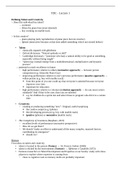
TRL 2604
Supply chain management [SCM] definitions: Consists of multiple firms collaborating to leverage strategic positioning & improve operating efficiency. Encompasses planning & management of all activities involved in sourcing & procurement, conversion, all logistics management activities. Includes coordination & collaboration with channel partners (i.e. suppliers / intermediaries/third party service providers/customers). Integrates supply & demand management within & across companies. Supply Chain: Is the alignment of firms that bring products/services to the market. Consists of the key business processes (from original supplier to end-user) that provide products/services/information which add value for customers & stakeholders. Logistics: Process of planning, implementing & controlling procedures for efficient & effective transportation and storage of goods, services & information from point of origin to point of consumption for the purpose of conforming to customer requirements. The work required to move & position inventory within the broader framework of supply chain. Definition includes in-, outbound, in- & external movements Logistics is the process that creates value by timing and positioning inventory and it is the combination of a firm’s - order management - transportation - Inventory - warehousing - materials handling - packaging Logistics is concerned with satisfying customer expectations by ensuring that the required quantity of product or services are available at the place & time required at the lowest total cost. Integrated Logistics: Serves to link & synchronize overall supply chain as continuous process & is essential for effective supply chain connectivity. Integrating activities to achieve particular level of customer service at lowest total cost. Integration management = create value Economic Value Market Value Relevancy Value Builds on economy of scale in operations as source of efficiency. Seeks to fully utilize fixed assets to achieve the lowest total landed cost. Its efficiency is quality product & Service creation. Customer take-away = high quality at low price. Presenting attractive assortment of products @ the right time & place. Focuses on achieving economy of scope in product & service presentation. Customer take-away = convenient product & service assortment & choice. Involves customization of value adding services. Means the right products & services, @ the right place. Transforming ingredients into ready-to-eat meals / fashionable apparel. Customer take-away = unique product/services bundle. Logistics SU 1 pg. 2; par. 1.3 & TB Ch. 1 pg.28-29 Is about satisfying customer expectations/adds value by ensuring required quantity of a particular product (raw materials/ semi-finished/finished products) is available at place and time required at the lowest total cost. It involves a number of processes/activities that cut across various functional departments and even other participants in the supply chain. Goal of logistics: - service & cost - to support procurement - manufacturing - customer accommodation Renaissance: Because logistics is both old & new, the term characterizes the rapid change taking place in best practice. Logistical Competency SU 1 pg. 6; par. 1.4 & TB Ch. 2 pg.29-30 Logistical competency Refers to a business’s level of performance with regard to logistics & customer requirements at realistic total cost expenditure. Superior logistical performance can be essential for business success, resulting in a competitive advantage. To gain competitive advantage, customer value needs to be created. Creation of customer value depends largely on effective logistics/logistical competency - a relative assessment of the capability of a business to provide superior customer service at the lowest total cost. Effective logistics requires the integration of various basic work and functional areas, as well as logistical temporal/spatial integration. When Malfunction (something going wrong) occurs, competency can be measured in terms of recovery time Logistical Mission SU 1 pg. 6-7; par. 1.5 & TB Ch. 1 pg.30-33 Logistical service is measured by: Availability: is the probability of having inventory to consistently meet customer material/product requirements. Operational performance: deals with the time required to deliver customer's order; involves speed, consistency, flexibility Service reliability: involves quality attributes of logistics. (accurate measurement of availability & operational performance) Logistical quality: it’s the product of careful planning supported by employee training, operational dedication, comprehensive measurement & continuous improvement Logistics value proposition: is matching operating competency & commitment to key customer expectations & requirements; a unique commitment of a firm to an individual/selected customer groups. Logistical Trade-Offs SU 1 pg. 7-9; par. 1.6 The Nature of Trade-Offs: SU 1 pg. 7; par 1.6.1 Trade-off: is simply a balance between two/more logistics functions to achieve total lowest cost. Occurs when increased cost in one area is more than matched by cost reduction in other areas, resulting in lower total cost. Trade-Off Levels: SU 1 pg. 8; par 1.6.2 1) INTER-ORGANISATIONAL TRADE-OFFS: Occur when using intermediaries (selecting wholesalers/ retailers /thirdparty logistical providers) in marketing channel. Involve selecting least total cost supply chains - N.B. to use the correct intermediaries. If none were used, there would be: close contact with the marketplace proper control over key areas such as customer (end-user) service policy Use of intermediaries has distinct advantages: Intermediaries in the channel specialise in particular activities which may result in economies of specialisation through the division of labour, for example, specialised sales staff. Intermediary may achieve economies of scale by means of high volume at high throughput levels. Results in reduction in contact costs, which are the costs of the contacts that need to be made between buyers and sellers in order to distribute a product. 2) INTER-FUNCTIONAL (INTERDEPARTMENTAL) TRADE-OFFS Trade-offs between different management functions/departments
Written for
- Institution
-
Chamberlain College Of Nursing
- Course
-
TRL 2604
Document information
- Uploaded on
- December 22, 2022
- Number of pages
- 12
- Written in
- 2022/2023
- Type
- Class notes
- Professor(s)
- Dr claus
- Contains
- All classes
Subjects