Chapter 4: Cell Membrane and Transport
Monday, 25 April 2022 9:30 PM
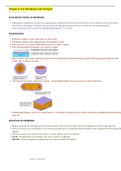
FLUID MOSAIC MODEL OF MEMBRANE
• Cell surface membranes create an enclosed space separating internal cell environment from external cell environment,
controls the exchange of material across them (partially permeable) and acts as interface for communication
• Cell membranes are formed from phospholipid bilayer (7 nm wide)
PHOSPHOLIPIDS
• Contains 2 regions: polar head and non-polar tails
• Phosphate head is polar (hydrophilic) and soluble in water
• Fatty acid tail is non-polar (hydrophobic) and insoluble in water
• Form phospholipid monolayers on surface of water
• When shaken with water, they form spheres with hydrophilic phosphate heads outside and hydrophobic fatty acid tails
inside. This is called a micelle.
• Two-layered structures may form in sheet - phospholipid bilayer (basic structure of cell membrane)
• Phospholipid bilayers can form compartments – the bilayer forming the cell surface membrane establishing the boundary
each cell
STRUCTURE OF MEMBRANE
• Bilayers making the membrane also contain proteins which can be either intrinsic (integral) or extrinsic (peripheral)
• Intrinsic proteins are embedded in the membrane with their arrangement determined by their hydrophilic and hydrophob
regions
• Extrinsic proteins are found on the outer or inner surface of the membrane
• FLUID - Phospholipids and proteins can move around via diffusion
MOSAIC - Scattered pattern produced by the proteins within the bilayer
AS BIOLOGY NOTES Page 1
, COMPONENTS OF CELL SURFACE MEMBRANE
1. Phospholipid
Forms a bilayer with hydrophobic tails pointing inwards and hydrophilic head pointing outwards
Tails form a hydrophobic core, acting as a barrier to water-soluble substances
Individual phospholipid molecules can move around within their own monolayer by diffusion
Can be chemically modified to act as signalling molecule
2. Cholesterol
Hydrophobic tails and hydrophilic head
Fits between phospholipid molecules; oriented in same way
Increases fluidity of membrane, by stopping membrane from becoming too rigid at low temperatures
Interaction between cholesterol and phospholipid tails also stabilises the cell membrane at higher temperatures by
stopping the membrane from becoming too fluid
Cholesterol molecules bind to the hydrophobic tails of phospholipids, stabilising them and causing phospholipids to pack
more closely together
They also contribute to the impermeabilty of the membrane to ions
Increase mechanical strength and stability of membrane
Absent in prokaryote membrane
3. Glycolipids
Lipids with carbohydrate chains - enabling them to act as receptor molecules
Carbohydrate chains project into fluid surrounding the cell
Some act as antigens for cell-to-cell recognition
4. Glycoproteins
Proteins with carbohydrate chains - enabling them to act as receptor molecules
Carbohydrate chains project into fluid surrounding the cell
Some act as antigens for cell-to-cell recognition
5. Proteins
Intrinsic proteins- proteins embedded within the membrane
Transmembrane proteins - proteins that span the entire membrane (eg transport proteins)
Extrinsic proteins (peripheral proteins) - proteins found on inner or outer surface of membrane
Transport proteins create hydrophilic channels to allow ions and polar molecules to travel through the membrane
(including channel protein and carrier protein)
Each transport protein is specific to a particular ion or molecule
Transport protein allow the cell to control which substances enter or leave
AS BIOLOGY NOTES Page 2
Monday, 25 April 2022 9:30 PM
FLUID MOSAIC MODEL OF MEMBRANE
• Cell surface membranes create an enclosed space separating internal cell environment from external cell environment,
controls the exchange of material across them (partially permeable) and acts as interface for communication
• Cell membranes are formed from phospholipid bilayer (7 nm wide)
PHOSPHOLIPIDS
• Contains 2 regions: polar head and non-polar tails
• Phosphate head is polar (hydrophilic) and soluble in water
• Fatty acid tail is non-polar (hydrophobic) and insoluble in water
• Form phospholipid monolayers on surface of water
• When shaken with water, they form spheres with hydrophilic phosphate heads outside and hydrophobic fatty acid tails
inside. This is called a micelle.
• Two-layered structures may form in sheet - phospholipid bilayer (basic structure of cell membrane)
• Phospholipid bilayers can form compartments – the bilayer forming the cell surface membrane establishing the boundary
each cell
STRUCTURE OF MEMBRANE
• Bilayers making the membrane also contain proteins which can be either intrinsic (integral) or extrinsic (peripheral)
• Intrinsic proteins are embedded in the membrane with their arrangement determined by their hydrophilic and hydrophob
regions
• Extrinsic proteins are found on the outer or inner surface of the membrane
• FLUID - Phospholipids and proteins can move around via diffusion
MOSAIC - Scattered pattern produced by the proteins within the bilayer
AS BIOLOGY NOTES Page 1
, COMPONENTS OF CELL SURFACE MEMBRANE
1. Phospholipid
Forms a bilayer with hydrophobic tails pointing inwards and hydrophilic head pointing outwards
Tails form a hydrophobic core, acting as a barrier to water-soluble substances
Individual phospholipid molecules can move around within their own monolayer by diffusion
Can be chemically modified to act as signalling molecule
2. Cholesterol
Hydrophobic tails and hydrophilic head
Fits between phospholipid molecules; oriented in same way
Increases fluidity of membrane, by stopping membrane from becoming too rigid at low temperatures
Interaction between cholesterol and phospholipid tails also stabilises the cell membrane at higher temperatures by
stopping the membrane from becoming too fluid
Cholesterol molecules bind to the hydrophobic tails of phospholipids, stabilising them and causing phospholipids to pack
more closely together
They also contribute to the impermeabilty of the membrane to ions
Increase mechanical strength and stability of membrane
Absent in prokaryote membrane
3. Glycolipids
Lipids with carbohydrate chains - enabling them to act as receptor molecules
Carbohydrate chains project into fluid surrounding the cell
Some act as antigens for cell-to-cell recognition
4. Glycoproteins
Proteins with carbohydrate chains - enabling them to act as receptor molecules
Carbohydrate chains project into fluid surrounding the cell
Some act as antigens for cell-to-cell recognition
5. Proteins
Intrinsic proteins- proteins embedded within the membrane
Transmembrane proteins - proteins that span the entire membrane (eg transport proteins)
Extrinsic proteins (peripheral proteins) - proteins found on inner or outer surface of membrane
Transport proteins create hydrophilic channels to allow ions and polar molecules to travel through the membrane
(including channel protein and carrier protein)
Each transport protein is specific to a particular ion or molecule
Transport protein allow the cell to control which substances enter or leave
AS BIOLOGY NOTES Page 2