Chapter 3: Enzymes
Monday, 25 April 2022 7:58 PM
ENZYMES AS PROTEINS
Enzymes are biological catalysts - function in living organism and speed up rate of chemical reaction without being used
up
Globular protein
Contain an active site - where the substrate binds
Can be intracellular (produced and function inside the cell) or extracellular (secreted by cell and catalyse reaction outside
the cell)
MODE OF ENZYME ACTION
Substrate binds to the active site forming an enzyme-substrate complex
Active site has a specific shape to the substrate
Extreme temperature / pH can denature the enzyme
Specificity of the enzyme is due to its complementary nature between shape of active site and substrate
Shape of active site is determined by complex tertiary structure of the protein that makes enzyme
Enzyme reactions can either be anabolic / catabolic (Catabolic involves breakdown of complex molecules into simpler
products eg cellular respiration and hydrolysis) (Anabolic involves building of more complex molecules from simpler one
eg protein synthesis and photosynthesis)
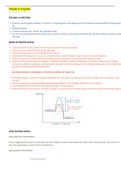
ENZYMES WORK BY LOWERING ACTIVATION ENERGY OF REACTION
Activation energy - amount of energy needed by the substrate to just become unstable enough and for products to be
formed
Enzymes speed up chemical reactions because they influence the stability of bonds in the reactants
The destabilisation of bonds in the substrate makes it more reactive
Enzymes work by lowering the activation energy of a reaction and in doing so they provide an alternative energy pathwa
HOW ENZYMES WORK?
LOCK-AND-KEY HYPOTHESIS
It was suggested that enzyme and substrate were rigid structures that locked into each other very precisely, like a lock in a
key. This was known as 'lock-and-key hypothesis'
INDUCED-FIT HYPOTHESIS
AS BIOLOGY NOTES Page 1
Monday, 25 April 2022 7:58 PM
ENZYMES AS PROTEINS
Enzymes are biological catalysts - function in living organism and speed up rate of chemical reaction without being used
up
Globular protein
Contain an active site - where the substrate binds
Can be intracellular (produced and function inside the cell) or extracellular (secreted by cell and catalyse reaction outside
the cell)
MODE OF ENZYME ACTION
Substrate binds to the active site forming an enzyme-substrate complex
Active site has a specific shape to the substrate
Extreme temperature / pH can denature the enzyme
Specificity of the enzyme is due to its complementary nature between shape of active site and substrate
Shape of active site is determined by complex tertiary structure of the protein that makes enzyme
Enzyme reactions can either be anabolic / catabolic (Catabolic involves breakdown of complex molecules into simpler
products eg cellular respiration and hydrolysis) (Anabolic involves building of more complex molecules from simpler one
eg protein synthesis and photosynthesis)
ENZYMES WORK BY LOWERING ACTIVATION ENERGY OF REACTION
Activation energy - amount of energy needed by the substrate to just become unstable enough and for products to be
formed
Enzymes speed up chemical reactions because they influence the stability of bonds in the reactants
The destabilisation of bonds in the substrate makes it more reactive
Enzymes work by lowering the activation energy of a reaction and in doing so they provide an alternative energy pathwa
HOW ENZYMES WORK?
LOCK-AND-KEY HYPOTHESIS
It was suggested that enzyme and substrate were rigid structures that locked into each other very precisely, like a lock in a
key. This was known as 'lock-and-key hypothesis'
INDUCED-FIT HYPOTHESIS
AS BIOLOGY NOTES Page 1