
Unit 2
Work (W)
Work is the product of the force (F) applied to an object over a distance (d) in which the object travels
as a result of the force
Formula: , θ is the angle between F and unit = Joules = 1Nm
When work is done on an object, the energy of the object will:
1. Increase (work due to applied force forward)
2. Decrease (work due to friction)
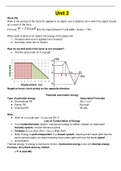
How do we find work if the force is not constant?
• Find the area under an F-d graph
Negative force= force acting on the opposite direction
Potential and kinetic energy
Type of potential energy Associated Formulas
● Gravitational PE Ek=½ mv 2
● Elastic PE Eg=mgh
● Chemical PE W=ΔEk
Note:
● Work on a circular part = 0J as cos 90= 0
Law of Conservation of Energy
• In an isolated(closed) system, mechanical energy is neither created nor destroyed.
Isolated system: choose reference points,
• Formula: EM initial (Eg1+Ek1) = EM final (Eg2+Ek2)
• Note: Energy is path independent in a closed system, meaning that If each path has the
same vertical height, an object traveling down either path will have the same speed
• at the bottom
Thermal energy: If energy is lost due to friction, mechanical energy turns into thermal energy
Formula: •ETH=Work done by friction
= FF d (cos180)
Work (W)
Work is the product of the force (F) applied to an object over a distance (d) in which the object travels
as a result of the force
Formula: , θ is the angle between F and unit = Joules = 1Nm
When work is done on an object, the energy of the object will:
1. Increase (work due to applied force forward)
2. Decrease (work due to friction)
How do we find work if the force is not constant?
• Find the area under an F-d graph
Negative force= force acting on the opposite direction
Potential and kinetic energy
Type of potential energy Associated Formulas
● Gravitational PE Ek=½ mv 2
● Elastic PE Eg=mgh
● Chemical PE W=ΔEk
Note:
● Work on a circular part = 0J as cos 90= 0
Law of Conservation of Energy
• In an isolated(closed) system, mechanical energy is neither created nor destroyed.
Isolated system: choose reference points,
• Formula: EM initial (Eg1+Ek1) = EM final (Eg2+Ek2)
• Note: Energy is path independent in a closed system, meaning that If each path has the
same vertical height, an object traveling down either path will have the same speed
• at the bottom
Thermal energy: If energy is lost due to friction, mechanical energy turns into thermal energy
Formula: •ETH=Work done by friction
= FF d (cos180)


