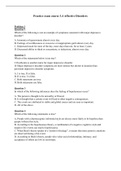
Practice exam course 3.4 Affective Disorders
Problem 1
Question 1
Which of the following is not an example of symptoms consistent with major depressive
disorder?
A. Insomnia or hypersomnia almost every day.
B. Feelings of worthlessness or excessive or inappropriate guilt almost every day.
C. Depressed mood for most of the day, more days than not, for at least 2 years.
D. Decreased ability to think or concentrate, or indecision, almost every day.
Question 2
Which of the statements below is/are true?
I: Dysthymia is another name for major depressive disorder.
II: Major depressive disorder symptoms are more intense but shorter in duration than
persistent depressive disorder symptoms.
A. I is true, II is false.
B. II is true, I is false.
C. Both statements are true.
D. Both statements are false.
Question 3
In which of the following inferences does the feeling of hopelessness occur?
A. The person is thought to be unworthy or flawed.
B. It is thought that a certain event will lead to other negative consequences.
C. The events are attributed to stable and global causes and are seen as important.
D. All of the above.
Question 4
Which of the following statements is true?
A. People with a depressogenic inferential style are always more likely to be hopeless than
people without this style.
B. According to the hopelessness theory, a combination of a negative cognitive style and
negative life events can lead to hopelessness.
C. When Beck's theory speaks of a "positive blockage", it means that more positive emotions
are observed during a fun event.
D. According to Beck's theory, people who value social relationships, intimacy, and
acceptance of others are low in sociotropy.
,Question 5
What are the following 4 factors also called?
1. A functioning relationship between patient and therapist.
2. A rational that lends credibility to the treatment.
3. Certain procedures or rituals in a structured way.
4. A healing context or setting.
A. Cognitive factors.
B. Common factors.
C. Contextual factors.
D. Component factors.
Question 6
Decommissioning investigations and additive investigations are examples of…
A. Component studies.
B. Bona fide investigations.
C. Publication bias.
D. Evidence-based studies.
Question 7
Which of the statements below is/are true?
I: The behavioral high-risk design is a better design to use compared to the remitted
depression paradigm.
II: There is something called a depressive realism effect. This means that depressed people are
more accurate than non-depressed people.
A. I is true, II is false.
B. II is true, I is false.
C. Both statements are true.
D. Both statements are false.
Question 8
What is not a resemblance between the hopelessness theory and Beck's theory?
A. Both theories emphasize that depressive cognition is impaired.
B. Both theories emphasize the role of cognition in the development and maintenance of
depression.
C. Both theories recognize the heterogeneity of depression and recognize the existence of a
cognitively mediating subtype of depression.
D. Both theories contain a cognitive sensitivity hypothesis in which negative cognitive
patterns increase a person's susceptibility to depression when they experience negative life
events.
, Question 9
Which statement is correct when looking at the research by Undurraga & Baldessarini (2017)
about TCAs and SSRIs?
A. There appeared to be large differences between the effectiveness of tricyclic
antidepressants and selective serotonin reuptake inhibitors.
B. There was a higher all-cause dropout rate in SSRIs than TCAs.
C. There were no limitations to this study.
D. The effectiveness of both drugs was higher at lower dropout rates.
Question 10
What is not a limitation of the systematic review by Mutz et al. (2019)?
A. Only a few trials compared new brain stimulation techniques with ECT protocols.
B. Most studies had an unclear risk of bias.
C. The focus was on acute antidepressant effects, so the conclusions may not apply to the
long-term effects of non-surgical brain stimulation.
D. There was no randomization in the study.
Question 11
Finish the sentence.
According to the article by Read et al. (2019), there is no direct evidence that
electroconvulsive therapy (ECT)…
A. prevents suicide.
B. is effective for forced patients.
C. improves quality of life.
D. All of the above.
Question 12
Which of the following statements is false?
A. Depressed people have an attentional bias to negative stimuli.
B. Depressed people have more activity in their rostral anterior cingulate cortex (ACC) when
inhibiting attention to negative stimuli.
C. Depressed people are more efficient at selecting stimuli than healthy people.
D. Depressed people have more intense and longer lasting reactivity in the amygdala than
healthy people.
Question 13
Which of the statements below is/are true?
I: ECT can also be called a failure of evidence-based medicine.
II: From the article by Read et al. (2019) serious conclusions can be drawn about the poor
effectiveness of ECT.
A. I is true, II is false.
B. II is true, I is false.
C. Both statements are true.
D. Both statements are false.
Problem 1
Question 1
Which of the following is not an example of symptoms consistent with major depressive
disorder?
A. Insomnia or hypersomnia almost every day.
B. Feelings of worthlessness or excessive or inappropriate guilt almost every day.
C. Depressed mood for most of the day, more days than not, for at least 2 years.
D. Decreased ability to think or concentrate, or indecision, almost every day.
Question 2
Which of the statements below is/are true?
I: Dysthymia is another name for major depressive disorder.
II: Major depressive disorder symptoms are more intense but shorter in duration than
persistent depressive disorder symptoms.
A. I is true, II is false.
B. II is true, I is false.
C. Both statements are true.
D. Both statements are false.
Question 3
In which of the following inferences does the feeling of hopelessness occur?
A. The person is thought to be unworthy or flawed.
B. It is thought that a certain event will lead to other negative consequences.
C. The events are attributed to stable and global causes and are seen as important.
D. All of the above.
Question 4
Which of the following statements is true?
A. People with a depressogenic inferential style are always more likely to be hopeless than
people without this style.
B. According to the hopelessness theory, a combination of a negative cognitive style and
negative life events can lead to hopelessness.
C. When Beck's theory speaks of a "positive blockage", it means that more positive emotions
are observed during a fun event.
D. According to Beck's theory, people who value social relationships, intimacy, and
acceptance of others are low in sociotropy.
,Question 5
What are the following 4 factors also called?
1. A functioning relationship between patient and therapist.
2. A rational that lends credibility to the treatment.
3. Certain procedures or rituals in a structured way.
4. A healing context or setting.
A. Cognitive factors.
B. Common factors.
C. Contextual factors.
D. Component factors.
Question 6
Decommissioning investigations and additive investigations are examples of…
A. Component studies.
B. Bona fide investigations.
C. Publication bias.
D. Evidence-based studies.
Question 7
Which of the statements below is/are true?
I: The behavioral high-risk design is a better design to use compared to the remitted
depression paradigm.
II: There is something called a depressive realism effect. This means that depressed people are
more accurate than non-depressed people.
A. I is true, II is false.
B. II is true, I is false.
C. Both statements are true.
D. Both statements are false.
Question 8
What is not a resemblance between the hopelessness theory and Beck's theory?
A. Both theories emphasize that depressive cognition is impaired.
B. Both theories emphasize the role of cognition in the development and maintenance of
depression.
C. Both theories recognize the heterogeneity of depression and recognize the existence of a
cognitively mediating subtype of depression.
D. Both theories contain a cognitive sensitivity hypothesis in which negative cognitive
patterns increase a person's susceptibility to depression when they experience negative life
events.
, Question 9
Which statement is correct when looking at the research by Undurraga & Baldessarini (2017)
about TCAs and SSRIs?
A. There appeared to be large differences between the effectiveness of tricyclic
antidepressants and selective serotonin reuptake inhibitors.
B. There was a higher all-cause dropout rate in SSRIs than TCAs.
C. There were no limitations to this study.
D. The effectiveness of both drugs was higher at lower dropout rates.
Question 10
What is not a limitation of the systematic review by Mutz et al. (2019)?
A. Only a few trials compared new brain stimulation techniques with ECT protocols.
B. Most studies had an unclear risk of bias.
C. The focus was on acute antidepressant effects, so the conclusions may not apply to the
long-term effects of non-surgical brain stimulation.
D. There was no randomization in the study.
Question 11
Finish the sentence.
According to the article by Read et al. (2019), there is no direct evidence that
electroconvulsive therapy (ECT)…
A. prevents suicide.
B. is effective for forced patients.
C. improves quality of life.
D. All of the above.
Question 12
Which of the following statements is false?
A. Depressed people have an attentional bias to negative stimuli.
B. Depressed people have more activity in their rostral anterior cingulate cortex (ACC) when
inhibiting attention to negative stimuli.
C. Depressed people are more efficient at selecting stimuli than healthy people.
D. Depressed people have more intense and longer lasting reactivity in the amygdala than
healthy people.
Question 13
Which of the statements below is/are true?
I: ECT can also be called a failure of evidence-based medicine.
II: From the article by Read et al. (2019) serious conclusions can be drawn about the poor
effectiveness of ECT.
A. I is true, II is false.
B. II is true, I is false.
C. Both statements are true.
D. Both statements are false.