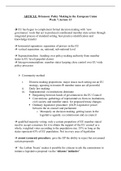
ARTICLE, Brianson: Policy Making in the European Union
Week 7, lecture 13
EU has begun to complement formal decision making with ‘new
governance’ tools that act to produced coordinated member state action through
integrated process of standard setting, best practice identification and
knowledge transfer
horizontal separation: separation of powers in the EU
vertical separation: eu, national, sub-national level
Supranationalism : handing over policy making authority from member
states to EU level (populist claim)
Intergovernmentalism: member states keeping close control over EU wide
policy processes
Community method
i. Historic-making proportions: major issues such setting out an EU
strategy, agreeing to treaties member states are all powerful
ii. Daily law making:
iii. Supranational: eu institutions dominate
Bargaining between heads of government in the EU Council
Conventions: gatherings of representatives from eu institutions,
civil society and member states for proposed treaty changes
Ordinary legislative procedure: (OLP) Legislative power
between the eu council and parliament
o Monopoly on decision making, getting issues in the
legislative agenda: eu commission and eu council
qualified majority voting: only a certain proportion of EU member stated
need to accept a measure for it to obtain the support of the EU council as a
whole, weighted votes according to the population size. 55% so long as the
states represent 65% of EU population. Not in every area of legislation
assent (consent) procedure: gave the EP the ability to reject but not amend
certain proposals
‘ the Lisbon Treaty’ makes it possible for citizens to ask the commission to
initiate a legislative proposal via the ‘citizens’ initiative’
, ‘directives’: they give the member states maximum leeway on issues of
implementation, find their own different methods of achieving a goal
EU REGULATORY MODE
- Improving competition single of EU market by creating EU wide
regulation
EU DISTRIBUTIONAL MODE
- Redistribute resources, prominent example: Cohesion Fund in regional
policy (countries get fund)
THE ORDINARY LEGISLATIVE PROCEDURE:
‘co-decision procedure’
A process and what happens at one stage has an impact on the next one,
‘policy chain’
qualified majority in eu council and of MEPs
conciliation committee: equal members from eu council and EP to
broker inter institutional agreements w the proposed legislation
task of citizens to report problems to the commission
THE OPEN METHOD OF COORDINATION
Despite the fact that new governance has been existed such as in the
OECD.
Voluntary and informal means of cooperation that establish
frameworks to work on policies
‘soft law’ no legally binding action or detailed obligation,
flexibility and participation knowledge creation and more
effective policy
OMC as a compromise while giving the EU a coordinating and
possibly policy shaping role that members states could accept
and easily accepted to national circumstances.
Decentralized approach w the method of subsidiarity
Terrains which might become EU jurisdiction
‘intensive trans governmentalism’: intense collaboration of
member states on terrains beyond EU jurisdiction
Week 7, lecture 13
EU has begun to complement formal decision making with ‘new
governance’ tools that act to produced coordinated member state action through
integrated process of standard setting, best practice identification and
knowledge transfer
horizontal separation: separation of powers in the EU
vertical separation: eu, national, sub-national level
Supranationalism : handing over policy making authority from member
states to EU level (populist claim)
Intergovernmentalism: member states keeping close control over EU wide
policy processes
Community method
i. Historic-making proportions: major issues such setting out an EU
strategy, agreeing to treaties member states are all powerful
ii. Daily law making:
iii. Supranational: eu institutions dominate
Bargaining between heads of government in the EU Council
Conventions: gatherings of representatives from eu institutions,
civil society and member states for proposed treaty changes
Ordinary legislative procedure: (OLP) Legislative power
between the eu council and parliament
o Monopoly on decision making, getting issues in the
legislative agenda: eu commission and eu council
qualified majority voting: only a certain proportion of EU member stated
need to accept a measure for it to obtain the support of the EU council as a
whole, weighted votes according to the population size. 55% so long as the
states represent 65% of EU population. Not in every area of legislation
assent (consent) procedure: gave the EP the ability to reject but not amend
certain proposals
‘ the Lisbon Treaty’ makes it possible for citizens to ask the commission to
initiate a legislative proposal via the ‘citizens’ initiative’
, ‘directives’: they give the member states maximum leeway on issues of
implementation, find their own different methods of achieving a goal
EU REGULATORY MODE
- Improving competition single of EU market by creating EU wide
regulation
EU DISTRIBUTIONAL MODE
- Redistribute resources, prominent example: Cohesion Fund in regional
policy (countries get fund)
THE ORDINARY LEGISLATIVE PROCEDURE:
‘co-decision procedure’
A process and what happens at one stage has an impact on the next one,
‘policy chain’
qualified majority in eu council and of MEPs
conciliation committee: equal members from eu council and EP to
broker inter institutional agreements w the proposed legislation
task of citizens to report problems to the commission
THE OPEN METHOD OF COORDINATION
Despite the fact that new governance has been existed such as in the
OECD.
Voluntary and informal means of cooperation that establish
frameworks to work on policies
‘soft law’ no legally binding action or detailed obligation,
flexibility and participation knowledge creation and more
effective policy
OMC as a compromise while giving the EU a coordinating and
possibly policy shaping role that members states could accept
and easily accepted to national circumstances.
Decentralized approach w the method of subsidiarity
Terrains which might become EU jurisdiction
‘intensive trans governmentalism’: intense collaboration of
member states on terrains beyond EU jurisdiction