
Lecture 1 Neuroanatomy
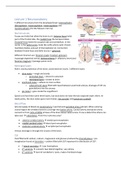
5 different structures form the developed brain: telencephalon,
diencephalon, mesencephalon, metencephalon and
myelencephalon (Tel Die Messen met my).
Skull structures
Fossae are folds that allow the brain to sit. Anterior fossa holds
part of the frontal lobe, the medial fossa the temporal lobes.
Occipital fossa holds the occipital lobe and cerebellum. In the
center is the Sella turcica, looks like settle where optic chiasm,
mamillary bodies and part of diencephalon sit. Connection
between frontal fossa and Sella turcica = sphenoid.
Different foremen are: foramen ovale, foramen spinosum
(=passage trigeminal nerve), lamina criborsa (= olfactory nerve) and
foramen magnum (=passage spinal cord).
Meningeal layers
Role is manly protection of the brain, avoid external insults. 3 different layers:
• dura mater = rough and sturdy
o periosteal layer = closest to calvarium
o meningeal layer = closest to brain
• arachnoid mater = adhere to more surface
o subarachnoid space filled with liquid between arachnoid and pia, drainage of CSF via
granulations into the sinuses
• pia mater = goes inside the engulfment
Spinal cord has these same three layers, but dura does not have the two separate layers there. At
weak points, the dura mater gets much thicker, falx cererbri and tentorium cerebelli.
Blood flow
Arterial supply of blood via carotid artery (=ventral) and vertebral artery (dorsal). When entering
cranial region the vertebral arteries converge into basilar artery. Carotid artery and basilar artery
connect to from circle of Willis at base of the brain above Sella turcica. If one is defect the others can
take over → redundancy. From this 3 arteries arise”
• anterior cerebral artery → medial part encephalon
• medial cerebral artery → lateral part encephalon
• posterior cerebral artery → occipital part encephalon
Venous drainage is through the sinuses of the brain.
CSF
Fluid filled with sodium, calcium, magnesium and glucose produced by choroid plexus = pia
invagination found at Ventricles = cavities filled with CSF important for distribution of CSF:
• 2 lateral ventricles → 1 per hemisphere
• 3rd ventricle → connects two lateral together, very skinny
• 4th ventricle → level of cerebellum / pons, makes rhomboid shape
,In between lateral and 3rd ventricle is foramen of Monro = allows communication
between lateral and 3rd ventricles. In between 3rd and 4th ventricles is the cerebral
aqueduct = connecting tube to spread CSF through brain and spinal cord. After the 4th
ventricle is the central canal = big tube that goes along whole spinal cord to provide
CSF.
The CSF is needed to give nutrients to brain and give buoyancy effect = reducing
weight of brain to 10% by letting the brain float instead of sitting on skull. At the last
station, the CSF gathered in subarachnoid space sent to sinuses via granulations.
Most of them are venous-like structures with a different cellular organization, walls of
dura mater. Via the sinuses CSF is sent through sigmoidal sinus to jugular vein to
leave CNS. Other sinuses are superior and inferior sagittal sinus, transverse sinus and sigmoidal
sinus.
,Lecture 2 Neurophysiology: electrical signals
Resting membrane potential
3 different potentials in the electrical signal pathway:
• Receptor potential
• Synaptic potential
• Action potential
Differ in amplitude and time, receptor potential is longest and smallest difference, action potential
short with big difference.
Active and passive response
Passive response = after negative/positive stimulus causing hyperpolarization. Can be small or big,
depending on strength of stimulus. Active response = after positive stimulus causing depolarization,
not above threshold gives same curve as in passive response. If the stimulus is strong enough, the
potential rises above the threshold and action potential is started. A passive signal becomes weaker
and will die out, active signal will have same action potential throughout.
Equilibrium
Resting membrane potential = based on 2 membrane properties: lipid bilayer is impermeable for
ions and specialized ion channels can conduct ions selectively. This is based on two principles in
physics: diffusion of particles and electrical forces. Uses the Goldman equation, in which P =
permeability of a membrane for ion X. It is dominated by K, because there are leak channels of this
always opened. Reversal potential = net flux of K from outside to inside, this is for a specific ion.
Inside of the cell a high KCL concentration, neutral in charge. Diffusion force (in to out) = electrical
force (out to in) → electrochemical equilibrium, because no net flux. Nernst equation to calculate
the membrane potential.
In this equation R = gas constant.
Z = valence of the ion
T = temperature in Kelvin
F = faraday constant
The same equation, but at room temperature. In this formula
X is the concentration in and outside of the cell.
, Ion channel transport
Different types of transporters are ion transporters to create
concentration gradients and actively move the selected ions. The
ion channels allow ions to diffuse down the concentration
gradient. The NA/K ATPase pump is dependent on
phosphorylation. High affinity for Na and low affinity for K, when
phosphorylated low affinity for Na and high affinity for K.
Ion exchangers use potential energy of other ion as energy
source. Usually sodium is used, one or more ions are taken up
their electrical gradient, while another one is taken down the
gradient. Can be an antiporter or cotransporter.
5 different structures form the developed brain: telencephalon,
diencephalon, mesencephalon, metencephalon and
myelencephalon (Tel Die Messen met my).
Skull structures
Fossae are folds that allow the brain to sit. Anterior fossa holds
part of the frontal lobe, the medial fossa the temporal lobes.
Occipital fossa holds the occipital lobe and cerebellum. In the
center is the Sella turcica, looks like settle where optic chiasm,
mamillary bodies and part of diencephalon sit. Connection
between frontal fossa and Sella turcica = sphenoid.
Different foremen are: foramen ovale, foramen spinosum
(=passage trigeminal nerve), lamina criborsa (= olfactory nerve) and
foramen magnum (=passage spinal cord).
Meningeal layers
Role is manly protection of the brain, avoid external insults. 3 different layers:
• dura mater = rough and sturdy
o periosteal layer = closest to calvarium
o meningeal layer = closest to brain
• arachnoid mater = adhere to more surface
o subarachnoid space filled with liquid between arachnoid and pia, drainage of CSF via
granulations into the sinuses
• pia mater = goes inside the engulfment
Spinal cord has these same three layers, but dura does not have the two separate layers there. At
weak points, the dura mater gets much thicker, falx cererbri and tentorium cerebelli.
Blood flow
Arterial supply of blood via carotid artery (=ventral) and vertebral artery (dorsal). When entering
cranial region the vertebral arteries converge into basilar artery. Carotid artery and basilar artery
connect to from circle of Willis at base of the brain above Sella turcica. If one is defect the others can
take over → redundancy. From this 3 arteries arise”
• anterior cerebral artery → medial part encephalon
• medial cerebral artery → lateral part encephalon
• posterior cerebral artery → occipital part encephalon
Venous drainage is through the sinuses of the brain.
CSF
Fluid filled with sodium, calcium, magnesium and glucose produced by choroid plexus = pia
invagination found at Ventricles = cavities filled with CSF important for distribution of CSF:
• 2 lateral ventricles → 1 per hemisphere
• 3rd ventricle → connects two lateral together, very skinny
• 4th ventricle → level of cerebellum / pons, makes rhomboid shape
,In between lateral and 3rd ventricle is foramen of Monro = allows communication
between lateral and 3rd ventricles. In between 3rd and 4th ventricles is the cerebral
aqueduct = connecting tube to spread CSF through brain and spinal cord. After the 4th
ventricle is the central canal = big tube that goes along whole spinal cord to provide
CSF.
The CSF is needed to give nutrients to brain and give buoyancy effect = reducing
weight of brain to 10% by letting the brain float instead of sitting on skull. At the last
station, the CSF gathered in subarachnoid space sent to sinuses via granulations.
Most of them are venous-like structures with a different cellular organization, walls of
dura mater. Via the sinuses CSF is sent through sigmoidal sinus to jugular vein to
leave CNS. Other sinuses are superior and inferior sagittal sinus, transverse sinus and sigmoidal
sinus.
,Lecture 2 Neurophysiology: electrical signals
Resting membrane potential
3 different potentials in the electrical signal pathway:
• Receptor potential
• Synaptic potential
• Action potential
Differ in amplitude and time, receptor potential is longest and smallest difference, action potential
short with big difference.
Active and passive response
Passive response = after negative/positive stimulus causing hyperpolarization. Can be small or big,
depending on strength of stimulus. Active response = after positive stimulus causing depolarization,
not above threshold gives same curve as in passive response. If the stimulus is strong enough, the
potential rises above the threshold and action potential is started. A passive signal becomes weaker
and will die out, active signal will have same action potential throughout.
Equilibrium
Resting membrane potential = based on 2 membrane properties: lipid bilayer is impermeable for
ions and specialized ion channels can conduct ions selectively. This is based on two principles in
physics: diffusion of particles and electrical forces. Uses the Goldman equation, in which P =
permeability of a membrane for ion X. It is dominated by K, because there are leak channels of this
always opened. Reversal potential = net flux of K from outside to inside, this is for a specific ion.
Inside of the cell a high KCL concentration, neutral in charge. Diffusion force (in to out) = electrical
force (out to in) → electrochemical equilibrium, because no net flux. Nernst equation to calculate
the membrane potential.
In this equation R = gas constant.
Z = valence of the ion
T = temperature in Kelvin
F = faraday constant
The same equation, but at room temperature. In this formula
X is the concentration in and outside of the cell.
, Ion channel transport
Different types of transporters are ion transporters to create
concentration gradients and actively move the selected ions. The
ion channels allow ions to diffuse down the concentration
gradient. The NA/K ATPase pump is dependent on
phosphorylation. High affinity for Na and low affinity for K, when
phosphorylated low affinity for Na and high affinity for K.
Ion exchangers use potential energy of other ion as energy
source. Usually sodium is used, one or more ions are taken up
their electrical gradient, while another one is taken down the
gradient. Can be an antiporter or cotransporter.




