HUMAN PARASITES: PART
MYCOLOGY
GENERAL INTRODUCTION
GENERAL CHARACTERISTICS OF TRUE FUNGI (EUMYCOTA)
Antifungals focus on mostly on 2 aspects that are specific for fungi
Cytoplasmic membrane contains sterol:
o Ergosterol is present VS humans which have cholesterol
Cell membrane = outer membrane: chitin, glucan, mannan
All fungi are eukaryotic
Most are filamentous: filaments = hyphae, these exhibit apical growth and form a network of
hyphae called a mycelium
Some are unicellular: e.g. yeasts
Protoplasm of a cell or a hyphae is surrounded by a rigid wall
Many reproduce both sexually and asexually: they both result in the production of spores
Their nuclei are typically haploid and hyphal compartments are often multinucleate
All are chemoheterotrophic (chemo-organotrophic): use carbon from the environment as
energy
They may be free-living or parasitic or mutualistic (symbiotic)
GENERAL STRUCTURE
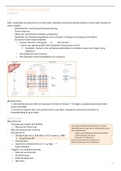
OF FUNGI
Vegetative hyphae: feeding
o These are present IN the agar
o Can be segmented or non-
segmented
Aerial hyphae: reproduction
Mycellium = large mass of hyphae
Fungael thallus (“body”) consists of hyphae
OF THE YEASTS
1
, Daughter cell will be same size as parent cell
Unicellular: oval to round
Fission yeasts divide symmetrically
Budding yeasts divide asymmetrically (e.g. Candida)
o Bud = knob = blastospore
o Parent cel budding breaks of parent cell ‘scar’ on parent cell
Real hyphen= 1 structure >< pseudohyphen= no full separation (of the knob)
OF DIMORPHIC FUNGI
Can grow both as fungus or as yeast
Dependent on environmental factors: T°, CO2 and nutrients
o E.g. thermal dismorphism: Dimorphism in pathogenic fungi:
37°C → yeast pathogenic form
25°C → fungus
SUBCELLULAR STRUCTURE
Capsule (polysaccharides) in some fungi!! (E.g. Cyptococcus neoformans)
o Protection against phagocytosis (because polysaccharides aren’t recognized)
virulence factor
Also a cell wall and cell membrane
Cytoplasm
o Nucleus & nuclear membrane
o Endoplasmic reticulum
o Mitochondria
o Vacuoles
Cholestrol (present in humans) is replaced by ergosterol (kind of specificity)
o Squalene produce ergosterol
Therapeutic targets for antifungals
o Squalene
o Ergosterol!! (mostly this one)
o Chitin
o Glucan
o DNA/RNA synthesis
Type and relative composition of chitin and glucan are
dependent on the fungal species
o Antifungals focussing on glucan and chitin
have different effects on different fungal species and the susceptibility between the
species can vary
LIFE CYCLE (DON’T NEED TO KNOW THIS)
Assexual
o Filamentous fungi: asexual by fragmentation of hyphae
o Asexual spores: Conidiospore (Aspergilus spp), Chlamydiaspore (C. albicans), Sporangiospore,
Macro-µnidia
2
, o There are conidia + conidiophore spores/conidia are released spores/conidia germinate
Sexual
o Sexual spores: formed by fusion of nuclei of different haploid gametes
o + / - nucleus come together = karyogamy 2n diploid
ISOLATIONoOF Haploid
FUNGI+ mitosis
Nutrients broths and agar’s (with addition of antibiotics (with no antifungal potential) to prevent
bacterial overgrowth)
General: supports the growth of most fungi
o Sabouraud
o Potato Dextrose Agar (PDA): good for growing spores
Selective: permits growth of a particular species
o Nickerson agar (bismuth-sulphate) Candida spp. and other
yeasts
Bismuth-sulphate: some yeast can reduce/metabolize
it colour change
But it’s still quite general: almost all candida
IDENTIFICATION OF FUNGI
Morphological not used a lot: there are other methods
STAINING METHODS
KOH + lactophenol-blue staining
o Function of KOH: clears the sample, it solubilizes, makes it
translucent
o Done correctly immediate diagnosis, but difficult interpretation
Gram-staining
o Candida are Gram-pos
o Hyphen are Gram-neg
Calcofluor
o Fluorescent dyes that bind specifically to the cell wall (to membrane
components)
o Fluorescence microscopic reading!
BIOCHEMICAL
API Candida
o Principle: Enzyme reaction of candida to different
carbohydrates (substrates)
This gives different colors depending on which
carbohydrates are fermented depends on the species
o OPM: Fungi grow slower than bacteria
ChomAgar
o Immediate identification and quantification used a lot in labs
o Agar plate + substrate
3
, o Depending on species (enzymatic digestion of substrate ) different colors (e.g.: C.
albicans = green)
o Advantages: quantitative, different species
o Disadvantage: expensive
ANTIFUNGAL DRUGS
Fungal treatment is always long term!!
TARGETS
Echinocandins, nikkomycin Z: Inhibition of fungal cell wall formation
Sordarins: Interference with protein assembly
Azoles, Polyenes, Terbinafine: Disruption of fungal cell membrane
Flucytosine: Interference with DNA synthesis
TIMELINES FOR SYSTEMIC ANTIFUNGALS
Antifungal treatment is relatively recent
Antifungals are used a lot in the food/agriculture industry
o Other methodsd to preserve food: irradiation (it’s a bit
expensive)
Azoles: o.a. Miconazole (=generic name = active compound)
Amphotericin: works against Leishmania, it’s toxic they make
liposomal formulations: these do cell targeting and integrate into
the cell wall
What to know:
POLYENES 1. Mechanism of action
2. Spectrum
Structures 3. Action: killing, inhibiting multiplication + growth
o High molecular lactones
o Amphophilic compounds: has a lipophilic and ionic part can solubilize to some
extent in water and is highly lipophilic as well
o MW above 500 (oral) absorption is a problem combination of systemic (oral
absorption or IV) and topical (ointments)
Action mechanism
4
MYCOLOGY
GENERAL INTRODUCTION
GENERAL CHARACTERISTICS OF TRUE FUNGI (EUMYCOTA)
Antifungals focus on mostly on 2 aspects that are specific for fungi
Cytoplasmic membrane contains sterol:
o Ergosterol is present VS humans which have cholesterol
Cell membrane = outer membrane: chitin, glucan, mannan
All fungi are eukaryotic
Most are filamentous: filaments = hyphae, these exhibit apical growth and form a network of
hyphae called a mycelium
Some are unicellular: e.g. yeasts
Protoplasm of a cell or a hyphae is surrounded by a rigid wall
Many reproduce both sexually and asexually: they both result in the production of spores
Their nuclei are typically haploid and hyphal compartments are often multinucleate
All are chemoheterotrophic (chemo-organotrophic): use carbon from the environment as
energy
They may be free-living or parasitic or mutualistic (symbiotic)
GENERAL STRUCTURE
OF FUNGI
Vegetative hyphae: feeding
o These are present IN the agar
o Can be segmented or non-
segmented
Aerial hyphae: reproduction
Mycellium = large mass of hyphae
Fungael thallus (“body”) consists of hyphae
OF THE YEASTS
1
, Daughter cell will be same size as parent cell
Unicellular: oval to round
Fission yeasts divide symmetrically
Budding yeasts divide asymmetrically (e.g. Candida)
o Bud = knob = blastospore
o Parent cel budding breaks of parent cell ‘scar’ on parent cell
Real hyphen= 1 structure >< pseudohyphen= no full separation (of the knob)
OF DIMORPHIC FUNGI
Can grow both as fungus or as yeast
Dependent on environmental factors: T°, CO2 and nutrients
o E.g. thermal dismorphism: Dimorphism in pathogenic fungi:
37°C → yeast pathogenic form
25°C → fungus
SUBCELLULAR STRUCTURE
Capsule (polysaccharides) in some fungi!! (E.g. Cyptococcus neoformans)
o Protection against phagocytosis (because polysaccharides aren’t recognized)
virulence factor
Also a cell wall and cell membrane
Cytoplasm
o Nucleus & nuclear membrane
o Endoplasmic reticulum
o Mitochondria
o Vacuoles
Cholestrol (present in humans) is replaced by ergosterol (kind of specificity)
o Squalene produce ergosterol
Therapeutic targets for antifungals
o Squalene
o Ergosterol!! (mostly this one)
o Chitin
o Glucan
o DNA/RNA synthesis
Type and relative composition of chitin and glucan are
dependent on the fungal species
o Antifungals focussing on glucan and chitin
have different effects on different fungal species and the susceptibility between the
species can vary
LIFE CYCLE (DON’T NEED TO KNOW THIS)
Assexual
o Filamentous fungi: asexual by fragmentation of hyphae
o Asexual spores: Conidiospore (Aspergilus spp), Chlamydiaspore (C. albicans), Sporangiospore,
Macro-µnidia
2
, o There are conidia + conidiophore spores/conidia are released spores/conidia germinate
Sexual
o Sexual spores: formed by fusion of nuclei of different haploid gametes
o + / - nucleus come together = karyogamy 2n diploid
ISOLATIONoOF Haploid
FUNGI+ mitosis
Nutrients broths and agar’s (with addition of antibiotics (with no antifungal potential) to prevent
bacterial overgrowth)
General: supports the growth of most fungi
o Sabouraud
o Potato Dextrose Agar (PDA): good for growing spores
Selective: permits growth of a particular species
o Nickerson agar (bismuth-sulphate) Candida spp. and other
yeasts
Bismuth-sulphate: some yeast can reduce/metabolize
it colour change
But it’s still quite general: almost all candida
IDENTIFICATION OF FUNGI
Morphological not used a lot: there are other methods
STAINING METHODS
KOH + lactophenol-blue staining
o Function of KOH: clears the sample, it solubilizes, makes it
translucent
o Done correctly immediate diagnosis, but difficult interpretation
Gram-staining
o Candida are Gram-pos
o Hyphen are Gram-neg
Calcofluor
o Fluorescent dyes that bind specifically to the cell wall (to membrane
components)
o Fluorescence microscopic reading!
BIOCHEMICAL
API Candida
o Principle: Enzyme reaction of candida to different
carbohydrates (substrates)
This gives different colors depending on which
carbohydrates are fermented depends on the species
o OPM: Fungi grow slower than bacteria
ChomAgar
o Immediate identification and quantification used a lot in labs
o Agar plate + substrate
3
, o Depending on species (enzymatic digestion of substrate ) different colors (e.g.: C.
albicans = green)
o Advantages: quantitative, different species
o Disadvantage: expensive
ANTIFUNGAL DRUGS
Fungal treatment is always long term!!
TARGETS
Echinocandins, nikkomycin Z: Inhibition of fungal cell wall formation
Sordarins: Interference with protein assembly
Azoles, Polyenes, Terbinafine: Disruption of fungal cell membrane
Flucytosine: Interference with DNA synthesis
TIMELINES FOR SYSTEMIC ANTIFUNGALS
Antifungal treatment is relatively recent
Antifungals are used a lot in the food/agriculture industry
o Other methodsd to preserve food: irradiation (it’s a bit
expensive)
Azoles: o.a. Miconazole (=generic name = active compound)
Amphotericin: works against Leishmania, it’s toxic they make
liposomal formulations: these do cell targeting and integrate into
the cell wall
What to know:
POLYENES 1. Mechanism of action
2. Spectrum
Structures 3. Action: killing, inhibiting multiplication + growth
o High molecular lactones
o Amphophilic compounds: has a lipophilic and ionic part can solubilize to some
extent in water and is highly lipophilic as well
o MW above 500 (oral) absorption is a problem combination of systemic (oral
absorption or IV) and topical (ointments)
Action mechanism
4