
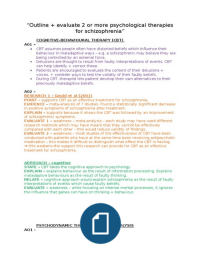
“Outline + evaluate 2 or more psychological therapies
for schizophrenia”
COGNITIVE-BEHAVIOURAL THERAPY (CBT)
A01 –
CBT assumes people often have distorted beliefs which influence their
behaviour in maladaptive ways – e.g. a schizophrenic may believe they are
being controlled by an external force.
Delusions are thought to result from faulty interpretations of events, CBT
can help identify + correct these.
Patients are encouraged to evaluate the content of their delusions +
voices, + consider ways to test the validity of their faulty beliefs.
During CBT, therapist lets patient develop their own alternatives to their
previously maladaptive beliefs.
A02 –
RESEARCH 1 – Gould et al (2001)
POINT – supports CBT as an effective treatment for schizophrenia.
EVIDENCE – meta-analysis of 7 studies. Found a statistically significant decrease
in positive symptoms of schizophrenia after treatment.
EXPLAIN – supports because it shows the CBT was followed by an improvement
of schizophrenic symptoms.
EVALUATE 1 – weakness – meta-analysis – each study may have used different
research methods which may have meant that they cannot be effectively
compared with each other – this would reduce validity of findings.
EVALUATE 2 – weakness – most studies of the effectiveness of CBT have been
conducted with patients who have at the same time been receiving antipsychotic
medication – this makes it difficult to distinguish what effect the CBT is having.
→ this weakens the support this research can provide for CBT as an effective
treatment for schizophrenia.
APPROACH – cognitive
STATE – CBT takes the cognitive approach to psychology.
EXPLAIN – explains behaviour as the result of information processing. Explains
maladaptive behaviours as the result of faulty thinking.
RELATE – cognitive approach would explain schizophrenia as the result of faulty
interpretations of events which cause faulty beliefs.
EVALUATE – weakness – while focusing on internal mental processes, it ignores
the influence that genes can have on thinking + behaviour.
PSYCHODYNAMIC THERAPY - PSYCHOANALYSIS
AO1 -
for schizophrenia”
COGNITIVE-BEHAVIOURAL THERAPY (CBT)
A01 –
CBT assumes people often have distorted beliefs which influence their
behaviour in maladaptive ways – e.g. a schizophrenic may believe they are
being controlled by an external force.
Delusions are thought to result from faulty interpretations of events, CBT
can help identify + correct these.
Patients are encouraged to evaluate the content of their delusions +
voices, + consider ways to test the validity of their faulty beliefs.
During CBT, therapist lets patient develop their own alternatives to their
previously maladaptive beliefs.
A02 –
RESEARCH 1 – Gould et al (2001)
POINT – supports CBT as an effective treatment for schizophrenia.
EVIDENCE – meta-analysis of 7 studies. Found a statistically significant decrease
in positive symptoms of schizophrenia after treatment.
EXPLAIN – supports because it shows the CBT was followed by an improvement
of schizophrenic symptoms.
EVALUATE 1 – weakness – meta-analysis – each study may have used different
research methods which may have meant that they cannot be effectively
compared with each other – this would reduce validity of findings.
EVALUATE 2 – weakness – most studies of the effectiveness of CBT have been
conducted with patients who have at the same time been receiving antipsychotic
medication – this makes it difficult to distinguish what effect the CBT is having.
→ this weakens the support this research can provide for CBT as an effective
treatment for schizophrenia.
APPROACH – cognitive
STATE – CBT takes the cognitive approach to psychology.
EXPLAIN – explains behaviour as the result of information processing. Explains
maladaptive behaviours as the result of faulty thinking.
RELATE – cognitive approach would explain schizophrenia as the result of faulty
interpretations of events which cause faulty beliefs.
EVALUATE – weakness – while focusing on internal mental processes, it ignores
the influence that genes can have on thinking + behaviour.
PSYCHODYNAMIC THERAPY - PSYCHOANALYSIS
AO1 -


