The Blackwell Guide to Ethical Theory
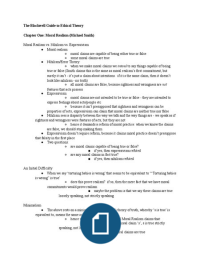
Chapter One: Moral Realism (Michael Smith)
Moral Realism vs. Nihilism vs. Expressivism
● Moral realism:
○ moral claims are capable of being either true or false
○ some moral claims are true
● Nihilism/Error Theory:
○ when we make moral claims we intend to say things capable of being
true or false (Smith claims this is the same as moral realism’s first commitment, but
surely it isn’t - it’s just a claim about intentions. if it is the same claim, then it doesn’t
look like nihilism - no truth)
○ all moral claims are false, because rightness and wrongness are not
features that acts possess
● Expressivism
○ moral claims are not intended to be true or false - they are intended to
express feelings about acts/people etc
○ because it isn’t presupposed that rightness and wrongness can be
properties of acts, expressivism can claim that moral claims are neither true nor false
● Nihilism sees a disparity between the way we talk and the way things are - we speak as if
rightness and wrongness were features of acts, but they are not
○ hence it demands a reform of moral practice: when we know the claims
are false, we should stop making them
● Expressivism doesn’t require reform, because it claims moral practice doesn’t presuppose
that falsity in the first place
● Two questions:
○ are moral claims capable of being true or false?
■ if yes, then expressivism refuted
○ are any moral claims in fact true?
■ if yes, then nihilism refuted
An Initial Difficulty
● When we say ‘torturing babies is wrong’ that seems to be equivalent to ‘“Torturing babies
is wrong” is true’
○ does this prove realism? if so, then the mere fact that we have moral
commitments would prove realism
■ maybe the problem is that we say these claims are true
loosely speaking, not strictly speaking
Minimalism
● The above rests on a minimalist (disquotational) theory of truth, whereby ‘s is true’ is
equivalent to, means the same as, ‘s’
○ hence we have a position: Minimal Moral Realism claims that:
■ when we make a moral claim ‘s’, s is true strictly
speaking, not loosely speaking
■ some of these moral claims are true
Chapter One: Moral Realism (Michael Smith)
Moral Realism vs. Nihilism vs. Expressivism
● Moral realism:
○ moral claims are capable of being either true or false
○ some moral claims are true
● Nihilism/Error Theory:
○ when we make moral claims we intend to say things capable of being
true or false (Smith claims this is the same as moral realism’s first commitment, but
surely it isn’t - it’s just a claim about intentions. if it is the same claim, then it doesn’t
look like nihilism - no truth)
○ all moral claims are false, because rightness and wrongness are not
features that acts possess
● Expressivism
○ moral claims are not intended to be true or false - they are intended to
express feelings about acts/people etc
○ because it isn’t presupposed that rightness and wrongness can be
properties of acts, expressivism can claim that moral claims are neither true nor false
● Nihilism sees a disparity between the way we talk and the way things are - we speak as if
rightness and wrongness were features of acts, but they are not
○ hence it demands a reform of moral practice: when we know the claims
are false, we should stop making them
● Expressivism doesn’t require reform, because it claims moral practice doesn’t presuppose
that falsity in the first place
● Two questions:
○ are moral claims capable of being true or false?
■ if yes, then expressivism refuted
○ are any moral claims in fact true?
■ if yes, then nihilism refuted
An Initial Difficulty
● When we say ‘torturing babies is wrong’ that seems to be equivalent to ‘“Torturing babies
is wrong” is true’
○ does this prove realism? if so, then the mere fact that we have moral
commitments would prove realism
■ maybe the problem is that we say these claims are true
loosely speaking, not strictly speaking
Minimalism
● The above rests on a minimalist (disquotational) theory of truth, whereby ‘s is true’ is
equivalent to, means the same as, ‘s’
○ hence we have a position: Minimal Moral Realism claims that:
■ when we make a moral claim ‘s’, s is true strictly
speaking, not loosely speaking
■ some of these moral claims are true