ATI MENTAL HEALTH PROCTORED EXAM 2 Q&A
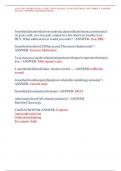
ATI MENTAL HEALTH PROCTORED EXAM 2 Q&A 4) A nurse is providing behavior therapy for a client who has obsessive-compulsive disorder. The client repeatedly checks that the doors are locked at night. Which of the following instructions should the nurse give the client when using thought stopping technique? a. Snap a rubber band on your wrist when you think about checking the locks. b. Ask a family member to check the locks for you at night. c. Focus on abdominal breathing whenever you go to check the locks. d. Keep a journal of how often you check the locks each night. 5) A nurse is caring for a client who is starting treatment for substance use disorder. Which of the following actions indicate the nurse is practicing the ethical principle of nonmaleficence? a. Provide the client with quality care regardless of their ability to pay for treatment. b. Educating the client about legal rights concerning treatment. c. Withholding the prescribed medication that is causing adverse effects for the client. d. Being truthful with the client about the manifestations of withdrawl. 6) A nurse in a group home facility is caring for a client who is developmentally disabled. The client has been stealing belongings from other clients. Which of the following techniques should the nurse use? a. Crisis intervention to decrease anxiety. b. Aversion therapy to provide distraction c. Positive reinforcement to increase desired behavior. d. Systematic desensitization to extinguish the behavior. 7) A nurse is caring for a client who is experiencing a panic attack. Which of the following actions should the nurse take? a. Ask the client to discuss precipitating events b. Speaks to the client in a high-pitched voice. c. Place the client in seclusion d. Have the client breathe into a paper bag. 8) The nurse is caring for a client following a physical assault. The client states "I don’t remember what happened to me." The nurse should recognize that the client is using which of the following defense mechanisms? a. Repression b. Displacement c. Rationalization d. Denial 9) A nurse is caring for a client who has anorexia nervosa. Which of the following findings require immediate intervention by the nurse? a. +2 edema of the lower extremities b. BUN 21 mg/dL c. Lanugo covering the body d. Blood pH 7.60 10) A nurse is caring for a client in a mental health facility. The client is agitated and threatens to harm herself and others. Which of the following is the priority intervention? a. Place the client in restraints b. Administer an anti-anxiety medication to the client c. Put the client in seclusion d. Set limits on the client's behavior 11) Dosage Calculation Question. 12) A nurse is caring for a client who was involuntarily committed and is scheduled to receive electroconvulsive therapy (ECT). The client refuses the treatment and will not discuss why with the health care team. Which of the following actions should the nurse take? a. Ask the clients family to encourage the client to receive ECT b. Inform the client that ECT does not require a consent. c. Document the client's refusal of the treatment in the medical record. d. Tell the client he cannot refuse the treatment because he was involuntarily committed. 13) A nurse in the emergency department is caring for a client who reports feeling sad, worthless, and hopeless 9 months after the death of her son. Which of the following actions should the nurse take first? a. Request a mental health consult for the client. b. Ask the client if she has thought about harming herself. c. Encourage the client to attend a grief support group. d. Discuss the clients coping skills. 14) A nurse is caring for a client who has borderline personality disorder and has been engaging in self-mutilation. The nurse should encourage the client to participate in which of the following groups. a. Dual diagnosis treatment group b. Dialectical treatment group c. Desensitization therapy d. Co-dependents support group. 15) The nurse is reviewing the medication administration record of a client who has schizophrenia. The nurse should plan to initiate the Abnormal Involuntary Movement Scale to monitor for adverse effects of which of the following medications.? a. Amantadine b. Diphenhydramine c. Benztropine d. Haloperidol 16) A nurse is counseling a client following the death of a clients partner 8 months ago. Which of the following client statements indicates maladaptive grieving? a. I am so sorry for the times I was angry with my partner. b. I find myself thinking about my partner often. c. I still don't feel up to returning to work. d. I like looking at his personal items in the closet. 17) A nurse is caring for a client who has borderline personality disorder. Which of the following outcomes should the nurse include in the treatment plan? a. The client will report a decrease in hallucinations. b. The client will communicate needs c. The client will verbalize improved mood d. The client will attend to personal hygiene. 18) A nurse is caring for a client who is prescribed massage therapy to treat panic disorder. The client states "I can't stand to be touched by another person." Which of the following responses should the nurse make? a. Why don’t you like to be touched by others b. Don’t worry about it. Your anxiety will lessen once the massage begins. c. I will tell your provider you would like a treatment other than a massage. d. I will request that the massage therapist wear gloves during your treatment. 19) A nurse is creating a plan of care for a client who has major depressive disorder. Which of the following interventions should the nurse include in the plan? a. Encourage physical activity for the client during the day b. Discourage the client from expressing feelings of anger c. Keep a bright light on in the client's room at night. d. Identify and schedule alternative group activities for the client. 20) A nurse is providing counseling for a family that consists of two parents and their two adolescent children. Which of the following family members should the nurse identify as acting in the role as the monopolizer? a. The mother who expresses hostility toward her spouse. b. The adolescent son who refuses to share personal feelings. c. The father who intervenes whenever the siblings argue. d. The adolescent daughter who attempts to dominate the conversation. 21) A nurse is developing a teaching plan for the family of an older adult client who is to receive transcranial magnetic stimulation. Which of the following information should the nurse include in the teaching plan? a. The client might have a headache after treatment. b. The client will experience seizure during treatment. c. The client will require intubation after treatment. d. The client is at risk for aspiration during treatment. 22) A nurse is providing teaching about disulfiram to a client who has a history of alcohol use. Which of the following instructions should the nurse include in the teaching? (Select all that apply) a. “You will need to take the medication once daily” b. “you will receive treatment in an inpatient setting” c. “You should avoid using mouthwash that contains alcohol” d. “you should avoid drinking carbonated beverages while taking the medication” e. “you can expect to develop a physical dependence to the medication” 23) A nurse is caring for a client who is in the manic phase of bipolar disorder. Which of the following actions should the nurse take? a. Avoid power struggles by remaining neutral b. Allow the client to set limits for his behavior c. Provide in-depth explanation of nursing expectations d. Encourage the client to participate in group activities 24) A nurse is assessing a young adult female client for schizophrenia. Which of the following findings should the nurse identify as a risk factor for this condition? a. Environmental stress b. Gender c. Depression d. Birth order 25) A nurse is providing discharge teaching about manifestations of relapse to the family of a client who has schizophrenia. Which of the following information should the nurse include in the teaching? a. The client exhibits an inflated sense of self b. The client develops an inability to concentrate c. The client increases participation in social activities d. The client begins sleeping more than usual 26) A nurse is assessing a client who is restless and constantly mutters to himself. Which of the following findings should lead the nurse to suspect delirium? a. The client is unable to recognize objects. b. The client manifestations developed suddenly c. The client has a flat affect d. The client’s speech is slow and repetitious 27) A nurse is caring for a client in an inpatient mental health facility. The client tells the nurse that the government is reading her mail. Which of the following responses should the nurse make? a. “ You know that’s not true, because it is against the law for others to read your mail” b. “All of your letters come sealed, so that seems unlikely” c. “It must be frightened to think that someone is reading your mail” d. “Why do you think the government wants to read your mail?” 28) A nurse is assessing a client who has neuroleptic malignant syndrome. Which of the following clinical findings should the nurse expect? a. Heart rate 48/min b. Temperature 40 C (104 F) c. WBC 3,000/mm3 d. Hypotonicity 29) A nurse is reviewing the medical record of a client who is taking clozapine. For which of the following findings should the nurse withhold the medication and notify the provider? (Click on the “Exhibit” button for additional information about the client. There are three tabs that contain separate categories of data.) a. WBC count b. Blood glucose level c. Report of photosensitivity d. Heart Rate 30) A nurse is caring for a client who has personality disorder and is using transference to cope. Which of the following behaviors should the nurse expect? a. Talking negatively about other staff members b. Expressing frustration regarding unit rules c. Reacting to the nurse as though she were his mother d. Refusing to participate in group activities 31) A nurse in a mental health facility is caring for a newly admitted client. Which of the following resources should the nurse recommend to help the client adapt to the health care setting? a. A community meeting b. A medication group c. A self-help meeting d. A symptom-management group 32) A nurse is assisting with obtaining informed consent for a client who has been declared legally incompetent. Which of the following actions should the nurse take? a. Request that the client’s guardian sign the consent b. Ask the charge nurse to obtain informed consent c. Contact the facility social worker to obtain the consent d. Explain implied consent to the client’s family 33) A nurse is caring for a client who has cocaine use disorder. Which of the following manifestations should the nurse expect the client to have during withdrawal? a. Hand tremors b. Rapid speech c. Fatigue d. Seizures 34) A nurse is providing teaching about disorder management for a client who has posttraumatic stress disorder (PTSD). Which of the following statements should the nurse include in the teaching? a. “Avoiding stimuli that trigger memories of the trauma can help you overcome your PTSD” b. “Talking about the traumatic experience is recommended” c. “Response prevention is an effective treatment for PTSD” d. “You should try to limit the number of hours that you sleep each day” 35) A nurse is assessing a client who has bipolar disorder and is taking lamtropine. Which of the following findings is the nurse’s priority? a. Thyroid-stimulating hormone (TSH) 4.0 microunits/mL b. Alanine transaminase (ALT) 20 IU/L c. Skin rash d. Epistaxis 36) A nurse is caring for a client who has schizophrenia and displays severe negative symptoms of the disorder. Which of the following actions should the nurse take? a. Manage the client’s loud, rambling, and incoherent communication patterns b. Direct the client to perform her own daily hygiene and grooming tasks c. Assist the client to identify somatic and thought-broadcasting delusions d. Use medication to decrease frequency of auditory and visual hallucination. 37) A nurse is beginning a therapeutic relationship with a client. The nurse should plan to accomplish which of the following tasks during the working phase? a. Inform the client about confidentiality rights b. Establish boundaries between the nurse and the client c. Set short and long-term objectives for the future d. Evaluate progress toward predetermined goals 38) A nurse in a mental health facility is making plans for a client’s discharge. Which of the following interdisciplinary team members should the nurse contact to assist the client with housing placement? a. Clinical nurse specialist b. Recreational therapist c. Occupational therapist d. Social worker 39) A nurse is caring for a client who reports that he is angry with his partner because she thinks he is just trying to gain attention. When the nurse attempts to talk to the client, he becomes angry and tells her to leave. Which of the following defense mechanism is the client demonstrating? a. Denial b. Displacement c. Compensation d. Rationalization 40) A charge nurse is discussing the care of a client who has a substance use disorder with a staff nurse. Which of the following statements by the staff nurse should the charge nurse identify as countertransference? a. “The client is just like my brother who finally overcame his habit” b. “The client needs to accept responsibility for his substance use” c. “The client generally shares his feelings during group therapy session” d. “The client asked me to go on a date with him, but I refuse” 41) A nurse is caring for a client who is admitted to a mental health facility after attempting suicide. Which of the following actions should the nurse take first? a. Establish a rapport to foster trust b. Implement continuous one-to-one observation c. Ask the client to sign a no-suicide contract d. Encourage the client to participate in group therapy 42) A nurse is providing teaching for a newly licensed nurse about the constructive use of defense mechanism. Which of the following examples should the nurse include in the teaching? a. A student who is upset with her teacher writes a story about an excellent student b. A school-age child whose mother died 2 years ago talks about her in present tense. c. A woman who has health concern postpones a medical appointment until after a vacation. d. An adult who was sexually abused as a child is unable to remember the incident 43) A nurse in an inpatient mental health facility is assessing a client who has schizophrenia and is taking haloperidol. Which of the following clinical findings is the nurse’s priority? a. High fever b. Urinary hesitancy c. Insomnia d. Headache 44) A nurse is planning care for a client who has a recent diagnosis of antisocial personality disorder. Which of the following outcomes should the nurse include in the care plan? a. The client recognizes the importance of others b. The client conforms to social norms regarding clothing choices c. The client reduces self-dramatization d. The client treats others with respect 45) A nurse is planning care for a newly admitted client who has anorexia nervosa. Which of the following interventions should the nurse include in the plan? a. Negotiate with the client how much weight she should gain each week. b. Decrease the client’s daily intake of fiber c. Weight the client weekly for the first month d. Notify the client about designated time for meals 46) A client is fearful of driving and enters a behavioral therapy program to help him overcome his anxiety. Using systematic desensitization, he is able to drive down a familiar street without experience a panic attack. The nurse should recognize that to continue positive results, the client should participate in which of the following? a. Therapist modeling b. Positive reinforcement c. Frequent practice d. Biofeedback 47) A nurse in the emergency department is counseling a client who reports experiencing intimate partner violence. Which of the following actions should the nurse take? a. Request permission from the client to take photographs of the injuries b. Offer to help the client escape form the partner the next time violence occurs c. Determine what the client did to trigger the violent incident d. Tell the client that staying with the partner shows a lack of judgment 48) A nurse is caring for a client who has prescription for phenelzine. The nurse should instruct the client to avoid which of the following over-the-counter medications? a. Ranitidine b. Pseudoephedrine c. Ibuprofen d. Docusate sodium 49) A nurse is caring for a client who is experiencing active auditory hallucinations. Which of the following actions should the nurse take? a. Avoid asking direct questions about the client’s experience b. Convey sympathy for the client’s experience c. Tell her client her experience is not real d. Focus the client on reality-based activities 50) A nurse is caring for a client who has just returned to the unit after receiving an electroconvulsive therapy treatment. Which of the following assessments is the nurse’s priority? a. First voiding b. Short-term memory c. Presence of gag reflex d. Return of bowel sounds 51) A nurse is talking to a client following a group therapy session. The client tells the nurse that one of the other clients in the group made an inappropriate comment. Which of the following responses should the nurse make? a. “I think you should ignore the comment” b. “You sound upset about today’s session” c. “Why do you think that he said that to you?” d. “I agree that the comment was inappropriate” 52) A nurse is assessing a client who is experiencing acute alcohol withdrawal. Which of the following findings should the nurse expect? a. Hypotension b. Insomnia c. Bradycardia d. Diminished reflexes 53) A nurse is teaching a client who has bipolar disorder and a new prescription for lithium carbonate. Which of the following statements by the client indicates an understanding of the teaching? a. “I should drink at least 6 liters of water per day” b. “I should be on a low-sodium diet” c. “I will call my doctor if I have diarrhea” d. “I will see my doctor to check my lithium levels annually” 54) A nurse in an acute care mental health facility is planning discharge care for a client who sustained a traumatic brain injury. For which of the following needs should the nurse collaborate with a clinical psychologist? a. The client needs a prescription for medication to promote nighttime sleep while in the facility b. The client needs to find a place to live after discharge c. The client needs to begin a group therapy program prior to discharge d. The client needs to relearn how to perform skill that require fine motor coordination 55) A nurse is reviewing the laboratory report of a client who is taking carbamazepine for bipolar disorder. Which of the following laboratory results should the nurse report to the provider? a. Urine specific gravity 1.029 b. Platelets 90,000/mm3 c. Urine pH 5.6 d. RBC 4.7/mm3 56) A nurse is teaching the caregiver of a client who has advanced Alzheimer’s disease about home safety. Which of the following statements by the caregiver indicates an understanding of the teaching? a. I will ensure the bedroom is dark while he is sleeping at night b. I will place a sliding bolt lock just above the doorknob c. I will notify law enforcement within 2 hours if he cannot be found d. I will give his most recent photo to the police 57) A nurse is teaching a client who has a new prescription for phenelzine to treat depression. The nurse instructs the client to avoid foods with tyramine to prevent which of the following? a. Hypertensive crisis b. Cardiac toxicity c. Serotonin Syndrome d. Urinary retention 58) A nurse in an outpatient clinic is assessing a client who has anorexia nervosa. Which of the following findings indicates the need for hospitalization? a. Potassium 3.8mEq/L b. Heart Rate 56/min c. Temperature 35.6C (96.1F) d. Weight 10% below ideal weight 59) A nurse us obtaining a medical history from a client who is requesting a prescription for bupropion for smoking cessation. Which of the following assessment finding in the client’s history should the nurse report to the provider? a. Hepatitis B Infection b. Hypothyroidism c. Knee arthroplasty 1 month ago d. Recent head injury 60) A nurse is providing crisis intervention for a client who was involved in a violent mass causality situation in the community. Which of the following actions should the nurse take during the initial session with the client? a. help the client focus on a wide variety of topics regarding the crisis b. identify the client’s usual coping style c. tell the client that his life will soon return to normal d. encourage the client to display anger toward the cause of the crisis 61) A nurse in the community health facility is interviewing a client who recently lost his job. The client states “I was fired because my boss doesn’t like me” Which of the following defense mechanisms is the client displaying? a. Rationalization b. Displacement c. Dissociation d. Repression 62) A nurse is providing teaching to a client who has depressive disorder and a new prescription for doxepin. Which of the following instructions should the nurse include in the teaching? a. sit on the side of the bed for a few minutes before standing b. decrease the prescribed dose by half when mood improves c. avoid over the counter magnesium when taking this medication d. eat a snack before going to bed 63) A nurse is planning care for a client who has dementia. Which of the following interventions should the nurse include in the plan? a. give detailed instructions for completion of self-care activities b. confront the client when he exhibits inappropriate behavior c. provide finger foods to enhance caloric intake d. remove clocks from the client’s room 64) A nurse is planning overall strategies to address problems for a client who has borderline personality disorder. Which of the following strategies is the priority for the nurse to incorporate in the plan of care? a. discuss the appropriate use of assertive behavior with the client b. encourage the client to attend weekly support group meetings c. assist the client to maintain awareness of her thoughts and feelings d. implement measures to prevent intentional self-inflicted injury A charge nurse is discussing mental status examinations with a newly licensed nurse. Which of the following statements by the newly licensed nurse indicates an understanding? SATA · "To assess cognitive ability; I should ask the client to count backwards by 7." · "To assess affect, I should observe the client's facial expression." · "To assess language ability; I should instruct the client to write a sentence." A nurse is planning care for a client who has a mental health disorder. Which of the following actions should the nurse include as a psychological intervention? · Monitor the client for adverse effects of medications A nurse in an outpatient mental health clinic is preparing to conduct an initial client interview. When conducting the interview, which of the following actions should the nurse identify as the priority? · Identify the client's perception of her of her own mental health status A nurse is told during change-of-shift report that a client is stuporous. When assessing the client, which of the following is an expected finding? · The client arouses briefly in response to a sternal rub A nurse is planning a peer group discussion about the DSM-5. Which of the following is appropriate to include in the discussion? (select all that apply) · The DSM-5 is used to identify mental health disorders · The DSM-5 establishes diagnostic criteria · The DSM-5 indicates expected assessment findings · The DSM‑5 assists nurses in planning care for client's who have mental health disorders. A nurse in an emergency mental health facility is caring for a group of clients. The nurse should identify that which of the following clients requires a temporary emergency admission? · A client who has bordering personality disorder and assaulted a homeless man with a metal rod A nurse decides to put a client who has a psychotic disorder in seclusion overnight because the unit is very short-staffed, and the client frequently fights with other clients. The nurse's actions are an example of which of the following torts? · False Imprisonment A client tells a nurse "Don't tell anyone, but I hid a sharp knife under my mattress in order to protect myself from my roommate, who is always yelling at me and threatening me." Which of the following actions should the nurse take? · Tell the Client that this must be reported to the health care team because it concerns the health and safety of the client and others A Nurse is caring for a client who is in mechanical restraints. Which of the following statements should the nurse include in the documentation? · "Client was offered 8oz of water every hour" · "Client shouted obscenities at assistive personnel" · "Client received chlorpromazine 15 mg by mouth at 1000." A nurse hears a newly licensed nurse discussing a client's hallucinations in the hallway with another nurse. Which of the following actions should the nurse take first? · Tell the nurse to stop discussing the behavior A charge nurse is conducting a class on therapeutic communication to a group of newly licensed nurses. Which of the following aspects of communication should the nurse identify as a component of verbal communication? · Intonation A nurse in an acute mental health facility is communicating with a client. The client states, "I can't sleep. I stay up all night." The nurse responds, "You are having difficulty sleeping?" Which of the following therapeutic communication techniques is the nurse demonstrating? · Restating A nurse is communicating with a client who was just admitted for treatment of a substance use disorder. Which of the following communication techniques should the nurse identify as a barrier to therapeutic communication? · Offering advice A nurse caring for a client who has anorexia nervosa. Which of the following examples demonstrates the nurse's use of interpersonal communication? · The nurse asks the client about her body image perception. A nurse is caring for the parents of a child who has demonstrated recent changes in behavior and mood. When the mother of the child asks the nurse for reassurance about her son's condition, which of the following responses should the nurse make? · "I understand you're concerned. Let's discuss what concerns you specifically." A nurse is caring for a client who smokes and has lung cancer. The client reports, "I'm coughing because I have that cold that everyone has been getting." The nurse should identify that the client is using which of the following defense mechanisms? · Denial A nurse is providing preoperative teaching for a client who was just informed that she requires emergency surgery. The client, has a respiratory rate 30/min, and says, "This is difficult to comprehend. I feel shaky and nervous." The nurse should identify that the client is experiencing which of the following levels of anxiety? · Moderate A nurse is caring for a client who is experiencing moderate anxiety. Which of the following actions should the nurse take when trying to give necessary information to the client? (Select all that apply.) · Discuss prior use of coping mechanisms with the client. · Demonstrate a calm manner while using simple and clear directions. A nurse is talking with a client who is at risk for suicide following the death of his spouse. Which of the following statements should the nurse make? · "Losing someone close to you must be very upsetting." A charge nurse is discussing the characteristics of a nurse‑client relationship with a newly licensed nurse. Which of the following characteristics should the nurse include in the discussion? (Select all that apply.) · It is goal-directed. · Behavioral change is encouraged. · A termination date is established. A nurse is in the working phase of a therapeutic relationship with a client who has methamphetamine use disorder. Which of the following actions indicates transference behavior? · The client accuses the nurse of telling him what to do just like his ex-girlfriend. A nurse is planning care for the termination phase of a nurse‑client relationship. Which of the following actions should the nurse include in the plan of care? · Discussing ways to use new behaviors A nurse is orienting a new client to a mental health unit. When explaining the unit's community meetings, which of the following statements should the nurse make? · "You and the other clients will meet with staff to discuss common problems." A nurse is caring for several clients who are attending community‑based mental health programs. Which of the following clients should the nurse plan to visit first? · A client who says he is hearing a voice that tells him he is not worthy of living anymore A community mental health nurse is planning care to address the issue of depression among older adult clients in the community. Which of the following interventions should the nurse plan as a method of tertiary prevention? · Establishing rehabilitation programs to decrease the effects of depression A nurse is working in a community mental health facility. Which of the following services does this type of program provide? (Select all that apply.) · Educational groups · Medication dispensing programs · Individual counseling programs · Family therapy A nurse in an acute mental health facility is assisting with discharge planning for a client who has a severe mental illness and requires supervision much of the time. The client's wife works all day but is home by late afternoon. Which of the following strategies should the nurse suggest as appropriate follow‑up care? · Attending a partial hospitalization program A nurse is caring for a group of clients. Which of the following clients should a nurse consider for referral to an assertive community treatment (ACT) group? · A client who lives at home and keeps "forgetting" to come in for his monthly antipsychotic injection for schizophrenia A nurse is teaching a client who has an anxiety disorder and is scheduled to begin classical psychoanalysis. Which of the following client statements indicates an understanding of this form of therapy? · "The therapist will focus on my past relationships during our sessions." A nurse is discussing free association as a therapeutic tool with a client who has major depressive disorder. Which of the following client statements indicates understanding of this technique? · "I should say the first thing that comes to my mind." A nurse is preparing to implement cognitive reframing techniques for a client who has an anxiety disorder. Which of the following are appropriate to include in the plan of care? (Select all that apply.) · Priority restructuring · Monitoring thoughts · Journal keeping A nurse is caring for a client who has a new prescription for disulfiram (Antabuse) for the treatment of his alcohol use disorder. The nurse informs the client that this medication can cause nausea and vomiting if he drinks alcohol. This form of treatment is an example of which of the following? · Aversion therapy A nurse is assisting with systematic desensitization for a client who has an extreme fear of elevators. Which of the following is appropriate when implementing this form of therapy? · Gradually expose the client to an elevator while practicing relaxation techniques. A nurse wants to use democratic leadership with a group whose purpose is to learn appropriate conflict resolution techniques. The nurse is correct in implementing this form of group leadership when demonstrating which of the following actions? · Asks for group suggestions of techniques and then supports discussion. A nurse is planning group therapy for clients dealing with bereavement. Which of the following should the nurse include in the initial phase? (SATA) · Define the purpose of the group. · Discuss termination of the group. · Establish an expectation of confidentiality within the group. A nurse is working on an acute mental health unit forms a group to focus on self-management of medications. At each of the meetings, two of the members conspire together to exclude the rest of the group. This is an example of which of the following? · Subgroup A nurse is working on an acute mental health unit forms a group to focus on self-management of medications. At each of the meetings, two of the members use the opportunity to discuss their common interest in gambling on sports. This is an example of which of the following? · Hidden agenda A nurse is conducting a family therapy session. The adolescent son tells the nurse that he plans ways to make his sister look bad so his parents will think he's the better sibling, which he believes will give him more privileges. The nurse should identify this dysfunctional behavior as which of the following? · Manipulation A nurse is working with an established group and identifies various member roles. Which of the following should the nurse identify as an individual role? · A member who brags about accomplishments. A nurse is preparing an educational seminar for other nursing staff. Which of the following information should the nurse include in the discussion? · Excessive stressors cause the client to experience distress. A nurse is discussing acute vs prolonged stress with a client. Which of the following effects should the nurse identify as an acute stress response? · Depressed immune system · Increased Blood pressure · Unhappiness A nurse is teaching a client about stress reduction techniques. Which of the following client statements indicates understanding of the teaching? · "Cognitive reframing will help me change my irrational thoughts to something positive." A client says she is experiencing increased stress because her significant other is "Pressuring me and my kids to go live with him. I love him, but I'm not ready to do that." Which of the following recommendations should the nurse make to promote a change in the client's situation? · Use assertive techniques. A nurse is caring for a client who states, "I'm so stressed at work because of my coworker. He expects me to finish his work because he's too lazy!" When discussing effective communication, which of the following statements by the client to his coworker indicates client understanding? · "When I have to pick up extra work, I feel very overwhelmed. I need to focus on my own responsibilities." A nurse is providing teaching for a client who is scheduled to receive ECT for the treatment of major depressive disorder. Which of the following client statements indicates understanding of the teaching? · "I will receive a muscle relaxant to protect me from injury during ECT." A charge nurse is discussing transcranial magnetic stimulation (TMS) with a newly licensed nurse. Which of the following statements by the newly licensed nurse indicates an understanding of the teaching? · "I will schedule the client for TMS treatments 3 to 5 times a week for the first several weeks." A charge nurse is discussing transcranial magnetic stimulation (TMS) with a newly licensed nurse. Which of the following statements by the newly licensed nurse indicates a need for further teaching? · "I will provide postanesthesia care following TMS." A nurse is assessing a client immediately following an electroconvulsive therapy (ECT) procedure. Which of the following are expected findings? (SATA) · Memory loss · Nausea · Confusion A nurse is leading a peer group discussion about the indications for electroconvulsive therapy (ECT). Which of the following is appropriate to include in the discussion? · Bipolar disorder with rapid cycling A nurse is planning care for a client following surgical implantation of a vagus nerve stimlation (VNS) device. The nurse should plan to monitor for which of the following adverse effects? (SATA) · Voice changes · Dysphagia · Neck pain · Cough A nurse observes a client who has OCD repeatedly applying, removing, and then reapplying makeup. The nurse identifies that repetitive behavior in a client who has OCD is due to which of the following underlying reasons? · Attempt to reduce anxiety A nurse is caring for a client who is experiencing a panic attack. Which of the following actions should the nurse take? · Stay with the client and remain quiet A nurse is assessing a client who has generalized anxiety disorder. Which of the following should the nurse expect? · Excessive worrying for 6 months · Need for reassurance · Restlessness A nurse is planning care for a client who has body dysmorphic disorder. Which of the following actions should the nurse plan to take first? · Assessing the client's risk for self-harm A nurse is caring for a client who has acute stress disorder and is experiencing severe anxiety. Which of the following statements actions should the nurse make? · "Tell me about how you are feeling right now." A nurse working on an acute mental health unit is caring for a client who has post-traumatic stress disorder (PTSD). Which of the following findings should the nurse expect? (SATA)
Written for
- Institution
-
West Coast University
- Course
-
ATI Mental Health
Document information
- Uploaded on
- December 4, 2022
- Number of pages
- 24
- Written in
- 2022/2023
- Type
- Exam (elaborations)
- Contains
- Questions & answers
Subjects
-
ati mental health proctored exam 2 qampa 4 a nurse is providing behavior therapy for a client who has obsessive compulsive disorder the client repeatedly checks that the doors are locked at night