Health
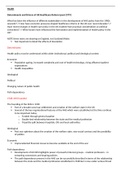
Determinants and Drivers of UK Healthcare Reform (post-1979)
What has been the influence of different stakeholders in the development of NHS policy from the 1980s
onwards? // How have economic pressures shaped healthcare reforms in the UK over recent decades? //
Have recent changes in health-care policy in the UK resulted from practical considerations or political
convictions? // What factors have influenced the formulation and implementation of health policy in the
UK?
NOTE these notes are drawing on England, not Scotland/Wales
Not important to detail the effects of devolution
Determinants
Health policy must be understood within wider institutional, political and ideological context.
Economic
Population ageing, increased complexity and cost of health technology, rising affluence/patient
expectations
Health inequalities
Ideological
Political
Changing nature of public health
Path dependency
1948: NHS founded
The founding of the NHS in 1948
Part of a broader post-war settlement and creation of the welfare state in the UK
Several of the key organisational features of the NHS which were established at the time continue
to be important today:
o Funded through general taxation
o Double-bed relationship between the state and the medical profession
o Tripartite split between hospitals, GPs and local authorities
Ideological
Post war optimism about the creation of the welfare state, new social contract and the possibility
of politics
Economic
Unprecedented financial resources became available at the end of the war
Path dependency
Development of UK NHS highlights power of powerful interest groups – medical profession – in
extracting concessions and shaping policies
The path dependence present in the NHS can be successfully described in terms of the relationship
between the state and the medical profession established in 1948 but is now under serious threat
, because of the move from it being necessary in formation to being more contingent. This has
meant a movement from a situational logic of protection and compromise to one of elimination
and the forcing of choice, as the interests of the state and the medical profession appear to have
diverged under New Labour. As this occurs, we can see the path dependence relationship identified
as being central to the NHS gradually breaking down, legitimised by new cultural ideas that position
the medical model of care as incompatible with the aims of either patients, or of the state
o Increasing scope for private care: the state could rely sufficiently upon non-public NHS care
to no longer have to take the public sector doctors into account, while the doctors would
have sufficient alternative employment outside of the NHS to be able to confront the state
(we are not there yet, but arguably on the way)
Medical model of care: predicated on professional, expert knowledge organised by an elite societal
grouping
We can still claim policy to be path dependent, but we might usefully think of health care as being
an area with considerable conflict, even if it largely maintains the status quo
Determinants and Drivers of UK Healthcare Reform (post-1979)
What has been the influence of different stakeholders in the development of NHS policy from the 1980s
onwards? // How have economic pressures shaped healthcare reforms in the UK over recent decades? //
Have recent changes in health-care policy in the UK resulted from practical considerations or political
convictions? // What factors have influenced the formulation and implementation of health policy in the
UK?
NOTE these notes are drawing on England, not Scotland/Wales
Not important to detail the effects of devolution
Determinants
Health policy must be understood within wider institutional, political and ideological context.
Economic
Population ageing, increased complexity and cost of health technology, rising affluence/patient
expectations
Health inequalities
Ideological
Political
Changing nature of public health
Path dependency
1948: NHS founded
The founding of the NHS in 1948
Part of a broader post-war settlement and creation of the welfare state in the UK
Several of the key organisational features of the NHS which were established at the time continue
to be important today:
o Funded through general taxation
o Double-bed relationship between the state and the medical profession
o Tripartite split between hospitals, GPs and local authorities
Ideological
Post war optimism about the creation of the welfare state, new social contract and the possibility
of politics
Economic
Unprecedented financial resources became available at the end of the war
Path dependency
Development of UK NHS highlights power of powerful interest groups – medical profession – in
extracting concessions and shaping policies
The path dependence present in the NHS can be successfully described in terms of the relationship
between the state and the medical profession established in 1948 but is now under serious threat
, because of the move from it being necessary in formation to being more contingent. This has
meant a movement from a situational logic of protection and compromise to one of elimination
and the forcing of choice, as the interests of the state and the medical profession appear to have
diverged under New Labour. As this occurs, we can see the path dependence relationship identified
as being central to the NHS gradually breaking down, legitimised by new cultural ideas that position
the medical model of care as incompatible with the aims of either patients, or of the state
o Increasing scope for private care: the state could rely sufficiently upon non-public NHS care
to no longer have to take the public sector doctors into account, while the doctors would
have sufficient alternative employment outside of the NHS to be able to confront the state
(we are not there yet, but arguably on the way)
Medical model of care: predicated on professional, expert knowledge organised by an elite societal
grouping
We can still claim policy to be path dependent, but we might usefully think of health care as being
an area with considerable conflict, even if it largely maintains the status quo