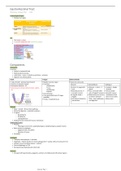
Gastrointestinal Tract
Wednesday, 24 August 2022 14:48
Embryological Origins
• Endodermal region
/Coeliac plexus
Lie superiorly
GIT
• Oral cavity → anus
• = muscular digestive tract + accessory organs
•
Components
Oral Cavity
Functions
• Analysis of potential food
• Mechanical processing
• Lubrication - mucus + salivatory secretions + enzymes
• Digestion by salivary glands
Teeth Tongue Salivary Glands
• 2 sets of teeth : primary & permanent • Mobile muscular organ • Drain into oral cavity
• Positions in alveolar sockets • Functions Parotid Submandibular Sublingual
• Permanent dentition : 32 • Mastication
• Unnecessary to know names incisors, canine, • Taste • Inferior to zygomatic • Bilateral - 2 ducts + 2 • Smallest + deeply
etc • Swallowing arch glands situated
• Speech • Mastoid process → • Floor of mouth either • Almond shape
• Oral cleansing masseter muscle side of lingual frenulum • Beneath mucous
• Taste generated back of tongue • Irregular shape + • Mixed serous an mucus membrane of the
(papillae) biggest secretions lubricant floor of oral cavity
• Tonsils = lymphoid tissue • Secretions drained by food = easy swallowing • Many ducts
parotid duct and digestion
Pharynx
• Nose + mouth + throat share pathway
• Shared by digestive + respiratory systems
• 3 regions
○ Nasopharynx
○ Oropharynx
○ Laryngopharynx
• Skeletal muscle, lined with mucous membrane
Swallowing Process
• Muscles
○ Pharyngeal constrictors, palatopharyngeus, stylopharyngeus, palatal muscles
• Bolus moves to esophagus
○ Epiglottis folds over glottis
○ Elevation of larynx
• Peristalsis
Esophagus
• Transports food pharynx → stomach
• Originates : inferior border of cricoid cartilage (C6) → cardiac orifice of stomach (T11)
• Follows curve of vertebral column - anterior
• Pierces diaphragm at T10
• Retroperitoneal (laterally and anteriorly)
Stomach
• Occupies left hypochondria, epigastric, portions of umbilical and left lumbar regions
Anatomy Page 1
Wednesday, 24 August 2022 14:48
Embryological Origins
• Endodermal region
/Coeliac plexus
Lie superiorly
GIT
• Oral cavity → anus
• = muscular digestive tract + accessory organs
•
Components
Oral Cavity
Functions
• Analysis of potential food
• Mechanical processing
• Lubrication - mucus + salivatory secretions + enzymes
• Digestion by salivary glands
Teeth Tongue Salivary Glands
• 2 sets of teeth : primary & permanent • Mobile muscular organ • Drain into oral cavity
• Positions in alveolar sockets • Functions Parotid Submandibular Sublingual
• Permanent dentition : 32 • Mastication
• Unnecessary to know names incisors, canine, • Taste • Inferior to zygomatic • Bilateral - 2 ducts + 2 • Smallest + deeply
etc • Swallowing arch glands situated
• Speech • Mastoid process → • Floor of mouth either • Almond shape
• Oral cleansing masseter muscle side of lingual frenulum • Beneath mucous
• Taste generated back of tongue • Irregular shape + • Mixed serous an mucus membrane of the
(papillae) biggest secretions lubricant floor of oral cavity
• Tonsils = lymphoid tissue • Secretions drained by food = easy swallowing • Many ducts
parotid duct and digestion
Pharynx
• Nose + mouth + throat share pathway
• Shared by digestive + respiratory systems
• 3 regions
○ Nasopharynx
○ Oropharynx
○ Laryngopharynx
• Skeletal muscle, lined with mucous membrane
Swallowing Process
• Muscles
○ Pharyngeal constrictors, palatopharyngeus, stylopharyngeus, palatal muscles
• Bolus moves to esophagus
○ Epiglottis folds over glottis
○ Elevation of larynx
• Peristalsis
Esophagus
• Transports food pharynx → stomach
• Originates : inferior border of cricoid cartilage (C6) → cardiac orifice of stomach (T11)
• Follows curve of vertebral column - anterior
• Pierces diaphragm at T10
• Retroperitoneal (laterally and anteriorly)
Stomach
• Occupies left hypochondria, epigastric, portions of umbilical and left lumbar regions
Anatomy Page 1