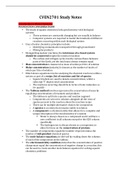
CVEN2701 Study Notes
Introduction to Water Chemistry
FOUNDATION CONSIDERATIONS
• The study of aquatic chemistry links geochemistry with biological
systems
o These systems are constantly changing but are usually in balance
o Computer systems are required to model the hundreds of different
reactions occurring within each biological system
• Uses of water chemistry principles include:
o Identifying contaminants transported through groundwater
o Mining by-products
• Disregarding nuclear reactions, the total mass of a closed system
should be conserved despite the internal reactions
o The carbon and nitrogen cycles involve various fluxes between
parts of the Earth, yet the total mass always remains equal
• Mass concentration is measured as mass of solute per litre of solution
• Molar concentration (molarity) is known as the number of moles of
solute per litre of solution
• Mole balance equations involve analysing the chemical reactions within a
system as part of a recipe, list of reactions and list of species
o Square brackets are used to denote concentrations, whilst a
subscript ‘T’ depicts total concentration
o The reactions occurring should be in terms of ionic molecules i.e.
H+ and OH-
• The Tableau method involves expression the conservation of mass by
equalising concentrations of reactants and products
o The tableau is split into a species and reaction segment
o Components are set out in columns alongside all the rows of
species present in the reaction above the reaction recipe
o There can be multiple alternative choices for components
o A species is an entity that remains stable in solution
o A component is a chemical entity that allows for a complete and
unique description of the stoichiometry of a system
§ Water is always chosen as a component and it will have a
zero coefficient in all columns except for the H2O column
specifically
§ The hydrogen ion is always chosen as a component, to
allow for focus on the conservation of protons
• The number of components equals the number of species minus the
number of independent chemical species
• The mole balance equations are derived by reading down the columns
of each of the components on the tableau
• The electroneutrality condition states that the concentration of positive
charge must equal the concentration of negative charge in a reaction, this
can be used to create another mole balance equation for solving aquatic
chemistry problems
, • From the study of thermodynamics, the concentration of H+ multiplied
by the concentration of OH- is always equal to 10^-14
o For carbonate reactions, [HCO3-]/([CO2]*[OH-]) = 10^7.7
MASS LAW EQUATIONS
• The free energy of a system is equal to the sum of the free energies of it’s
chemical species
o Thus for a system: G=sum(n*u) where G=total free energy (J),
n=moles of species (mol), u=free energy of species (J/mol)
• Chemical equilibrium occurs at the lowest free energy state and this
occurs spontaneously
• The free energy of a chemical species can be divided into three parts:
o Potential energy gained from the formation of the species from
some reference state (change from metal to ion)
o Energy related to the concentration of the species in the system
o Energy corresponding to the interactions with other species (this
is less important for the purpose of CVEN2701)
• Free energy of a species is thus given as: u = u0 + RT*ln(X) where u0=free
energy of species in present state, R=universal gas constant (8.31),
T=absolute temperature, X=mole fraction
o For a solid species, X=1 therefore the second term equals zero
o Mole fraction of water in dilute aqueous solutions is approximately
one, therefore the second term equals zero
o In both of these situations, the free energy of the species is
constant
o For solute species in solution, concentration units can also be
used within the logarithm term, since the volume denominators
will inevitably cancel out
o For gaseous species, partial pressure units can also be used
within the logarithm term
• The study of free energies allows chemists to analyse the consequences of
a reaction on the change in energy of certain species
• The formula for ‘G’ above can be differentiated via the product rule
alongside number of moles
o For the basic water dissociation reaction in solution, dG/dn = -
uwater +uhydronium + uhydroxide
o The term dG/dn is known as the free energy change of the
reaction
o Chemical equilibrium occurs when dG/dn=0
• The mole fraction of a species can be calculated via the mass law
equation as: Q = exp((-dG/dn)/RT)
• The equilibrium constant (K) is the value of the molarity concentration
(X(hydronium)*X(hydroxide)/X(water)) of a species at equilibrium
• The following are all practical applications of the mass law equations:
o K = Product of products/Product of reactants
o Remember that [water]=[solid]=1
o The solubility product for the reaction: CaCO3 = Ca2+ + CO32- is
[Ca2+]*[CO32-] = KCaCO3 (solid-solutes)
Introduction to Water Chemistry
FOUNDATION CONSIDERATIONS
• The study of aquatic chemistry links geochemistry with biological
systems
o These systems are constantly changing but are usually in balance
o Computer systems are required to model the hundreds of different
reactions occurring within each biological system
• Uses of water chemistry principles include:
o Identifying contaminants transported through groundwater
o Mining by-products
• Disregarding nuclear reactions, the total mass of a closed system
should be conserved despite the internal reactions
o The carbon and nitrogen cycles involve various fluxes between
parts of the Earth, yet the total mass always remains equal
• Mass concentration is measured as mass of solute per litre of solution
• Molar concentration (molarity) is known as the number of moles of
solute per litre of solution
• Mole balance equations involve analysing the chemical reactions within a
system as part of a recipe, list of reactions and list of species
o Square brackets are used to denote concentrations, whilst a
subscript ‘T’ depicts total concentration
o The reactions occurring should be in terms of ionic molecules i.e.
H+ and OH-
• The Tableau method involves expression the conservation of mass by
equalising concentrations of reactants and products
o The tableau is split into a species and reaction segment
o Components are set out in columns alongside all the rows of
species present in the reaction above the reaction recipe
o There can be multiple alternative choices for components
o A species is an entity that remains stable in solution
o A component is a chemical entity that allows for a complete and
unique description of the stoichiometry of a system
§ Water is always chosen as a component and it will have a
zero coefficient in all columns except for the H2O column
specifically
§ The hydrogen ion is always chosen as a component, to
allow for focus on the conservation of protons
• The number of components equals the number of species minus the
number of independent chemical species
• The mole balance equations are derived by reading down the columns
of each of the components on the tableau
• The electroneutrality condition states that the concentration of positive
charge must equal the concentration of negative charge in a reaction, this
can be used to create another mole balance equation for solving aquatic
chemistry problems
, • From the study of thermodynamics, the concentration of H+ multiplied
by the concentration of OH- is always equal to 10^-14
o For carbonate reactions, [HCO3-]/([CO2]*[OH-]) = 10^7.7
MASS LAW EQUATIONS
• The free energy of a system is equal to the sum of the free energies of it’s
chemical species
o Thus for a system: G=sum(n*u) where G=total free energy (J),
n=moles of species (mol), u=free energy of species (J/mol)
• Chemical equilibrium occurs at the lowest free energy state and this
occurs spontaneously
• The free energy of a chemical species can be divided into three parts:
o Potential energy gained from the formation of the species from
some reference state (change from metal to ion)
o Energy related to the concentration of the species in the system
o Energy corresponding to the interactions with other species (this
is less important for the purpose of CVEN2701)
• Free energy of a species is thus given as: u = u0 + RT*ln(X) where u0=free
energy of species in present state, R=universal gas constant (8.31),
T=absolute temperature, X=mole fraction
o For a solid species, X=1 therefore the second term equals zero
o Mole fraction of water in dilute aqueous solutions is approximately
one, therefore the second term equals zero
o In both of these situations, the free energy of the species is
constant
o For solute species in solution, concentration units can also be
used within the logarithm term, since the volume denominators
will inevitably cancel out
o For gaseous species, partial pressure units can also be used
within the logarithm term
• The study of free energies allows chemists to analyse the consequences of
a reaction on the change in energy of certain species
• The formula for ‘G’ above can be differentiated via the product rule
alongside number of moles
o For the basic water dissociation reaction in solution, dG/dn = -
uwater +uhydronium + uhydroxide
o The term dG/dn is known as the free energy change of the
reaction
o Chemical equilibrium occurs when dG/dn=0
• The mole fraction of a species can be calculated via the mass law
equation as: Q = exp((-dG/dn)/RT)
• The equilibrium constant (K) is the value of the molarity concentration
(X(hydronium)*X(hydroxide)/X(water)) of a species at equilibrium
• The following are all practical applications of the mass law equations:
o K = Product of products/Product of reactants
o Remember that [water]=[solid]=1
o The solubility product for the reaction: CaCO3 = Ca2+ + CO32- is
[Ca2+]*[CO32-] = KCaCO3 (solid-solutes)