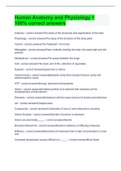
Human Anatomy and Physiology 1 100% correct answers
Human Anatomy and Physiology 1 100% correct answersAnatomy The study of the structures and organization of the body Physiology The study of the functions of the body parts Ventral The "bellyside" / front size Midsagittal Plane vertically dividing the body into equal right and left portions Mediastinum The space between the lungs Cell The basic unit of life; collection of organelles Superior Uppermost or above Ventral Cavity Bellyside cavity that includes thoracic cavity and abdominopelvic cavity ATP Energy; adenosine-triphosphate Atoms Smallest particle of an element that maintains all the characteristics of that element Elements Substance with the same amount of protons and electrons Ion Charged atom Compounds Combination of two or more elements in bonding Atomic Number Number of protons or electrons Atoms are electrically_____ Neutral Brownian Movement Random collisions of diffusing molecules Diffusion Movement of molecules from a high concentration to a low one Increased temperature causes diffusion to _____ Move faster Osmosis Diffusion of water Hypotonic Solute Concentration higher inside than outside. Water moves into cell and causes swelling. Hypertonic Solute Concentration higher outside than inside. Water moves out of cell and causes shrinking. Isotonic Solute concentration equal on inside and outside. Water stays the same in concentration. Neutral pH reading is____ that only _____ has 10^-7; distilled water Buffers Substances that function to prevent radical changes in pH. Act as reservoirs for H+. Donates H+ when H+ concentration falls and accepts when rises. Protoplasm The living content of a cell that is surrounded by a plasma membrane (cell membrane); solution made of water, carbohydrates, proteins, lipids, nucleic acids, and inorganic cells Cytoplasm The protoplasm of a cell excluding the nucleus ; the region of the cell between the cell membrane and the nucleus Nucleus "Control center" of the cell ; a part of the cell containing DNA and RNA and responsible for growth and reproduction ; contains nucleolus ; nucleic pores ; continuous with Endoplasmic Reticulum ; the most prominent organelle Nucleolus The organelle where ribosomes are made, synthesized and partially assembled, located in the nucleus Lysosomes Spheres that contain digestive enzymes ; stores food, maintains and repairs organelles, contains suicide agent for old and damaged cells Chloroplasts Large organelles containing chlorophyll (green pigment) ; composed of double membrane (inner + outer), thylakoids, and stroma (liquid). Where photosynthesis takes place. Mitochondria "Powerhouse" of the cell. Organelle involved in ATP production through cellular respiration (converts energy in food into usable chemical energy) Ribosome Site of protein synthesis ; composed of ribosomal RNA (rRNA) and proteins ; no membrane ; free in cytoplasm (results in proteins made to go anywhere within the cell needed) or bound to Endoplasmic Reticulum (results in proteins made to stay within the ER and/or be transported in vesicles) Plant cell wall is made of_____ cellulose Photosynthesis Occurs in plants; converts light energy (photons), CO2, and H20 into "food"(glucose) and oxygen. 6 CO2 + 12 H2O → C6H12O6 + 6 O2 + 6 H2O Cell membrane is ______, allowing materials to enter and exit. Semi-permeable Cilia Short, hair-like structures made of microtubules that are located on the cell's surface and enable the movement of cells or the movement of materials outside a cell ; small projections for movement Flagella Long, threadlike structures that protrude from the cell's surface and enable movement; large projections for movement Periosteum Tough membrane on outside of bone; protects long bones ; provides nutrient-rich blood for bones cells and is a source of bone - developing cells during growth or after a fracture Osteoclasts Bone-destroying cells; remove bone during remodeling Osteoblasts Bone-forming cells ; spindle shaped cells Osteocytes Develop from osteoblasts ; mature bone cells Ossification The developmental process of bone formation Hemotopoiesis Blood cell formation, occurs in red bone marrow Patella Largest Sesamoid bone Hyoid Only facial bone that doesn't articulate with another bone Atlas The 1st cervical vertebrae (C1); yes bone Axis The 2nd cervical vertebrae (C2) ; no bone Ischium Strongest bone of pelvic girdle; the "sit down" bone Diaphysis The shaft of the long bone; contains compact bone with a central cavity Epiphysis The end of a long bone; externally has compact bone, internally had cancellous (spongy) bone; capped with articular cartilage Bone Growth Occurs at the boundary between the metaphysis and epiphysis (growth plate); epiphyseal line Kyphosis An abnormal outward (backward) curvature of the vertebral column Lordosis An abnormal inward (forward) curvature of the vertebral column Scoliosis An abnormal lateral curve to the vertebral column. True Ribs First 7 pairs of ribs that attach directly to the sternum by individual cartilage False Ribs Ribs 8-10 Floating Ribs Ribs 11-12; Don't attach to the sternum. Ligaments Tissue that connects bone to bone Tendons Tissue that connects muscle to bone Long bone A type of bone that is longer than it is wide; femur, humerus, phalanges ; consist of a Diaphysis and an Epiphysis Short bone Cubelike bones; the length, width, and height measurements are all about the same ; include the carpal bones (hands, wrist) and tarsal bones (feet, ankles) ; orregular Flat bone Thin, usually curved bones located in skull, sternum, ribs, scapulae ; supply protection and excessive muscle attachment Osteoporosis Condition of decreased bone mass, causing bones to become brittle and have an increased susceptibility to fractures. 206 bones There are ____ bones in the skeleton. Manubrium, gladiolus, xiphoid process 3 parts of the sternum are _____, _____ , and _____. Humerus Upper arm bone ; largest bone in the upper extremity Ulna The larger and medial bone of the lower arm Radius The shorter and lateral bone of the lower arm Kneecap General name for "patella" Thigh bone Femur - Heaviest, strongest, and longest bone in the body. Hand bones Carpals, metacarpals, phalanges Ankle bones Tarsals Wrist bones Carpals Heel bone Calcaneus Collar bone Clavicle Breast bone Sternum Shoulder blade Scapula Foot bones Metatarsals In order to prevent the development of osteoporosis, extra calcium is needed in the diet, exercise can help by stimulating the formation of new bone ; Vitamins A and C are necessary for proper bone development ; Vitamin D (from Sun) is necessary for proper absorption of calcium Explain how diet and exercise relates to bone growth and formation. Articulation A place of junction between two or more bones; the point where two bones come together ; a joint Structure; function Joints are classified according to ______ and ______ Synarthoses Types of joints that do not allow any movement Hinge Joint Joints limited to a flexion and extension in on
Written for
- Institution
- Human anatomy and physiology
- Course
- Human anatomy and physiology
Document information
- Uploaded on
- November 22, 2022
- Number of pages
- 9
- Written in
- 2022/2023
- Type
- Exam (elaborations)
- Contains
- Questions & answers
Subjects
-
human anatomy and physiology 1 100 correct answers
-
anatomy the study of the structures and organization of the body
-
physiology the study of the functions of the body part
-
ventral the bellyside

Also available in package deal