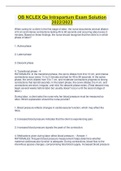
OB NCLEX Qs Intrapartum Exam Solution 2022/2023
OB NCLEX Qs Intrapartum Exam Solution 2022/2023 When caring for a client in the first stage of labor, the nurse documents cervical dilation of 9 cm and intense contractions lasting 45 to 60 seconds and occurring about every 2 minutes. Based on these findings, the nurse should recognize that the client is in which phase of labor? 1. Active phase 2. Latent phase 3. Descent phase 4. Transitional phase - 4 RATIONALES: In the transitional phase, the cervix dilates from 8 to 10 cm, and intense contractions occur every 1½ to 2 minutes and last for 45 to 90 seconds. In the active phase, the cervix dilates from 5 to 7 cm, and moderate contractions progress to strong contractions that last 60 seconds. In the latent phase, the cervix dilates 3 to 4 cm, and contractions are short, irregular, and mild. No descent phase exists. (Fetal descent may begin several weeks before labor but usually doesn't occur until the second stage of labor.) During labor, a client asks the nurse why her blood pressure must be measured so often. Which explanation should the nurse provide? 1. Blood pressure reflects changes in cardiovascular function, which may affect the fetus. 2. Increased blood pressure indicates that the client is experiencing pain. 3. Increased blood pressure signals the peak of the contraction. 4. Medications given during labor affect blood pressure. - Answer: 1 RATIONALES: Frequent blood pressure measurement helps determine whether maternal cardiovascular function is adequate. During contractions, blood flow to the intervillous spaces changes, compromising fetal blood supply. Increased blood pressure is expected during pain and contractions. Measuring blood pressure frequently helps determine whether blood pressure has returned to precontraction levels, ensuring adequate blood flow to the fetus. Although medications given during labor can affect blood pressure, the main purpose of measuring blood pressure is to verify adequate fetal status. Because cervical effacement and dilation aren't progressing in a client in labor, the physician orders I.V. administration of oxytocin (Pitocin). Why must the nurse monitor the client's fluid intake and output closely during oxytocin administration? 1. Oxytocin causes water intoxication. 2. Oxytocin causes excessive thirst. 3. Oxytocin is toxic to the kidneys. 4. Oxytocin has a diuretic effect. - Answer: 1 RATIONALES: The nurse should monitor fluid intake and output because prolonged oxytocin infusion may cause severe water intoxication, leading to seizures, coma, and death. Excessive thirst results from the work of labor and limited oral fluid intake — not oxytocin. Oxytocin has no nephrotoxic or diuretic effects. In fact, it produces an antidiuretic effect. Assessment of a client in active labor reveals meconium-stained amniotic fluid and fetal heart sounds in the upper right quadrant. Which of the following is the most likely cause of this situation? 1. Breech position 2. Late decelerations 3. Entrance into the second stage of labor 4. Multiple gestation - Answer: 1 RATIONALES: Fetal heart sounds in the upper right quadrant and meconium-stained amniotic fluid indicate a breech presentation. The staining is usually caused by the squeezing actions of the uterus on a fetus in the breech position, although late...
Connected book
Written for
- Institution
- OB NCLEX Qs Intrapartum
- Course
- OB NCLEX Qs Intrapartum
Document information
- Uploaded on
- November 22, 2022
- Number of pages
- 26
- Written in
- 2022/2023
- Type
- Exam (elaborations)
- Contains
- Questions & answers
Subjects
- ob nclex qs intrapartum
-
ob nclex qs intrapartum exam solution 20222023
-
when caring for a client in the first stage of labor
-
the nurse documents cervical dilation of 9 cm and intense contractions las

Also available in package deal