PATHO Mod 6 Pulmonary Disorders & Pain
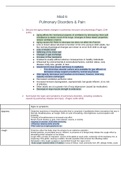
Mod 6 Pulmonary Disorders & Pain 1. Discuss the aging related changes in pulmonary structure and physiology (Pages 1244- 1245). ● Aging affects the mechanical aspects of ventilation by decreasing chest wall compliance & elastic recoil of the lungs. Changes in these elastic properties reduce ventilatory reserve. ● Aging causes the PaO2 to decrease but does not affect the PaCO2. ● Less is known about structure & function in the very young & older adults, but few normal physiological changes are known to occur from birth to old age. ● Loss of elastic recoil ● Stiffening of the chest wall ● Changes in gas exchange ● Increase in flow resistance ● Gradual & usually without adverse consequences in healthy individuals ● Influenced by environmental & sociocultural factors, nutrition status, resp disease, body size, gender, & race. ● Alveoli tend to lose alveoli wall tissue & capillaries ○ This diminishes alveolar surface area available for gas diffusion & decreases airway support provided by normal lung tissues ● Vital capacity decreases and residual vol increases; however, total lung capacity remains unchanged. ● Decreased ventilation-perfusion ratios ● Increased immune dysregulation, asymptomatic low-grade inflamm, & inc risk of infection. ● Older adults are at a greater risk of resp depression caused by medications ● Decrease in resp muscle strength & endurance 2. Summarize the signs and symptoms of pulmonary disorders, including conditions caused by pulmonary disease and injury. (Pages ) Signs & symptoms dyspnea Subjective experience of breathing discomfort that is comprised of qualitatively distinct sensations that vary in intensity. Breathlessness, air hunger, SOB, inc work of breathing, chest tightness, & preoccupation with breathing. *A feeling of breathlessness & increased resp effort. Result of pulm disease or pain, heart disease, trauma, or anxiety. -dyspnea on exertion: SOB while exercising -orthopnea: dyspnea while lying flat -PND: wake up at night gasping for air cough Protective reflex that helps clear the airways by an explosive expiration. Inhaled particles, accumulated mucus, inflamm, or presence of a foreign body initiates the cough reflex by stimulating irritant receptors in the airway. Cough reflex consists of inspiration, closure of the glottis & vocal cords, contraction of the expiratory mm, & reopening of the glottis, causing a sudden, forceful expiration that removes the offending matter. Stimulation of the cough receptors is transmitted through the vagus nerve. -Acute cough: resolves within 2-3 weeks of onset of illness- most commonly from URI, allergic rhinitis, acute bronchitis, pna, chf, PE, or aspiration. -Chronic cough: persistent for more than 3 weeks or 7-8 weeks. Commonly caused by post nasal drip, nonasthmatic eosinophilic bronchitis, asthma, gerd, or heightened cough reflex sensitivity. In smokers, chronic bronchitis is the most common cause of chronic cough. ACE- cough. Abnormal sputum Changes in amount, consistency, color, & odor of sputum provide info about progression of disease & effectiveness of therapy. Hemoptysis: coughing up of blood or bloody secretions. -usually bright red, alkaline pH, mixed with frothy sputum. -indicates infection or inflamm that damages the bronchi or lung. Abnormal breathing patterns Adjustments made by the body to minimize the work of resp muscles. Kussmaul: strenuous exercise or metabolic acidosis cause. (hyperpnea). Slightly increased vent rate, very large tidal volume, & no expiratory pause. Labored breathing: occurs when there is inc work of breathing, esp if airways are obstructed like in COPD. Large airway obs=-slow vent rate, increased effort, prolonged inspiration or exp, stridor (high pitched on inspiration)- or wheezing (on expiration) are typical. Small airway obs= like asthma & copd, rapid vent rate, small tidal vol, inc effort, prolonged expiration, & wheezing. Restricted Breathing: commonly caused by pulmonary fibrosis that stiffen the lungs or chest wall & decrease compliance. - small tidal vol & rapid vent rate (tachypnea) Cheyne-Stokes : alternating periods of deep & shallow breathing. Apnea lasting 15-60 seconds followed by ventilations that incr in volume until a peak is reached, after which tidal vol decreases again until apnea. Usually from neuro impairment above brainstem. hypoventilation Inadequate alveolar ventilation in relation to metabolic demands. Caused by alteration in pulmonary mechanics or in the neuro control of breathing such that minute vol ( tidal vol x resp rate) is reduced. CO2 removal does not keep up with CO2 production & PaCO2 increases, causing hypercapnia. This results in increased hydrogen ion in the blood, respiratory acidosis. -pronounced hypoventilation can cause somnolence or disorientation. Hypovent causes increases in PaCO2 hyperventilation Alveolar ventilation that exceeds metabolic demands. The lungs remove CO2 at a faster rate than it is produced, resulting in a decreased PaCO2. Respiratory alkalosis. Commonly occurs with severe anxiety, acute head injury, & conditions that cause insuff O2 of blood. Hypervent causes decreases in PaCO2
Document information
- Uploaded on
- November 21, 2022
- Number of pages
- 16
- Written in
- 2022/2023
- Type
- Exam (elaborations)
- Contains
- Questions & answers