Psychology Test Review #2 with Complete Solutions
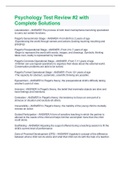
Lateralization - ANSWER The process of both brain hemispheres becoming specialized to carry out certain functions. Piaget's Sensorimotor Stage - ANSWER -From Birth to 2 years of age -Experiencing the world through senses and actions (looking touching mouthing and grasping) Piaget's Preoperational Stage - ANSWER -From 2 to 7 years of age -Begin to represent the world with words, images, and drawings. Symbolic thinking takes over, reality is represented by mentally. Piaget's Concrete Operational Stage - ANSWER -From 7-11 years of age -Children can use logical operations to organize their ideas about the external world. Conservation problems are able to be solved. Piaget's Formal Operational Stage - ANSWER -From 12+ years of age -The capacity for abstract, systematic, scientific thinking are possible. Egocentrism - ANSWER In Piaget's theory, the preoperational child's difficulty taking another's point of view. Animism - ANSWER In Piaget's theory, the belief that inanimate objects are alive and have feelings and intentions. Centration - ANSWER In Piaget's theory, the tendency to focus on one part of a stimulus or situation and exclude all others. Irreversibility - ANSWER In Piaget's theory, the inability of the young child to mentally reverse an action Guided Participation - ANSWER A form of sensitive teaching in which the partner is attuned to the needs of the child and helps him/her accomplish more than the child could alone. Scaffolding - ANSWER Adjusting the support offered during a teaching session to fit the child's current level of performance. Zone of Proximal Development (ZPD) - ANSWER Vygotsky's concept of the difference between what a child can do alone and what that child can do with the help of a teacher. Sustained Attention - ANSWER The ability to remain focused on a stimulus for an extended period of time. Selective Attention - ANSWER The ability to focus on relevant information while ignoring distractors. Episodic Memory - ANSWER Memory acquired from experiencing events. Recognition Memory - ANSWER The ability to generate a recognize a stimulus one has encountered before. Recall Memory - ANSWER The ability to generate a memory of a stimulus encountered before without seeing it. Autobiographical Memory - ANSWER Refers to memory of personally meaningful events that took place at a specific time and place in one's past. Theory of Mind - ANSWER Refers to the awareness of one's own mental processes and the mental processes of others Metacognition - ANSWER Awareness and understanding of one's own thought processes. Scripts - ANSWER General descriptions of what occurs and when it occurs in a particular situation Logical Extension - ANSWER After learning a word, children use it to describe other objects in the same category. For example dalmatian = spotted. A child may see a spotted bunny and call it a dalmatian bunny. Mutual Exclusivity Assumption - ANSWER The assumption within children that all objects have only one label or name. Overregularization Errors - ANSWER Grammatical mistakes young children make when applying grammatical rules to stringently. Example: See! I goed on the slide! False-Belief Tasks - ANSWER Tasks that measure whether children understand that others can believe things that are incorrect. Private Speech - ANSWER The internal dialogue that occurs when people talk to themselves (either silently or out loud). Heteronomous Morality - ANSWER In Piaget's theory of moral development, around age 6 children become aware of rules and view them as sacred and unalterable. AKA Morality of Constraint. Preconventional Morality - ANSWER Lawrence Kohlberg's idea that young children's behavior is governed by self-interest, avoiding punishment, and gaining rewards. "Good" or moral behavior is a response to external pressure. Conservation - ANSWER The understanding that the physical quantity of a substance, such as number, mass, or volume, remains the same even when its appearance changes. Prosocial Behavior - ANSWER Voluntary behavior with the intent to help other people. Instrumental Aggression - ANSWER Aggression used to achieve a goal. Relational Aggression - ANSWER Aggression intended to harm others social relationships. Authoritative Parenting Style - ANSWER Marked by firm and consistent punishment coupled with reason for punishment. Parents are a good amount of warm and firm towards child. This is the best style of parenting. Authoritarian Parenting Style - ANSWER Marked by high control and harsh punishments with no explanation of reason for punishment. Parents are not very warm towards child. Permissive Parenting Style - ANSWER Marked by little control and little to no punishment. Parents are usually loving and warm towards child. Neglectful/Uninvolved Parenting Style - ANSWER Parents do not show attempts of control or punishment on child. Parents seem to not care about child's outcome. Inductive Discipline - ANSWER A discipline strategy in which parents explain to children why a punished behavior is wrong. This is the most healthy of all disciplines. Gender Role Norms - ANSWER Society's expectations or standards concerning what males and females should be like. Gender Typing - ANSWER The acquisition of a traditional masculine or feminine role. Acceptance-Responsiveness - ANSWER The extent of a parent being aware of their child's needs. Demandingness-Control - ANSWER How much control parents exert over their children. Heritability - ANSWER The proportion of variation among individuals that we can attribute to genes. Heritability is a population statistic that does not apply to individuals.
Written for
- Institution
- Psychology
- Course
- Psychology
Document information
- Uploaded on
- November 21, 2022
- Number of pages
- 6
- Written in
- 2022/2023
- Type
- Exam (elaborations)
- Contains
- Questions & answers
Subjects
- psychology
- psychology test review 2
- piaget
-
psychology test review 2 with complete solutions
-
lateralization the process of both brain hemispheres becoming specialized to carry out certain functions

Also available in package deal