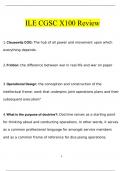
X100 CGSC 7 Exam with complete solutions
Army force management model - ANSWER "system of systems" approach that is designed to generate trained and ready units for the Combatant Commanders (CCDRs); Army Force Management Model steps - ANSWER 1) Determine strategic requirements, 2) develop required capabilities 3a) Design organizations 3b) acquire material solutions 4) develop organizational models 5)determine authorizations 6) document org authorizations 7) acquire, train, distro personnel and equipment Range of military operations across conflict continuum - ANSWER military engagement, security cooperation, and deterrence; crisis response and limited contingency operations; and large-scale combat operations. Unified action - ANSWER the combination of Comprehensive approach (mil cooperation with NGOs/IGOs) + whole of government approach (mil cooperation w/ OGAs) + unity of command in joint and multinational operations = unity of effort What are instruments of national power and what are their purpose? - ANSWER DIME; national-level means our national leaders can apply in various ways to achieve strategic objectives (ends). OPCON - ANSWER Operational control is a delegate-able authority from COCOM characterized by the ability to task and organize subordinate forces TACON - ANSWER Tactical Control is a delegateable authority from COCOM characterized by limited control of movement and maneuver of a subordinate force during a mission; no task organization control or admin support General support - ANSWER support that is given to the supported force as a whole rather than to a particular subdivision thereof. Direct support - ANSWER A mission requiring a force to support another specific force and authorizing it to answer directly to the supported force's request for assistance. Mutual support - ANSWER That support that units render each other against an enemy because of their assigned tasks, their position relative to each other and to the enemy, and their inherent capabilities. Close support - ANSWER support against targets or objectives sufficiently near the supported force as to require detailed integration or coordination with the fire, movement, or other actions of the supported force. Offensive task - ANSWER task conducted to defeat and destroy enemy forces and seize terrain, resources, and population centers Offensive tasks - ANSWER movement to contact, attack, exploitation, and pursuit. Movement to Contact - ANSWER offensive task designed to develop the situation and establish or regain contact What is an attack and what forms are there? - ANSWER offensive task that destroys or defeats enemy forces, seizes and secures terrain, or both; ambush, counterattack, demonstration, feint, raid, and spoiling attack. Exploitation - ANSWER offensive task that usually follows the conduct of a successful attack and is designed to disorganize the enemy in depth Pursuit - ANSWER offensive task designed to catch or cut off a hostile force attempting to escape, with the aim of destroying it Six forms of maneuver - ANSWER envelopment, turning movement, frontal attack, penetration, infiltration, and flank attack. Envelopment - ANSWER form of maneuver where attacking force avoids the enemy defenses by seizing objectives behind those defenses to destroy the enemy in their current positions. Turning movement - ANSWER form of maneuver in which the attacking force avoids the enemy's defensive positions by seizing objectives behind the enemy's current positions thereby causing the enemy force to move out of their current positions or divert major forces to meet the threat. Infiltration - ANSWER form of maneuver in which an attacking force conducts undetected movement through or into an area occupied by enemy forces to occupy a position of advantage behind those enemy positions while exposing only small elements to enemy defensive fires. Penetration - ANSWER form of maneuver in which an attacking force seeks to rupture enemy defenses on a narrow front to disrupt the defensive system. Frontal attack - ANSWER form of maneuver in which an attacking force seeks to destroy a weaker enemy force or fix a larger enemy force in place over a broad front. Flank Attack - ANSWER form of offensive maneuver directed at the flank of an enemy. Characteristics of offense - ANSWER surprise, concentration, tempo, and audacity Purpose of defense - ANSWER create conditions for a counteroffensive that allows Army forces to regain the initiative; Retaining decisive terrain or denying a vital area to the enemy; Attriting or fixing the enemy as a prelude to offensive actions; Surprise action by the enemy; Increasing the enemy's vulnerability by forcing the enemy to concentrate subordinate forces. defensive task purpose - ANSWER task conducted to defeat an enemy attack, gain time, economize forces, and develop conditions favorable for offensive or stability tasks Defensive tasks - ANSWER the area defense, the mobile defense, and the retrograde Area Defense - ANSWER defensive task that concentrates on denying enemy forces access to designated terrain for a specific time rather than destroying the enemy outright Mobile defense - ANSWER defensive task that concentrates on the destruction or defeat of the enemy through a decisive attack by a striking force Retrograde - ANSWER defensive task that involves organized movement away from the enemy Forms of defense - ANSWER Defense of a linear obstacle, Perimeter defense, Reverse slope defense Philosophy of mission command - ANSWER exercise of authority and direction by the commander using mission orders to enable disciplined initiative within the commander's intent to empower agile and adaptive leaders in the conduct of Unified Land Operations 6 Principles of mission command - ANSWER Build cohesive teams through mutual trust, create shared understanding, provide a clear commander's intent, exercise disciplined initiative, use mission orders, and accept prudent risk. Minimum essential stability tasks - ANSWER provide for minimum levels of security, food, water, shelter, and medical treatment of civilians in your area of operations as you encounter them Primary army stability tasks - ANSWER Establish civil security • Establish civil control • Restore essential services • Support to governance • Support to economic and infrastructure development Stability framework - ANSWER Distinct phases in which specific essential stability tasks should be conducted: Initial response phase - stabilize an operational environment in a crisis state Transformation phase - post-conflict reconstruction, stabilization, and capacity-building tasks Fostering sustainability phase - long-term efforts to enable sustainable development Security cooperation - ANSWER all Department of Defense interactions with foreign defense establishments to build defense relationships that promote specific United States security interests, develop allied and friendly military capabilities for self-defense and multinational operations, and provide United States forces with peacetime and contingency access to a host nation Security force assistance - ANSWER support the development of the capacity and capability of foreign security forces and their supporting institutions Stability mechanisms - ANSWER Compel, control, influence, support DOTMLPF-P - ANSWER Organizational requirements for changes or additions to doctrine, organization, training, material, leadership and education, personnel, facilities, policies identified in JCIDS process Ethical triangle - ANSWER 1) principles - what is my moral obligation based on defined rules (law, Army Values)? 2) consequences - what does the greatest good for the greatest number of people? 3) virtues - what kind of person do I want to be (golden rule)? Analyze possible decisions to ethical dilemmas where no right answer exists by this triangle to understand and justify your decision Jus in bellum - ANSWER Just conduct during war based on discrimination of targets and proportionality of weapons and tactics Jus ad bellum - ANSWER Justification for initiating a war based on proper authority, just cause, right intention, probability of success, as a last resort, and macroproportionality Direct leadership - ANSWER face-to-face or first-line leadership; generally in teams, squads, sections, platoons, departments, companies, batteries, and troops; span of influence may range from a few to dozens of people; more certainty and less complexity than organizational and strategic leaders. Organizational leadership - ANSWER influence several hundred to several thousand people at battalion through corps levels indirectly, generally through more levels of subordinates and staffs using policies, visions, climate, culture and systems Strategic leadership - ANSWER Influence several thousand or more people at COCOM level or higher through resource allocation and strategic vision; decisions can affect more people, commit more resources, and have wider-ranging consequences in space, time, and political impact, than those of organizational and direct leaders; highest level of complexity of problems and uncertainty in decisions Commitment-focused organizational change - ANSWER (Climate first) When leaders change their subordinates' thinking first through a supportive mutually trusting command climate which creates commitment and changes behavior slowly over time Compliance-focused organizational change - ANSWER (Culture first) When leaders change their subordinates' behavior first through compliance and change their thinking (and the organizational climate) later Integrative organizational change - ANSWER When leaders integrate commitment and compliance based on the appropriate situations for each; compliance is best suited for more immediate requirements like combat operations while commitment is more suited for longer term objectives position power - ANSWER Power based on legitimate authority of position to reward or punish subordinates Personal Power - ANSWER Power based on your expertise (expert power) or personal relationships with subordinates (referents power) Influence tactics continuum - ANSWER Hard influence tactics gain compliance (pressure, orders); soft tactics may gain commitment (ingratiation, inspiration, buy-in, participation, relationships); rational tactics most useful for peers (persuasion, favors, personal benefit, collaboration) Primary embedding mechanisms - ANSWER Methods for embedding a behavior within a culture by changing what you pay attention to, how you react to crises, how you mentor, what you allocate resources to, who you recruit, what you reward and what you punish Secondary reinforcing mechanisms - ANSWER Methods that reinforce primary embedding mechanisms in shaping a culture through organizational design, procedures, rituals, stories, and formal statements emotional intelligence - ANSWER self-awareness, self-management, social awareness, relationship management that allow a leader to apply correct influence tactic at the right time for the right person Vision process purpose - ANSWER A process to develop a meaningful vision that addresses necessary change within an organization, to develop specific goals to measure accomplishment of the vision's implementation, and gain buy in for the vision from the organization Kotter Model for Leading Change - ANSWER 1) create sense of urgency 2) create a guiding coalition 3) develop a vision 4) communicate the vision 5) empower action 6) generate short term wins 7) consolidate gains 8) anchor the change in the culture What is the difference between MDMP and JPP? - ANSWER JPP is inherently strategic or operational, joint, multinational, multidomain, and interagency - MDMP is Army only, land-centric, operational or tactical JPP is conceptual and objective-focused - MDMP is detailed planning for execution of tasks JPP is initiated when a plan is needed - MDMP is initiated from higher WARNORD What is a Center of Gravity and what are its critical factors? - ANSWER Moral or physical strength of an element, reason for its will to act or what provides its freedom of action; critical capabilities, requirements, and vulnerabilities Elements of Operational Design (Joint) - ANSWER Termination criteria, endstate*, objectives, effects, center of gravity*, decisive points*, lines of operation and effort*, indirect and direct approaches, anticipation, operational reach*, culmination*, arranging operations, forces and functions; used to create an operational approach to get from current operating environment to desired endstate Operational art (JPP) - ANSWER link strategic objectives to tactical tasks through use of ends, ways, and means to attain the desired end state Operational design - ANSWER Meth
Written for
- Institution
- X100 CGSC 7
- Course
- X100 CGSC 7
Document information
- Uploaded on
- November 20, 2022
- Number of pages
- 12
- Written in
- 2022/2023
- Type
- Exam (elaborations)
- Contains
- Questions & answers
Subjects
- x100 cgsc 7
- unified action
-
x100 cgsc 7 exam with complete solutions
-
army force management model
-
army force management model steps
-
range of military operations across conflict continuum