4.1 - Fluid Mosaic Membranes:
Phospholipid Bilayer membranes (7nm):
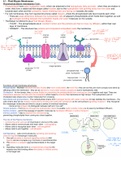
• Phospholipids have polar hydrophilic heads which are attached to the hydrophobic fatty acid tails - when they are shaken in
water, they form a stable ball-like shape called micelles due to the hydrophobic tails pointing away from the water and
towards each other and the hydrophilic heads shielding them and facing out towards the water.
• For cell membranes, they form layered structures called bilayers, where the phospholipid tails face towards each other.
◦There are weak attractions between the hydrophobic tails of adjacent phospholipids which holds them together, as well
as hydrogen bonding between the hydrophilic heads and water molecules on the outside.
• The Bilayer is referred to as a Fluid Mosaic Model...
◦‘FLUID’ - The phospholipids are in constant motion and the proteins are free to move, by di usion, within their own
layer of membrane.
◦‘MOSAIC’ - The structure has proteins and cholesterol embedded inside the membrane.
Functions of Cell membrane structures:
Phospholipids - Maintain structure and also uidity (the more unsaturated, the more uid they are as they are more compact and bent) by
di using within the membrane - they act as barriers to most water-soluble substances due to hydrophobic tails.
Cholesterol - At low temps, they increase uidity by preventing the phospholipids from coming too close together and rigid. There are
interactions between the tails with the cholesterol which helps to stabilise the membrane at high temps. The hydrophobic part of
cholesterol also stops ions or polar molecules from crossing.
Glycolipids and glycoproteins - The carbohydrate chains form hydrogen bonds with water molecules to help stabilise the membrane - the
carb chains also act as receptor molecules by binding with particular substances at the cell surface (signalling receptors - they recognise
the messenger molecules and bind to cause a series of chemical reactions).
- Some act as antigens to distinguish between self and ‘non-self’.
Chanel proteins - Form a pore through the hydrophobic interior to enable water soluble molecules to pass by facilitated di usion.
Carrier proteins - permit the passage of speci c molecules by facilitated di usion or active transport.
Intrinsic proteins - help to stabilise the membranes by
preventing phospholipids from coming too close together.
The role of the Plasma membrane:
• controls the entry and exit of chemicals in and out of the cells.
• Allows cells to communicate with each other - cell signalling
• Allows cells to recognise each other - cell recognition
• Allows cells to join together - cell adhesion.
Cell Signalling - cells communicate by secreting and receiving
chemical signals/messenger molecules:
1. One cell secretes a chemical signalling molecule AKA
ligands across a synapse e.g. hormone or neurotransmitter.
2. This binds to a receptor (glycoproteins/lipid) on the target
cell.
3. Signalling molecules form a complementary shape to the
receptor and this binding either stimulates or inhibits activity
in the target cell.
Phospholipid Bilayer membranes (7nm):
• Phospholipids have polar hydrophilic heads which are attached to the hydrophobic fatty acid tails - when they are shaken in
water, they form a stable ball-like shape called micelles due to the hydrophobic tails pointing away from the water and
towards each other and the hydrophilic heads shielding them and facing out towards the water.
• For cell membranes, they form layered structures called bilayers, where the phospholipid tails face towards each other.
◦There are weak attractions between the hydrophobic tails of adjacent phospholipids which holds them together, as well
as hydrogen bonding between the hydrophilic heads and water molecules on the outside.
• The Bilayer is referred to as a Fluid Mosaic Model...
◦‘FLUID’ - The phospholipids are in constant motion and the proteins are free to move, by di usion, within their own
layer of membrane.
◦‘MOSAIC’ - The structure has proteins and cholesterol embedded inside the membrane.
Functions of Cell membrane structures:
Phospholipids - Maintain structure and also uidity (the more unsaturated, the more uid they are as they are more compact and bent) by
di using within the membrane - they act as barriers to most water-soluble substances due to hydrophobic tails.
Cholesterol - At low temps, they increase uidity by preventing the phospholipids from coming too close together and rigid. There are
interactions between the tails with the cholesterol which helps to stabilise the membrane at high temps. The hydrophobic part of
cholesterol also stops ions or polar molecules from crossing.
Glycolipids and glycoproteins - The carbohydrate chains form hydrogen bonds with water molecules to help stabilise the membrane - the
carb chains also act as receptor molecules by binding with particular substances at the cell surface (signalling receptors - they recognise
the messenger molecules and bind to cause a series of chemical reactions).
- Some act as antigens to distinguish between self and ‘non-self’.
Chanel proteins - Form a pore through the hydrophobic interior to enable water soluble molecules to pass by facilitated di usion.
Carrier proteins - permit the passage of speci c molecules by facilitated di usion or active transport.
Intrinsic proteins - help to stabilise the membranes by
preventing phospholipids from coming too close together.
The role of the Plasma membrane:
• controls the entry and exit of chemicals in and out of the cells.
• Allows cells to communicate with each other - cell signalling
• Allows cells to recognise each other - cell recognition
• Allows cells to join together - cell adhesion.
Cell Signalling - cells communicate by secreting and receiving
chemical signals/messenger molecules:
1. One cell secretes a chemical signalling molecule AKA
ligands across a synapse e.g. hormone or neurotransmitter.
2. This binds to a receptor (glycoproteins/lipid) on the target
cell.
3. Signalling molecules form a complementary shape to the
receptor and this binding either stimulates or inhibits activity
in the target cell.