Chapter 5 - The Time Value of Money
After studying this chapter, you should be able to:
5.1 Calculate the future value of money that is invested at a particular interest rate
5.2 Calculate the present value of a future payment
5.3 Calculate present and future values of a level stream of cash payments
5.4 Compare interest rates quoted over different time intervals - for example, monthly versus
annual rates.
5.5 Understand the difference between real and nominal cash flows and between real and
nominal interest rates.
5.1 Future Values and Compound Interest
Interest = interest rate x initial investment
Value of investment after 1 year = initial investment + interest
= initial investment x (1 + r)
Value of investment after 2 years = initial investment x (1 + r)^2
Future value (FV), amount to which an investment will grow after earning interest.
- rate = r
- years = t
Future value (FV) = initial investment x (1 + r)^t
The interest income changes with the year. Your income in the second year is higher
because you now earn interest on both the original investment and the interest earned in the
previous year.
- Earning interest on interest is called compounding or compound interest (= interest
earned on interest).
- In contrast, if the bank calculated the interest only on you original investment, you
would be paid simple interest (= interest earned only on the original investment; no
interest is earned on interest). The formula stays initial investment x (1+r) every
year.
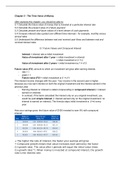
How your savings grow; the future value of $100 invested to earn 6% with compound
interest:
→ The higher the rate of interest, the faster your savings will grow.
→ Compound growth means that value increases each period by the factor
(1+growth rate). The value after t periods will equal the initial value times
(1+growth rate)^t. When money is invested at compound interest, the growth
rate is the interest rate.
, 5.2 Present Values
‘A dollar today is worth more than a dollar tommorrow’
How much do we need to invest now in order to product $106 at the end of the
year? → What is the present value (PV) of the $106 payoff?
- To calculate future value, we multiply today’s investment by 1 plus the interst rate,
0.6 or 1.06.
- To calculate present value, we simply reverse the process and divide the future value
by 1.06:
Present value = PV = future value after t periods / (1 + r)^t
To calculate present value, we discounted the future value at the interest rate r. The
calculation is therefore termed a discounted cash-flow (=method of calculating present
value by discounting future cash flows) calculation, and the interest rate r is known as the
discount rate (= interest rate used to compute present values of future cash flows).
To work out how much you will have in the future if you invest for t years at an interest rate r,
multiply the initial investment by (1+r)^t. To find the present value of a future payment, run
the process in reverse and divide by (1+r).
- Present values are always calculated using compound interest.
- In contrast, present values decline, other things equal, when future cash payments
are delayed. The longer you have to wait for money, the less it’s worth today.
The present value formula is sometimes written differently. Insead of dividing the future
payment by (1+r)^t, we could equally well multiply it by 1/(1+r)^t.
PV = future payment / (1+r)^t = future payment x 1 / (1+r)^t
The expression 1/(1+r)^t is called the discount factor (= present value of a $1 future
payment). It measures the present value of $1 received in year t.
Strip, a U.S. Treasury security that pays a single cash flow at a specified future date.
It is really important to use present values when comparing alternative patterns of cash
payment. You should never compare cash flows occurring at different times without first
discounting them to a common date. By calculating present values, we see how much cash
must be set aside today to pay future bills.
Finding the Interest Rate
Sometimes you are given the price and have to calculate the interest rate that is being
offered. To answer a question like ‘What is the interest rate, r?’, you can rearrange the
equation and use your calculator.
5.3 Multiple Cash Flows
When there are many payments, you’ll hear managers refer to a stream of cash flows.
After studying this chapter, you should be able to:
5.1 Calculate the future value of money that is invested at a particular interest rate
5.2 Calculate the present value of a future payment
5.3 Calculate present and future values of a level stream of cash payments
5.4 Compare interest rates quoted over different time intervals - for example, monthly versus
annual rates.
5.5 Understand the difference between real and nominal cash flows and between real and
nominal interest rates.
5.1 Future Values and Compound Interest
Interest = interest rate x initial investment
Value of investment after 1 year = initial investment + interest
= initial investment x (1 + r)
Value of investment after 2 years = initial investment x (1 + r)^2
Future value (FV), amount to which an investment will grow after earning interest.
- rate = r
- years = t
Future value (FV) = initial investment x (1 + r)^t
The interest income changes with the year. Your income in the second year is higher
because you now earn interest on both the original investment and the interest earned in the
previous year.
- Earning interest on interest is called compounding or compound interest (= interest
earned on interest).
- In contrast, if the bank calculated the interest only on you original investment, you
would be paid simple interest (= interest earned only on the original investment; no
interest is earned on interest). The formula stays initial investment x (1+r) every
year.
How your savings grow; the future value of $100 invested to earn 6% with compound
interest:
→ The higher the rate of interest, the faster your savings will grow.
→ Compound growth means that value increases each period by the factor
(1+growth rate). The value after t periods will equal the initial value times
(1+growth rate)^t. When money is invested at compound interest, the growth
rate is the interest rate.
, 5.2 Present Values
‘A dollar today is worth more than a dollar tommorrow’
How much do we need to invest now in order to product $106 at the end of the
year? → What is the present value (PV) of the $106 payoff?
- To calculate future value, we multiply today’s investment by 1 plus the interst rate,
0.6 or 1.06.
- To calculate present value, we simply reverse the process and divide the future value
by 1.06:
Present value = PV = future value after t periods / (1 + r)^t
To calculate present value, we discounted the future value at the interest rate r. The
calculation is therefore termed a discounted cash-flow (=method of calculating present
value by discounting future cash flows) calculation, and the interest rate r is known as the
discount rate (= interest rate used to compute present values of future cash flows).
To work out how much you will have in the future if you invest for t years at an interest rate r,
multiply the initial investment by (1+r)^t. To find the present value of a future payment, run
the process in reverse and divide by (1+r).
- Present values are always calculated using compound interest.
- In contrast, present values decline, other things equal, when future cash payments
are delayed. The longer you have to wait for money, the less it’s worth today.
The present value formula is sometimes written differently. Insead of dividing the future
payment by (1+r)^t, we could equally well multiply it by 1/(1+r)^t.
PV = future payment / (1+r)^t = future payment x 1 / (1+r)^t
The expression 1/(1+r)^t is called the discount factor (= present value of a $1 future
payment). It measures the present value of $1 received in year t.
Strip, a U.S. Treasury security that pays a single cash flow at a specified future date.
It is really important to use present values when comparing alternative patterns of cash
payment. You should never compare cash flows occurring at different times without first
discounting them to a common date. By calculating present values, we see how much cash
must be set aside today to pay future bills.
Finding the Interest Rate
Sometimes you are given the price and have to calculate the interest rate that is being
offered. To answer a question like ‘What is the interest rate, r?’, you can rearrange the
equation and use your calculator.
5.3 Multiple Cash Flows
When there are many payments, you’ll hear managers refer to a stream of cash flows.