Lecture 1 Structure and function of nerve cells
From chemical elements to cell membrane:
• Oxygen, carbon (sugar & fats), hydrogen are the most present elements in our body
Bonding elements:
• Ionic bond (electrostatic) force: + attracts -
• Covalent bond (sharing of electrons to form molecules): e.g. H combines with O and
forms H2O (more centered around O because the proton is more positively charged
and therefore attracts more negatively charged neutron→ by sharing electrons both
atoms will be fully filled and ‘happy’
Carbon chains:
• Glucose (sugar) C6H12O6
• Amino acid (extra Nitrgogen atom)
• Protein: are coupled amino acids
- Peptides: short protein chains
• Lipids (fat) (long carbon chains)
Phospholipids: Carbon chains connected by an extra phosphate
(P) group
• Hydorphilic: has a negative charge and is consequently, and is thus attracted to water → The
head contains Phosphate
• Hydrophobic: don’t have an electrical charge and thus not attracted to water →The tails are
fatty acids (Lipids (fats))
- Double layer of phospholipids forms the cell membrane → the head are orientated towards
the water Colom and the tails are orientated towards each other
Nerve cells: global function neurons
• Dendrites (receive signals) → soma (=cell body) (integrate signals)→ axon (send signals) →
terminal buttons (passes on the signal to other neurons)
- Meylin sheath: fatty layers around the axon that speeds up the signal that is transported
through the axon
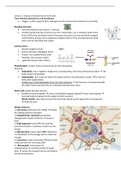
Global structure:
1: Cell nucleus with pores for mRNA → Recepy
for making proteins) transport
2: Endoplasmatic reticulum (production,
storage and transport proteins) → recepy is
read
3: Golgi apparatus: post office for packing
(neurotransmitter in vesicles) → packs up the
recepy
4: Mitochondria: power plant (ATP: Adenosine
Tri-Phosphate → the energy used to make the
recepy)
5: Lysosomes: waste processing →brakes down
molecules that are not being used
6: : Microtubuli: road system for
transportation of neurotransmitter through
axon → moves the recepy from the cell body to
the terminal buttons
,Cell nucleus and protein production:
• Nucleus contains chromosomes with genes (pieces of DNA: DeoxyriboNucleic
Acid) → provide recepy to make certain proteins
• Transcription: genes are read from the DNA and converted to mRNA
(messenger RNA)→ mRNA leaves the nucleus through the pores, and the
recepy is read out by ribosomes (complex of proteins), to form a protein
Axoplasmic transport:
• Kinesin: anterograde transport from the cell body (soma) to terminal buttons
• Dynein: retrograde transport from terminal buttons to soma (recycling
mechanism; transports it to the Lysosomes)
Glia cells (support cells):
• Microglia: immunologic defense and removal of dead cells
• Macroglia:
- Oligodendrocytes: creates myelin sheath around the axon in our CNS (multiple myelin
sheets)
- Schwann cells: creates myelin sheath around the axon in our in PNS (single sheet of myelin)
- Astrocytes:
o structure and solidity (glia = glue) (attaches neurons with each other)
o isolate synaptic clefts → keeps the terminal buttons of one neuron in contact with
the dendrites of another neurons
o Feeding neurons with glucose → because it is connected with the blood vessel it can
bypasses the Blood-brain-barrier for important substances e.g. glucose
Bioelectricity: membrane potential
• Neuron is a small battery!
• Inside of cell is negatively charged relative to the outside (-65 mV in humans)
Membrane potential origin →The membrane potential is caused by a balance between two forces:
• Diffusion: Due to random motion, particles will move from regions with high concentration
to regions with low concentration
• Electrostatics: Oppositely charged particles (+,-) attract each other
(+ repel + and – repel - )
The membrane contains io specific channels (Na+= sodium, K+=
potassium), Cl-, etc):
• Will open and close due to changes in voltages
• Outside cell: many Na+ en Cl-, want to move in (diffusion)
• Cl- remains out because of the electrostatic
force
• Na+ driven inward by both diffusion and
electrostatic forces (does leak in, but
transported to the outside by Na+-K+ pump to
keep it in balance)
• Inside cell: many K+ en A- (negatively charged
proteins made by the DNA), that want to go out
(diffusion) → A- can’t because they are to big
(cannot pass membrane channel)
, • K+ retained by electrostatic force (also some are leaked out but are pumped back at the same
rate by the Na+-K+ pump to keep it in balance)
Sodium-Potassium pump maintains membrane potential
• Higher Na+ concentration outside cell due to Na+-K+ pomp → for every 3
sodium ios pumped out, 2 potassium ions will be pumped in → therefor
higher potassium ions concentration inside
• Active 24/7 → highly energy consuming (ATP)!!
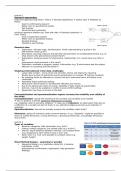
Action potential:
• Electric stimulation of the axon induces an action potential
• The axon generates an action potential only if the resting potential
crosses a threshold (e.g. from -70mV to -60mV)
• Al-or-none law: The magnitude of the action potential is always the
same!! → only the frequency can change
Action potential mechanism:
• Electrical stimulation causes the membrane potential to be less negative
• If a threshold is crossed (-70mV to -60mV) a cascade starts:
1. More Na+ channels are opened, Na+ flows into the cell, cell inside becomes
less negative (depolarisation)
2. K+ channels open, K+ flows out the cell, will counteract the electrical effect
of the Na+ inflow (potassium wants to go out due to diffusion)
3. Na+ channels close (refractory period), Na+ inflow is halted.
4. K+ keeps flowing out, cell inside returns to negative (repolarisation)
5. K+ channels close, Na+ channels return to their normal closed condition (can be opened
again)
6. Following the massive outflow of K+, the membrane temporarily has an extra negative charge
(hyperpolarisation) → relative refractory period
Action potential conduction: The first action potential triggers a domino effect in the axon → in this
way an action potential can be conducted along the axon → But this type of conduction is:
• Relatively slow - new action potentials are generated in neighboring regions
• Energy consuming – resting potential needs to be recovered across the whole axon, by
means of the Na+-K+ pumps
Myelin (passive conduction): An action potential can also be conducted passively (without new
action potentials).
• This is much faster, but the signal decays strongly with distance! → Solution: saltatory
conduction:
- Axon covered with pieces of myelin that prevent the generation of action potentials .
- Action potential is conducted passively through the myelin
- A new action potential is generated at the myelin interruptions (nodes of Ranvier)
Advantages myelin conduction:
• Saltatory conduction is faster (partly passive and fast through myelin)
• Saltatory conduction is energy efficient (no action potentials in myelin regions)
From chemical elements to cell membrane:
• Oxygen, carbon (sugar & fats), hydrogen are the most present elements in our body
Bonding elements:
• Ionic bond (electrostatic) force: + attracts -
• Covalent bond (sharing of electrons to form molecules): e.g. H combines with O and
forms H2O (more centered around O because the proton is more positively charged
and therefore attracts more negatively charged neutron→ by sharing electrons both
atoms will be fully filled and ‘happy’
Carbon chains:
• Glucose (sugar) C6H12O6
• Amino acid (extra Nitrgogen atom)
• Protein: are coupled amino acids
- Peptides: short protein chains
• Lipids (fat) (long carbon chains)
Phospholipids: Carbon chains connected by an extra phosphate
(P) group
• Hydorphilic: has a negative charge and is consequently, and is thus attracted to water → The
head contains Phosphate
• Hydrophobic: don’t have an electrical charge and thus not attracted to water →The tails are
fatty acids (Lipids (fats))
- Double layer of phospholipids forms the cell membrane → the head are orientated towards
the water Colom and the tails are orientated towards each other
Nerve cells: global function neurons
• Dendrites (receive signals) → soma (=cell body) (integrate signals)→ axon (send signals) →
terminal buttons (passes on the signal to other neurons)
- Meylin sheath: fatty layers around the axon that speeds up the signal that is transported
through the axon
Global structure:
1: Cell nucleus with pores for mRNA → Recepy
for making proteins) transport
2: Endoplasmatic reticulum (production,
storage and transport proteins) → recepy is
read
3: Golgi apparatus: post office for packing
(neurotransmitter in vesicles) → packs up the
recepy
4: Mitochondria: power plant (ATP: Adenosine
Tri-Phosphate → the energy used to make the
recepy)
5: Lysosomes: waste processing →brakes down
molecules that are not being used
6: : Microtubuli: road system for
transportation of neurotransmitter through
axon → moves the recepy from the cell body to
the terminal buttons
,Cell nucleus and protein production:
• Nucleus contains chromosomes with genes (pieces of DNA: DeoxyriboNucleic
Acid) → provide recepy to make certain proteins
• Transcription: genes are read from the DNA and converted to mRNA
(messenger RNA)→ mRNA leaves the nucleus through the pores, and the
recepy is read out by ribosomes (complex of proteins), to form a protein
Axoplasmic transport:
• Kinesin: anterograde transport from the cell body (soma) to terminal buttons
• Dynein: retrograde transport from terminal buttons to soma (recycling
mechanism; transports it to the Lysosomes)
Glia cells (support cells):
• Microglia: immunologic defense and removal of dead cells
• Macroglia:
- Oligodendrocytes: creates myelin sheath around the axon in our CNS (multiple myelin
sheets)
- Schwann cells: creates myelin sheath around the axon in our in PNS (single sheet of myelin)
- Astrocytes:
o structure and solidity (glia = glue) (attaches neurons with each other)
o isolate synaptic clefts → keeps the terminal buttons of one neuron in contact with
the dendrites of another neurons
o Feeding neurons with glucose → because it is connected with the blood vessel it can
bypasses the Blood-brain-barrier for important substances e.g. glucose
Bioelectricity: membrane potential
• Neuron is a small battery!
• Inside of cell is negatively charged relative to the outside (-65 mV in humans)
Membrane potential origin →The membrane potential is caused by a balance between two forces:
• Diffusion: Due to random motion, particles will move from regions with high concentration
to regions with low concentration
• Electrostatics: Oppositely charged particles (+,-) attract each other
(+ repel + and – repel - )
The membrane contains io specific channels (Na+= sodium, K+=
potassium), Cl-, etc):
• Will open and close due to changes in voltages
• Outside cell: many Na+ en Cl-, want to move in (diffusion)
• Cl- remains out because of the electrostatic
force
• Na+ driven inward by both diffusion and
electrostatic forces (does leak in, but
transported to the outside by Na+-K+ pump to
keep it in balance)
• Inside cell: many K+ en A- (negatively charged
proteins made by the DNA), that want to go out
(diffusion) → A- can’t because they are to big
(cannot pass membrane channel)
, • K+ retained by electrostatic force (also some are leaked out but are pumped back at the same
rate by the Na+-K+ pump to keep it in balance)
Sodium-Potassium pump maintains membrane potential
• Higher Na+ concentration outside cell due to Na+-K+ pomp → for every 3
sodium ios pumped out, 2 potassium ions will be pumped in → therefor
higher potassium ions concentration inside
• Active 24/7 → highly energy consuming (ATP)!!
Action potential:
• Electric stimulation of the axon induces an action potential
• The axon generates an action potential only if the resting potential
crosses a threshold (e.g. from -70mV to -60mV)
• Al-or-none law: The magnitude of the action potential is always the
same!! → only the frequency can change
Action potential mechanism:
• Electrical stimulation causes the membrane potential to be less negative
• If a threshold is crossed (-70mV to -60mV) a cascade starts:
1. More Na+ channels are opened, Na+ flows into the cell, cell inside becomes
less negative (depolarisation)
2. K+ channels open, K+ flows out the cell, will counteract the electrical effect
of the Na+ inflow (potassium wants to go out due to diffusion)
3. Na+ channels close (refractory period), Na+ inflow is halted.
4. K+ keeps flowing out, cell inside returns to negative (repolarisation)
5. K+ channels close, Na+ channels return to their normal closed condition (can be opened
again)
6. Following the massive outflow of K+, the membrane temporarily has an extra negative charge
(hyperpolarisation) → relative refractory period
Action potential conduction: The first action potential triggers a domino effect in the axon → in this
way an action potential can be conducted along the axon → But this type of conduction is:
• Relatively slow - new action potentials are generated in neighboring regions
• Energy consuming – resting potential needs to be recovered across the whole axon, by
means of the Na+-K+ pumps
Myelin (passive conduction): An action potential can also be conducted passively (without new
action potentials).
• This is much faster, but the signal decays strongly with distance! → Solution: saltatory
conduction:
- Axon covered with pieces of myelin that prevent the generation of action potentials .
- Action potential is conducted passively through the myelin
- A new action potential is generated at the myelin interruptions (nodes of Ranvier)
Advantages myelin conduction:
• Saltatory conduction is faster (partly passive and fast through myelin)
• Saltatory conduction is energy efficient (no action potentials in myelin regions)