
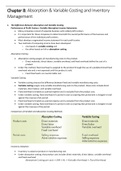
Chapter 8: Absorption & Variable Costing and Inventory
Management
1. The Difference Between Absorption and Variable Costing
Performance of Profit Centers: Variable Absorption Income Statements
Many companies consist of separate business units called profit centers.
It is important for these companies to determine both the overall performance of the business and
performance of the individual profit centers.
Must develop a segmented income statement for each profit center.
Two methods of computing income have been developed:
o one based on variable costing and
o the other based on full or absorption costing.
Absorption Costing
Absorption costing assigns all manufacturing costs to the product.
o Direct materials, direct labour, variable overhead, and fixed overhead define the cost of a
product.
Under this method, fixed overhead is assigned to the product through the use of a predetermined fixed
overhead rate and is not expensed until the product is sold.
o Fixed Overhead is an inventoriable cost.
Variable Costing
Variable costing stresses the difference between fixed and variable manufacturing costs.
Variable costing assigns only variable manufacturing costs to the product; these costs include direct
materials, direct labour, and variable overhead.
Fixed overhead is treated as a period expense and is excluded from the product cost.
Under variable costing, fixed overhead of a period is seen as expiring that period and is charged in total
against the revenue of eh period.
Fixed overhead is treated as a period expense and is excluded from the product cost.
Under variable costing, fixed overhead of a period is seen as expiring that period and is charged in total
against the revenues of the period.
Comparison of Variable and Absorption Costing Methods
Inventory Valuation
Inventory is valued at product or manufacturing cost.
Under absorption costing, that product cost includes direct materials, direct labour, variable overhead
and fixed overhead.
𝐴𝑏𝑠𝑜𝑟𝑝𝑡𝑖𝑜𝑛 𝐶𝑜𝑠𝑡𝑖𝑛𝑔 𝑝𝑒𝑟 𝑢𝑛𝑖𝑡 = 𝐷𝑀 + 𝐷𝐿 + 𝑉𝑎𝑟𝑖𝑎𝑏𝑙𝑒 𝑂𝑣𝑒𝑟ℎ𝑒𝑎𝑑 + 𝐹𝑖𝑥𝑒𝑑 𝑂𝑣𝑒𝑟ℎ𝑒𝑎𝑑
, Under variable costing, the product cost includes only direct materials, direct labour, and variable
overhead.
𝑉𝑎𝑟𝑖𝑎𝑏𝑙𝑒 𝐶𝑜𝑠𝑡𝑖𝑛𝑔 𝑃𝑟𝑜𝑑𝑢𝑐𝑡 𝐶𝑜𝑠𝑡 = 𝐷𝑀 + 𝐷𝐿 + 𝑉𝑎𝑟𝑖𝑎𝑏𝑙𝑒 𝑂𝑣𝑒𝑟ℎ𝑒𝑎𝑑
Cornerstone 8.1: Computing Inventory under Absorption Costing
Information:
During the most recent year, Fairland Company had the following data associated with the product it makes:
Units in beginning inventory
Units produced 10 000
Units sold ($300 per unit) 8 000
Variable cost per unit
Direct material 50
Direct labour 100
Variable Overhead 50
Fixed Costs
Fixed per unit produced 25
Fixed selling and administrative 100 000
Required
1. How many units are in ending inventory
Units Ending Inventory = Units Beginning Inventory + Units Produced – Units Sold
= 0 + 10 000 – 8 000
= 2 000 units
2. Using absorption costing, calculate the per unit product cost.
Direct Materials 50
Direct Labour 100
Variable Overhead 50
Fixed Overhead 25
Unit product cost 225
3. What is the value of end inventory
Value of Ending Inventory = Unit Ending Inventory x Absorption Unit Product Cost
= 2 000 x $225
= $450 000
Cornerstone 8.2: Computing Inventory under Variable Costing
Information:
During the most recent year, Fairland Company had the following data associated with the product it makes:
Units in beginning inventory
Units produced 10 000
Units sold ($300 per unit) 8 000
Variable cost per unit
Direct material 50
Direct labour 100
Variable Overhead 50
Fixed Costs
Fixed per unit produced 25
Fixed selling and administrative 100 000
Required
1. How many units are in ending inventory
, Units Ending Inventory = Units Beginning Inventory + Units Produced – Units Sold
= 0 + 10 000 – 8 000
= 2 000 units
2. Using absorption costing, calculate the per unit product cost.
Direct Materials 500
Direct Labour 1000
Variable Overhead 500
Unit product cost 2 000
3. What is the value of end inventory
Value of Ending Inventory = Unit Ending Inventory x Variable Unit Product Cost
= 2 000 x $2 000
= $4 000 000
Income Statements Using Variable and Absorption Costing
Because Unit product costs are the basis for the cost of goods sold, the variable and absorption- costing
methods can lead to different operating income figures
The difference arises because of the amount of fixed overhead recognized as an expense under the two
methods.
Cornerstone 8.3 Preparing an Absorption-costing Income Statement
Information:
During the most recent year, Fairland Company had the following data associated with the product it makes:
Units in beginning inventory
Units produced 10 000
Units sold ($300 per unit) 8 000
Variable cost per unit
Direct material 50
Direct labour 100
Variable Overhead 50
Fixed Costs
Fixed per unit produced 25
Fixed selling and administrative 100 000
Required:
1. Calculate the cost of goods sold under absorption costing.
Cost of Goods Sold = Absorption Unit Product Cost x Units Sold
= R2 250 x 8 000
= R18 000 000
2. Prepare an income statement using absorption costing.
Fairchild Company
Absorption-costing income statement
Sales (3 000 x8 000) 24 000 000
Less: Cost of Goods Sold 18 000 000
Gross margin 6 000 000
Less: Selling and Administrative Expense 1 000 000
Operating Income 5 000 000
Management
1. The Difference Between Absorption and Variable Costing
Performance of Profit Centers: Variable Absorption Income Statements
Many companies consist of separate business units called profit centers.
It is important for these companies to determine both the overall performance of the business and
performance of the individual profit centers.
Must develop a segmented income statement for each profit center.
Two methods of computing income have been developed:
o one based on variable costing and
o the other based on full or absorption costing.
Absorption Costing
Absorption costing assigns all manufacturing costs to the product.
o Direct materials, direct labour, variable overhead, and fixed overhead define the cost of a
product.
Under this method, fixed overhead is assigned to the product through the use of a predetermined fixed
overhead rate and is not expensed until the product is sold.
o Fixed Overhead is an inventoriable cost.
Variable Costing
Variable costing stresses the difference between fixed and variable manufacturing costs.
Variable costing assigns only variable manufacturing costs to the product; these costs include direct
materials, direct labour, and variable overhead.
Fixed overhead is treated as a period expense and is excluded from the product cost.
Under variable costing, fixed overhead of a period is seen as expiring that period and is charged in total
against the revenue of eh period.
Fixed overhead is treated as a period expense and is excluded from the product cost.
Under variable costing, fixed overhead of a period is seen as expiring that period and is charged in total
against the revenues of the period.
Comparison of Variable and Absorption Costing Methods
Inventory Valuation
Inventory is valued at product or manufacturing cost.
Under absorption costing, that product cost includes direct materials, direct labour, variable overhead
and fixed overhead.
𝐴𝑏𝑠𝑜𝑟𝑝𝑡𝑖𝑜𝑛 𝐶𝑜𝑠𝑡𝑖𝑛𝑔 𝑝𝑒𝑟 𝑢𝑛𝑖𝑡 = 𝐷𝑀 + 𝐷𝐿 + 𝑉𝑎𝑟𝑖𝑎𝑏𝑙𝑒 𝑂𝑣𝑒𝑟ℎ𝑒𝑎𝑑 + 𝐹𝑖𝑥𝑒𝑑 𝑂𝑣𝑒𝑟ℎ𝑒𝑎𝑑
, Under variable costing, the product cost includes only direct materials, direct labour, and variable
overhead.
𝑉𝑎𝑟𝑖𝑎𝑏𝑙𝑒 𝐶𝑜𝑠𝑡𝑖𝑛𝑔 𝑃𝑟𝑜𝑑𝑢𝑐𝑡 𝐶𝑜𝑠𝑡 = 𝐷𝑀 + 𝐷𝐿 + 𝑉𝑎𝑟𝑖𝑎𝑏𝑙𝑒 𝑂𝑣𝑒𝑟ℎ𝑒𝑎𝑑
Cornerstone 8.1: Computing Inventory under Absorption Costing
Information:
During the most recent year, Fairland Company had the following data associated with the product it makes:
Units in beginning inventory
Units produced 10 000
Units sold ($300 per unit) 8 000
Variable cost per unit
Direct material 50
Direct labour 100
Variable Overhead 50
Fixed Costs
Fixed per unit produced 25
Fixed selling and administrative 100 000
Required
1. How many units are in ending inventory
Units Ending Inventory = Units Beginning Inventory + Units Produced – Units Sold
= 0 + 10 000 – 8 000
= 2 000 units
2. Using absorption costing, calculate the per unit product cost.
Direct Materials 50
Direct Labour 100
Variable Overhead 50
Fixed Overhead 25
Unit product cost 225
3. What is the value of end inventory
Value of Ending Inventory = Unit Ending Inventory x Absorption Unit Product Cost
= 2 000 x $225
= $450 000
Cornerstone 8.2: Computing Inventory under Variable Costing
Information:
During the most recent year, Fairland Company had the following data associated with the product it makes:
Units in beginning inventory
Units produced 10 000
Units sold ($300 per unit) 8 000
Variable cost per unit
Direct material 50
Direct labour 100
Variable Overhead 50
Fixed Costs
Fixed per unit produced 25
Fixed selling and administrative 100 000
Required
1. How many units are in ending inventory
, Units Ending Inventory = Units Beginning Inventory + Units Produced – Units Sold
= 0 + 10 000 – 8 000
= 2 000 units
2. Using absorption costing, calculate the per unit product cost.
Direct Materials 500
Direct Labour 1000
Variable Overhead 500
Unit product cost 2 000
3. What is the value of end inventory
Value of Ending Inventory = Unit Ending Inventory x Variable Unit Product Cost
= 2 000 x $2 000
= $4 000 000
Income Statements Using Variable and Absorption Costing
Because Unit product costs are the basis for the cost of goods sold, the variable and absorption- costing
methods can lead to different operating income figures
The difference arises because of the amount of fixed overhead recognized as an expense under the two
methods.
Cornerstone 8.3 Preparing an Absorption-costing Income Statement
Information:
During the most recent year, Fairland Company had the following data associated with the product it makes:
Units in beginning inventory
Units produced 10 000
Units sold ($300 per unit) 8 000
Variable cost per unit
Direct material 50
Direct labour 100
Variable Overhead 50
Fixed Costs
Fixed per unit produced 25
Fixed selling and administrative 100 000
Required:
1. Calculate the cost of goods sold under absorption costing.
Cost of Goods Sold = Absorption Unit Product Cost x Units Sold
= R2 250 x 8 000
= R18 000 000
2. Prepare an income statement using absorption costing.
Fairchild Company
Absorption-costing income statement
Sales (3 000 x8 000) 24 000 000
Less: Cost of Goods Sold 18 000 000
Gross margin 6 000 000
Less: Selling and Administrative Expense 1 000 000
Operating Income 5 000 000


