1.3 Membrane Structure
Objectives:
❏ Understanding:
❏ Phospholipids form bilayers in water due to the amphipathic properties of phospholipid
molecules
❏ Membrane proteins are diverse in terms of structure, position in the membrane and function
❏ Cholesterol is a component of animal cell membranes
❏ Applications:
❏ Cholesterol in mammalian membranes reduces membrane fluidity and permeability to some
solutes
❏ Skills
❏ Drawing the fluid mosaic model
❏ Analysis of evidence from electron microscopy that led to the proposal of the Davson-Danielli
model
❏ Analysis of the falsification of the Davson-Danielli model that led to the Singer-Nicolson model
❏ Nature of Science
❏ Using models as representations of the real world: there are alternative models of membrane
structure
❏ Falsification of theories with one theory being superseded by another: evidence falsified the
Davson-Danielli model
Phospholipid bilayers:
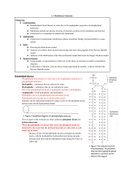
- Phospholipids form bilayers in water due to the amphipathic properties of
phospholipid molecules
- Hydrophilic = substances that are attracted to water
- Hydrophobic = substances that are not attracted to water
- Part of the phospholipid molecule is hydrophilic and part is hydrophobic
- Amphipathic = both hydrophobic and hydrophilic
- Hydrophilic part of a phospholipid is the phosphate group
- Hydrophobic part consists of two hydrocarbon chains
- Structure can be represented simply by using a circle for the phosphate group
and two lines for the hydrocarbon chains
- The two parts of the molecule are often called the phosphate heads and
hydrocarbon tails
- When phospholipids are mixed with water the phosphate heads are
attracted to the water but the hydrocarbon tails are attracted to each
other, not to water
- Because of this, the phospholipids become arranged into double
layers, with the hydrophobic hydrocarbon tails facing inwards
towards each other and the hydrophilic heads facing the water on
either side
, - The bilayer is held together by weak hydrophobic interactions between the tails
- These double layers are called phospholipid bilayers
- Stable structures
- Form the basis of all cell membranes
- Individual phospholipids can move within the bilayer, allowing for membrane fluidity and
flexibility
- This fluidity allows for the spontaneous breaking and reforming of membranes (endocytosis /
exocytosis)
Phospholipids:
- Phospholipids are one of the principle components in cell membranes (in conjunction with membrane
proteins)
- Amphipathic molecules
- Phospholipids typically share a common basic structure that includes:
1. A polar organic molecule (e.g. chlorine, serine)
2. A phosphate group
3. A glycerol molecule (replaces by sphingosine in sphingomyelin)
4. Two fatty acid tails (may be saturated or unsaturated)
Objectives:
❏ Understanding:
❏ Phospholipids form bilayers in water due to the amphipathic properties of phospholipid
molecules
❏ Membrane proteins are diverse in terms of structure, position in the membrane and function
❏ Cholesterol is a component of animal cell membranes
❏ Applications:
❏ Cholesterol in mammalian membranes reduces membrane fluidity and permeability to some
solutes
❏ Skills
❏ Drawing the fluid mosaic model
❏ Analysis of evidence from electron microscopy that led to the proposal of the Davson-Danielli
model
❏ Analysis of the falsification of the Davson-Danielli model that led to the Singer-Nicolson model
❏ Nature of Science
❏ Using models as representations of the real world: there are alternative models of membrane
structure
❏ Falsification of theories with one theory being superseded by another: evidence falsified the
Davson-Danielli model
Phospholipid bilayers:
- Phospholipids form bilayers in water due to the amphipathic properties of
phospholipid molecules
- Hydrophilic = substances that are attracted to water
- Hydrophobic = substances that are not attracted to water
- Part of the phospholipid molecule is hydrophilic and part is hydrophobic
- Amphipathic = both hydrophobic and hydrophilic
- Hydrophilic part of a phospholipid is the phosphate group
- Hydrophobic part consists of two hydrocarbon chains
- Structure can be represented simply by using a circle for the phosphate group
and two lines for the hydrocarbon chains
- The two parts of the molecule are often called the phosphate heads and
hydrocarbon tails
- When phospholipids are mixed with water the phosphate heads are
attracted to the water but the hydrocarbon tails are attracted to each
other, not to water
- Because of this, the phospholipids become arranged into double
layers, with the hydrophobic hydrocarbon tails facing inwards
towards each other and the hydrophilic heads facing the water on
either side
, - The bilayer is held together by weak hydrophobic interactions between the tails
- These double layers are called phospholipid bilayers
- Stable structures
- Form the basis of all cell membranes
- Individual phospholipids can move within the bilayer, allowing for membrane fluidity and
flexibility
- This fluidity allows for the spontaneous breaking and reforming of membranes (endocytosis /
exocytosis)
Phospholipids:
- Phospholipids are one of the principle components in cell membranes (in conjunction with membrane
proteins)
- Amphipathic molecules
- Phospholipids typically share a common basic structure that includes:
1. A polar organic molecule (e.g. chlorine, serine)
2. A phosphate group
3. A glycerol molecule (replaces by sphingosine in sphingomyelin)
4. Two fatty acid tails (may be saturated or unsaturated)