AP European History- Enlightenment Already Passed
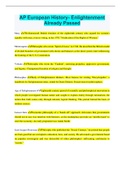
AP European History- Enlightenment Already Passed Mary Wollstonecraft British feminist of the eighteenth century who argued for women's equality with men, even in voting, in her 1792 "Vindication of the Rights of Women." Montesquieu Philosophe who wrote "Spirit of Laws" in 1748. He described the British model of divided branches of government with checks and balances as the ideal system, later influencing the framing of the U.S. Constitution. Voltaire Philosophe who wrote the "Candide", satirizing prejudice, oppressive government, and bigotry. Championed freedom of religion and thought. Philosophes Body of Enlightenment thinkers. Most famous for writing "Encyclopedia", a handbook for Enlightenment ideas, etided be Denis Diderot. French term for philosophers. Age of Enlightenment Eighteenth-century period of scientific and philosophical innovation in which people investigated human nature and sought to explain reality through rationalism, the notion that truth comes only through rational, logical thinking. This period formed the basis of modern science. Laissez-faire Economic philosophy of a "hands off" approach. Advocates that governments should not in any way interfere with business, as the marketplace provides an "inisible hand" to steer the economy. An early proponent was Adam Smith. Jean-Jacques Rousseau Philosphe who published the "Social Contract." he posited that people are born good but are corrupted e education, laws, and society. He advocated a government based on popular sovereignty and was distrustful of other philosophes' suffocating conformity to "reason."atheist A person who does not believe in the existence of God. This belief became prominent in the West during the Enlightenment of the 18th century, as scientists and philosophers discovered natural explanations for how the universe operated that did not rely on divine intervention. Enlightened Despots European rulers who sought to apply some of the reforms of the 18th century Enlightenment to their governments without giving up their own absolutist authority. These rulers were characterized by legal, administrative, and educational improvements when it suited the state and as a means to enhance its power. Examples of these rulers include Frederick the Great of Prussia (r. ), Catherine the Great of Russia (r. ), and Joseph II of Austria (r. ). Freemasons Members of Masonic lodges, social clubs organized around the elaborate secret rituals of stonemasons' guilds. Membership provided a place outside the traditional channels of socializing where nobles and middle-class professionals and even some artisans mingled and shared their common interest in the Enlightenment and reform. The movement began in Great Britain in the early 18th century and spread eastward across Europe. Although not explicitly political, members encouraged equality among its members utilitarianism A liberal ideology promoted by English philosopher Jeremy Bentham (1748- 1832). Based on the writings of John Locke (), it argues that the best social and political policies are those that produce - in Bentham's words - "the greatest good for the greatest number" and are therefore the most useful, which, to him, meant liberalism. Liberals supported the Enlightenment ideas of increased personal liberty and free trade in economics.
Written for
- Institution
- AP EURO
- Course
- AP EURO
Document information
- Uploaded on
- November 14, 2022
- Number of pages
- 6
- Written in
- 2022/2023
- Type
- Exam (elaborations)
- Contains
- Questions & answers
Subjects
-
ap european history enlightenment already passed

Also available in package deal