1
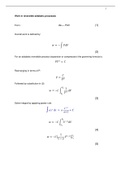
Work in reversible adiabatic processes
From : dw = -PdV (1)
Overall work is defined by:
𝑤 = − ∫ 𝑃𝑑𝑉
(2)
For an adiabatic reversible process (expansion or compression) the governing formula is:
𝑃𝑉 𝛾 = 𝐶
Rearranging in terms of P:
𝐶
𝑃=
𝑉𝛾
Followed by substitution in (2):
𝑉2
1
𝑤 = −𝐶 ∫ 𝑑𝑉
𝑉1 𝑉𝛾
(3)
Solve integral by applying power rule:
∫ n
x n+1
ax dx = a +C
n+1
𝑉2
𝑤 = −𝐶 ∫ 𝑉 −𝛾 𝑑𝑉
𝑉1
(4)
1 𝑉
𝑤 = −𝐶[ 𝑉 1−𝛾 ]𝑉21
1−𝛾
(5)
, 2
1 1
𝑤 = −𝐶[ 𝑉2 1−𝛾 − 𝑉 1−𝛾 ]
1−𝛾 1−𝛾 1
𝐶 1−𝛾
𝑤=− [𝑉2 − 𝑉1 1−𝛾 ]
1−𝛾
(6)
You may further want to get rid of the negative sign. Since 1-γ = -(γ-1), the equation then
changes to:
𝐶 1−𝛾
𝑤= [𝑉 − 𝑉1 1−𝛾 ]
𝛾−1 2
(7)
Work can also be evaluated in terms of the temperature change, since
𝑑𝑈 = 𝑑𝑤
(8)
𝑑𝑤 = 𝑛𝐶𝑉 𝑑𝑇
𝑇2
𝑤 = 𝑛𝐶𝑉 ∫ 𝑑𝑇
𝑇1
𝑤 = 𝑛𝐶𝑉 (𝑇2 − 𝑇1 )
(9)
It is assumed that CV is constant.
Example1: Work of adiabatic reversible expansion
Consider the adiabatic, reversible expansion of 0.020 mol Ar, initially at 25°C, from
0.50 dm3 to 1.00 dm3. Calculate the work of expansion.
Given: Cvm = 12.48 J K-1 mol-1
Method 1: Use of
𝐶 1−𝛾
𝑤= [𝑉2 − 𝑉1 1−𝛾 ]
𝛾−1
Work in reversible adiabatic processes
From : dw = -PdV (1)
Overall work is defined by:
𝑤 = − ∫ 𝑃𝑑𝑉
(2)
For an adiabatic reversible process (expansion or compression) the governing formula is:
𝑃𝑉 𝛾 = 𝐶
Rearranging in terms of P:
𝐶
𝑃=
𝑉𝛾
Followed by substitution in (2):
𝑉2
1
𝑤 = −𝐶 ∫ 𝑑𝑉
𝑉1 𝑉𝛾
(3)
Solve integral by applying power rule:
∫ n
x n+1
ax dx = a +C
n+1
𝑉2
𝑤 = −𝐶 ∫ 𝑉 −𝛾 𝑑𝑉
𝑉1
(4)
1 𝑉
𝑤 = −𝐶[ 𝑉 1−𝛾 ]𝑉21
1−𝛾
(5)
, 2
1 1
𝑤 = −𝐶[ 𝑉2 1−𝛾 − 𝑉 1−𝛾 ]
1−𝛾 1−𝛾 1
𝐶 1−𝛾
𝑤=− [𝑉2 − 𝑉1 1−𝛾 ]
1−𝛾
(6)
You may further want to get rid of the negative sign. Since 1-γ = -(γ-1), the equation then
changes to:
𝐶 1−𝛾
𝑤= [𝑉 − 𝑉1 1−𝛾 ]
𝛾−1 2
(7)
Work can also be evaluated in terms of the temperature change, since
𝑑𝑈 = 𝑑𝑤
(8)
𝑑𝑤 = 𝑛𝐶𝑉 𝑑𝑇
𝑇2
𝑤 = 𝑛𝐶𝑉 ∫ 𝑑𝑇
𝑇1
𝑤 = 𝑛𝐶𝑉 (𝑇2 − 𝑇1 )
(9)
It is assumed that CV is constant.
Example1: Work of adiabatic reversible expansion
Consider the adiabatic, reversible expansion of 0.020 mol Ar, initially at 25°C, from
0.50 dm3 to 1.00 dm3. Calculate the work of expansion.
Given: Cvm = 12.48 J K-1 mol-1
Method 1: Use of
𝐶 1−𝛾
𝑤= [𝑉2 − 𝑉1 1−𝛾 ]
𝛾−1