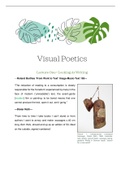
Visual Poetics
Lecture One • Looking At Writing
---Roland Barthes ‘From Work to Text’ Image-Music-Text 163---
“The reduction of reading to a consumption is clearly
responsible for the ‘boredom’ experienced by many in the
face of modern (‘unreadable’) text, the avant-garde
[modern] film or painting: to be bored means that one
cannot produce the text, open it out, set it going.”
---Dieter Roth---
“From time to time I take books I can’t stand or from
authors I want to annoy and make: sausages c.40 cm
long, 8cm thick, should end up as an edition of 50, titled
on the outside, signed numbered’.
Picture 1: Literaturwurst (Literature
Sausage), Dieter Roth, 1969, materials:
lard, spices, ground book, sausage casing,
gelatine. Words in German reads: "search
for a new world"
, 1 A solitude ten thousand fathoms deep
2 Sustains the bed on which we lie, my dear
3 Although I love you, you will have to leap
4 Our dream of safety has to disappear
Source: ‘Leap Before You Look’ by WH Auden, 1940
< Xu Bing, ‘Leap Before you Look’ (2007) –
Reproduced as discussed by Sowon S. Park in the
chapter ‘Scriptworlds’
‘An official script is an expression of economic
dominance, political power, and cultural prestige,
rather than a rational reflection of people can best
communicate’ (Park ‘Scriptworlds’ 112)
[The script in which people write is mainly the result
of for example European colonialism, domination,
political power of Rome for example, cultural prestige
for example Traditional Chinese (Taiwanese Mandarin), this does not necessarily reflect
how people best communicate].
‘In the context of our present digital age, where technology allows for increasingly diverse
means of visual communication and cybertexts [WhatsApp language, shorthand] are part
of the mainstream, and where visual units of meaning such as GIFs and emoticons [emoji]
are rapidly becoming part of our everyday semiotic system [sign or symbol meaning-
making system], the view of writing as visible speech is becoming increasingly
inadequate.’ [emojis take preference to writing out physical words, often words become
obsolete and restrictive as emojis can say a lot more than words can ‘a picture speaks a
thousand words] (Park 206)
, The Stroop Effect
Psychologist John Ridley Stroop conducted an experiment with a group of ‘highly literate
American college students’ (McDonald 265), who ‘saw printed words first and foremost
as abstract [intellectual], intelligible signs, rather than as concrete, sensible marks. They
had no trouble reading the word “red”, for instance, no matter whether it as printed as
RED, RED, or RED; they experienced…slight cognitive delay, however; when asked to
identify the colour rather than the word when confronted with a card saying RED … they
looked through the writing in their “urge to decode”, effectively putting their intelligible (the
word) before the sensible (the colour), and so had to word harder to give the correct
answer “green” (Peter McDonald Artefacts of Writing 265)
“[Written language] stands before us as a
billboard or advertising column, a wall or fence,
it hangs above us as a sign or banner; it rides
on furniture trucks and floats past us on ships;
sometimes we walk over it on the street or even
eat it was cookies, Russich Brot [alphabet
cookies] or pasta; when we don’t look at it, it
flicker at us as a neon light […] WE live in a
written world of symbols and icons, numbers
and emblems, allegories [symbols] and
pictographies, crossword puzzles and comic
strips, and the writing of tallies has unmissably
asserted its place on coasters.” (Ferdinand
Kriwet 1967, 14, quoted in Benthien et al. The
Literariness of Media Art 88)
“One of the beauties of writing is that it is, in a
sense, invisible. We read all day long; we see
street signs, hoardings [billboards], and he Picture 2: Neon Text 3 by Ferdinand Kriwet (1973)
names of shops, registering what they say
, without being aware of the fact that we are reading. Words are embedded in the
contemporary landscape.” (Sean Cubitt 60 quoted in Benthien et. al. 89)
“The perfection of language lies in its capacity to pass unnoticed. But therein lies the
virtue of language: it is language which propels us toward the things it signifies. In the
way it works, language hides itself from us. Its triumph is to efface [destroy] itself.”
(Merleau-Ponty 1973, 10 quoted in Benthien et. al. 21)
“[W]e learn to read in ‘three major phases’, each of which
depends and continues to depend on the other: ‘the pictorial
stage, a brief period where children “photograph” a few words;
the phonological stage, where they learn to decode graphemes
[graphical symbols or characters] into phonemes [verbal or
phonetical]; and the orthographic [pronunciation] stage, where
word recognition becomes fast and automatic.” (McDonald
Artefacts of Writing 5)
Picture 3 Rene Magritte 'Key to
Dreams' (1935)
Lecture One • Looking At Writing
---Roland Barthes ‘From Work to Text’ Image-Music-Text 163---
“The reduction of reading to a consumption is clearly
responsible for the ‘boredom’ experienced by many in the
face of modern (‘unreadable’) text, the avant-garde
[modern] film or painting: to be bored means that one
cannot produce the text, open it out, set it going.”
---Dieter Roth---
“From time to time I take books I can’t stand or from
authors I want to annoy and make: sausages c.40 cm
long, 8cm thick, should end up as an edition of 50, titled
on the outside, signed numbered’.
Picture 1: Literaturwurst (Literature
Sausage), Dieter Roth, 1969, materials:
lard, spices, ground book, sausage casing,
gelatine. Words in German reads: "search
for a new world"
, 1 A solitude ten thousand fathoms deep
2 Sustains the bed on which we lie, my dear
3 Although I love you, you will have to leap
4 Our dream of safety has to disappear
Source: ‘Leap Before You Look’ by WH Auden, 1940
< Xu Bing, ‘Leap Before you Look’ (2007) –
Reproduced as discussed by Sowon S. Park in the
chapter ‘Scriptworlds’
‘An official script is an expression of economic
dominance, political power, and cultural prestige,
rather than a rational reflection of people can best
communicate’ (Park ‘Scriptworlds’ 112)
[The script in which people write is mainly the result
of for example European colonialism, domination,
political power of Rome for example, cultural prestige
for example Traditional Chinese (Taiwanese Mandarin), this does not necessarily reflect
how people best communicate].
‘In the context of our present digital age, where technology allows for increasingly diverse
means of visual communication and cybertexts [WhatsApp language, shorthand] are part
of the mainstream, and where visual units of meaning such as GIFs and emoticons [emoji]
are rapidly becoming part of our everyday semiotic system [sign or symbol meaning-
making system], the view of writing as visible speech is becoming increasingly
inadequate.’ [emojis take preference to writing out physical words, often words become
obsolete and restrictive as emojis can say a lot more than words can ‘a picture speaks a
thousand words] (Park 206)
, The Stroop Effect
Psychologist John Ridley Stroop conducted an experiment with a group of ‘highly literate
American college students’ (McDonald 265), who ‘saw printed words first and foremost
as abstract [intellectual], intelligible signs, rather than as concrete, sensible marks. They
had no trouble reading the word “red”, for instance, no matter whether it as printed as
RED, RED, or RED; they experienced…slight cognitive delay, however; when asked to
identify the colour rather than the word when confronted with a card saying RED … they
looked through the writing in their “urge to decode”, effectively putting their intelligible (the
word) before the sensible (the colour), and so had to word harder to give the correct
answer “green” (Peter McDonald Artefacts of Writing 265)
“[Written language] stands before us as a
billboard or advertising column, a wall or fence,
it hangs above us as a sign or banner; it rides
on furniture trucks and floats past us on ships;
sometimes we walk over it on the street or even
eat it was cookies, Russich Brot [alphabet
cookies] or pasta; when we don’t look at it, it
flicker at us as a neon light […] WE live in a
written world of symbols and icons, numbers
and emblems, allegories [symbols] and
pictographies, crossword puzzles and comic
strips, and the writing of tallies has unmissably
asserted its place on coasters.” (Ferdinand
Kriwet 1967, 14, quoted in Benthien et al. The
Literariness of Media Art 88)
“One of the beauties of writing is that it is, in a
sense, invisible. We read all day long; we see
street signs, hoardings [billboards], and he Picture 2: Neon Text 3 by Ferdinand Kriwet (1973)
names of shops, registering what they say
, without being aware of the fact that we are reading. Words are embedded in the
contemporary landscape.” (Sean Cubitt 60 quoted in Benthien et. al. 89)
“The perfection of language lies in its capacity to pass unnoticed. But therein lies the
virtue of language: it is language which propels us toward the things it signifies. In the
way it works, language hides itself from us. Its triumph is to efface [destroy] itself.”
(Merleau-Ponty 1973, 10 quoted in Benthien et. al. 21)
“[W]e learn to read in ‘three major phases’, each of which
depends and continues to depend on the other: ‘the pictorial
stage, a brief period where children “photograph” a few words;
the phonological stage, where they learn to decode graphemes
[graphical symbols or characters] into phonemes [verbal or
phonetical]; and the orthographic [pronunciation] stage, where
word recognition becomes fast and automatic.” (McDonald
Artefacts of Writing 5)
Picture 3 Rene Magritte 'Key to
Dreams' (1935)