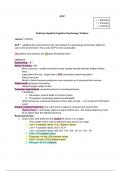
Objectivism: set of facts independent of any subjects. Moral objectivism maintains there's a single set of moral standards, rights and wrongs which are universal.
Subjectivism: (individual relativism), morals are subjective; they are based on personal tastes, feelings, and opinions; Relativism: truth has no absolute, universal validity
but is relative to our personal historical and cultural circumstances, knowledge is always a matter of interpretation; Engaged Self: self, engaged within the process of
interpretation; taking into account personal context, tradition and prejudices; self fundamentally connected to the world – not living in a vacuum; Language: gives
Concepts
humans unique ability to abstract images from immediate experience; world is already interpreted through language; Hermeneutic circle: some greater context always
influences how we understand particular parts, whole and parts influence each other; Objective understanding- requires personal engagement and passionate curiosity;
All knowledge is always relative to personal context and view point, but herm. Is beyond relativism as we are not isolated selves living in the vacuum; we are informed by
history, language and pre-understanding. Truth always includes universally valid context (horizon); not relativism but admission we are not gods.
Descartes Mind and world become disconnected; rationalism – reasoning mind; withdraw from the sense to withdraw from prejudices; no traditional authority.
Kant Intellectual maturity meant independence of reason from tradition.
Romantic hermeneutics: seek authors meaning behind the text; Holistic view of reality- knowledge through expression of spirit ‘feeling of absolute dependence’; cosmic-
spirit connects our minds; Methodology: grammar, psychology, history, great linguistic sensitivity; how to access human minds (empathy, intuition, language);
Schleirm.
reconstruct authors state of mind and intention when writing; human reasoning operates in hermeneutic circle; Understanding mastery of the fulness of language and
its forms; Against Schleiermacher: neglecting our own context, not debate but dialogue; understanding not debunking; epistemology rather than ontology.
Husserl Phenomenology: mind is correlated with objects in the world; we can get in touch with a essence or a true meaning of the object.
Understanding: matrix of meaningful relations-> making visible meaning-structures (existentials); All understanding is interpretive; understanding is motivated by us;
it’s a way of life; our reason is temporal = same as history; existentials-ontological level how we perceive the world; attentiveness-how we relate to things that help us
achieve something – hammer becomes an abstract object when we want to understand it- existential mode of being; ontological significance of language>understanding;
Heidegger
herm. is the way we move around the world; we are interpreting animals; we are history and language and pre-understanding (symbolic universe we are born into);
pre-understanding is not negative or a prison; herm of experience (like Gadamer): perception is not theoretical but practical; langue is a medium; Understanding is more
than entering the inner aspect of experience – whether by empathy and intuition (Schleiermacher) or historically (Dilthey).
Explaining vs. Understanding; Explaining appropriate when examining something as an object’s pf study (laws, natural forces); Understanding appropriate when engaging
in something or someone as subject with inner life; human sciences can understand culture (as they examine will, emotion, intention); natural sciences cannot
understand culture; (Methodology) Understanding deciphering imprint of human spirit on material world – to understand objective spirit; self-understanding through
Dilthey
hermeneutical endeavor; collective mind (Schleiermacher individual); knowledge is life experiencing itself – life is a bedrock of meaning; Human
sciences>objective>verifiable cultural manifestations of life experience; we need to understand a single event within its historical and societal context; Dilthey herm: 1
self-understanding – only possible by interpreting life expressions of others, 2 herm. as first truly historical conversation about knowledge.
Truth and Method; all theories must begin with recognition of hermeneutical circle; Fusion of Horizons: melting identities, contexts and prejudices; Only the horizon of
a tradition can determine the interpretation of any text; only the totality of texts a tradition comprises can constitute that larger semantic horizon; Prejudices are
inevitable but not negative; All understanding is heavily conditioned by authority, tradition, history; Formative effects of history shape our understanding about world -
> primarily through language; Critical engagement with tradition unfolds the activity of historical consciousness (being aware of one’s own historicity); Religious tradition
Gadamer is a living stream that can be apprehended only form within of its own self-reference – we move in a stream of history; Engaged knowing>playing game>spiel>knowledge
derived from arts; focal awareness – applicatory dimension of hermeneutics; Language connects mind and world (a medium); Language is objective-it gives order to
the world-not subjective consciousness; Objective understanding discloses itself through meaningful relations; Understanding: basic movement of human existence
with experience; Authority: ideally never imposed but derived from superior skills or experience; Hearing>Seeing; Theoretical>Practical; Mediation= understanding,
application=soul; Reader enters plays give structure and overcomes alienation; Experience=Education=shaping/cultivating human spirit.
Look and see; facts about reality; Interpretation through practical inductive experiments; observation: theory-laden is biased; world is like machine; not meaning but
data; Methodology: Verification- experiment confirms truth.
Herm.
of
Scientific Objectivism – sciences empirical method leads to the highest form of knowledge; objective truth -> by scientific experimentation.
Science
Positivism ‘scientism’- make the world predictable -> scientific facts will explain the world.
Subjectivism: (individual relativism), morals are subjective; they are based on personal tastes, feelings, and opinions; Relativism: truth has no absolute, universal validity
but is relative to our personal historical and cultural circumstances, knowledge is always a matter of interpretation; Engaged Self: self, engaged within the process of
interpretation; taking into account personal context, tradition and prejudices; self fundamentally connected to the world – not living in a vacuum; Language: gives
Concepts
humans unique ability to abstract images from immediate experience; world is already interpreted through language; Hermeneutic circle: some greater context always
influences how we understand particular parts, whole and parts influence each other; Objective understanding- requires personal engagement and passionate curiosity;
All knowledge is always relative to personal context and view point, but herm. Is beyond relativism as we are not isolated selves living in the vacuum; we are informed by
history, language and pre-understanding. Truth always includes universally valid context (horizon); not relativism but admission we are not gods.
Descartes Mind and world become disconnected; rationalism – reasoning mind; withdraw from the sense to withdraw from prejudices; no traditional authority.
Kant Intellectual maturity meant independence of reason from tradition.
Romantic hermeneutics: seek authors meaning behind the text; Holistic view of reality- knowledge through expression of spirit ‘feeling of absolute dependence’; cosmic-
spirit connects our minds; Methodology: grammar, psychology, history, great linguistic sensitivity; how to access human minds (empathy, intuition, language);
Schleirm.
reconstruct authors state of mind and intention when writing; human reasoning operates in hermeneutic circle; Understanding mastery of the fulness of language and
its forms; Against Schleiermacher: neglecting our own context, not debate but dialogue; understanding not debunking; epistemology rather than ontology.
Husserl Phenomenology: mind is correlated with objects in the world; we can get in touch with a essence or a true meaning of the object.
Understanding: matrix of meaningful relations-> making visible meaning-structures (existentials); All understanding is interpretive; understanding is motivated by us;
it’s a way of life; our reason is temporal = same as history; existentials-ontological level how we perceive the world; attentiveness-how we relate to things that help us
achieve something – hammer becomes an abstract object when we want to understand it- existential mode of being; ontological significance of language>understanding;
Heidegger
herm. is the way we move around the world; we are interpreting animals; we are history and language and pre-understanding (symbolic universe we are born into);
pre-understanding is not negative or a prison; herm of experience (like Gadamer): perception is not theoretical but practical; langue is a medium; Understanding is more
than entering the inner aspect of experience – whether by empathy and intuition (Schleiermacher) or historically (Dilthey).
Explaining vs. Understanding; Explaining appropriate when examining something as an object’s pf study (laws, natural forces); Understanding appropriate when engaging
in something or someone as subject with inner life; human sciences can understand culture (as they examine will, emotion, intention); natural sciences cannot
understand culture; (Methodology) Understanding deciphering imprint of human spirit on material world – to understand objective spirit; self-understanding through
Dilthey
hermeneutical endeavor; collective mind (Schleiermacher individual); knowledge is life experiencing itself – life is a bedrock of meaning; Human
sciences>objective>verifiable cultural manifestations of life experience; we need to understand a single event within its historical and societal context; Dilthey herm: 1
self-understanding – only possible by interpreting life expressions of others, 2 herm. as first truly historical conversation about knowledge.
Truth and Method; all theories must begin with recognition of hermeneutical circle; Fusion of Horizons: melting identities, contexts and prejudices; Only the horizon of
a tradition can determine the interpretation of any text; only the totality of texts a tradition comprises can constitute that larger semantic horizon; Prejudices are
inevitable but not negative; All understanding is heavily conditioned by authority, tradition, history; Formative effects of history shape our understanding about world -
> primarily through language; Critical engagement with tradition unfolds the activity of historical consciousness (being aware of one’s own historicity); Religious tradition
Gadamer is a living stream that can be apprehended only form within of its own self-reference – we move in a stream of history; Engaged knowing>playing game>spiel>knowledge
derived from arts; focal awareness – applicatory dimension of hermeneutics; Language connects mind and world (a medium); Language is objective-it gives order to
the world-not subjective consciousness; Objective understanding discloses itself through meaningful relations; Understanding: basic movement of human existence
with experience; Authority: ideally never imposed but derived from superior skills or experience; Hearing>Seeing; Theoretical>Practical; Mediation= understanding,
application=soul; Reader enters plays give structure and overcomes alienation; Experience=Education=shaping/cultivating human spirit.
Look and see; facts about reality; Interpretation through practical inductive experiments; observation: theory-laden is biased; world is like machine; not meaning but
data; Methodology: Verification- experiment confirms truth.
Herm.
of
Scientific Objectivism – sciences empirical method leads to the highest form of knowledge; objective truth -> by scientific experimentation.
Science
Positivism ‘scientism’- make the world predictable -> scientific facts will explain the world.