

SECTION A
Livelihoods
• “A means of gaining a living”
• “A livelihood comprises the capabilities, assets (including both
material and social resources) and activities for a means of living. A
livelihood is sustainable when it can cope with and recover from
stresses and shocks, maintain, or enhance its capabilities and
assets, while not undermining the natural resource base”
• Ian Scoones developed the Sustainable livelihoods Framework (SLF)
to analyse livelihoods (Scoones, 2009)
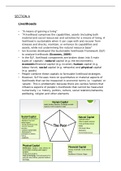
• In the SLF, livelihood components are broken down into 5 main
types of ‘capitals’: natural capital (e.g. the environment),
economic/financial capital (e.g. income), human capital (e.g.
labour force), social capital (e.g. networks) and physical capital
(e.g. goods)
• People combine these capitals to formulate livelihood strategies
• However, SLF focuses more on quantitative or material aspects of
livelihoods that can be measured in economic terms i.e. ‘capitals’ or
‘assets’. This is problematic because there are various factors that
influence aspects of people’s livelihoods that cannot be measured
numerically, i.e. history, politics, culture, social relations/networks,
wellbeing, religion and other elements
,• Robert Chambers publisded the Sustainable Livelihoods thinking
(SLT) that argued that it was fundamental to combine the thinking
of professionals (usually Western) and of poor people in developing
countries about environment and development by promoting a
bottom-up way of understanding livelihoods
• There were arguments against the tendency of professionals to
think of “development” and “environment” as separate issues, and
to think of policymaking in terms of population, resources,
environment and development discourses without considering the
voices of the poor
• Rio summit (that lead to Agenda 21) outcomes:
1. International cooperation to accelerate SD and
developing countries
2. Integrating environment and development in decision-
making
3. Combating poverty
4. Promoting biodiversity conservation
5. Gender issues
6. Recognising and strengthening the role of indigenous
people and communities
7. International institutional arrangements for SD
implementations
• 8 years after Agenda 21 was established, the United Nations
facilitated the development of Millennium Development Goals
(MDGs) for years between 2000 to 2015
• Their 8 goals for improving the livelihoods of the poor:
, • By 2015, MDGs were still not being realised
• The United Nations therefore facilitated the establishment of the
Sustainable Development Goals (SDGs) which are 17 global goals
subscribed to by over 190 countries to improve livelihoods globally
• The SDGs build on the MDGs and recognize that improving
livelihoods needs to go hand in hand with social, economic, and
environmental sustainability
Livelihoods
• “A means of gaining a living”
• “A livelihood comprises the capabilities, assets (including both
material and social resources) and activities for a means of living. A
livelihood is sustainable when it can cope with and recover from
stresses and shocks, maintain, or enhance its capabilities and
assets, while not undermining the natural resource base”
• Ian Scoones developed the Sustainable livelihoods Framework (SLF)
to analyse livelihoods (Scoones, 2009)
• In the SLF, livelihood components are broken down into 5 main
types of ‘capitals’: natural capital (e.g. the environment),
economic/financial capital (e.g. income), human capital (e.g.
labour force), social capital (e.g. networks) and physical capital
(e.g. goods)
• People combine these capitals to formulate livelihood strategies
• However, SLF focuses more on quantitative or material aspects of
livelihoods that can be measured in economic terms i.e. ‘capitals’ or
‘assets’. This is problematic because there are various factors that
influence aspects of people’s livelihoods that cannot be measured
numerically, i.e. history, politics, culture, social relations/networks,
wellbeing, religion and other elements
,• Robert Chambers publisded the Sustainable Livelihoods thinking
(SLT) that argued that it was fundamental to combine the thinking
of professionals (usually Western) and of poor people in developing
countries about environment and development by promoting a
bottom-up way of understanding livelihoods
• There were arguments against the tendency of professionals to
think of “development” and “environment” as separate issues, and
to think of policymaking in terms of population, resources,
environment and development discourses without considering the
voices of the poor
• Rio summit (that lead to Agenda 21) outcomes:
1. International cooperation to accelerate SD and
developing countries
2. Integrating environment and development in decision-
making
3. Combating poverty
4. Promoting biodiversity conservation
5. Gender issues
6. Recognising and strengthening the role of indigenous
people and communities
7. International institutional arrangements for SD
implementations
• 8 years after Agenda 21 was established, the United Nations
facilitated the development of Millennium Development Goals
(MDGs) for years between 2000 to 2015
• Their 8 goals for improving the livelihoods of the poor:
, • By 2015, MDGs were still not being realised
• The United Nations therefore facilitated the establishment of the
Sustainable Development Goals (SDGs) which are 17 global goals
subscribed to by over 190 countries to improve livelihoods globally
• The SDGs build on the MDGs and recognize that improving
livelihoods needs to go hand in hand with social, economic, and
environmental sustainability


