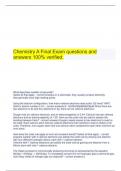
Chemistry A Final Exam | Questions with 100% Correct Answers | Updated & Verified
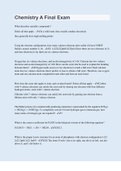
What describes metallic compounds? Select all that apply. - in a solid state, they usually conduct electricity they generally have high melting points Using the electron configuration, how many valence electrons does sulfur (S) have? HINT: Sulfur's atomic number is 16. - S: 1s222s222p663s223p44 Since there are two electrons in 3s and four electrons in 3p, there are six valence electrons. Oxygen has six valence electrons, and an electronegativity of 3.44. Calcium has two valence electrons and an electronegativity of 1.00. How can the octet rule be used to explain the bonding between them? - Oxygen needs access to two electrons to reach a full octet. Each calcium atom has two valence electrons that it prefers to lose to obtain a full octet. Therefore, one oxygen atom and one calcium atom complement each other and form an ionic bond. How does the octet rule apply to ionic and covalent bonds? Select all that apply. - Carbon with 4 valence electrons can satisfy the octet rule by sharing one electron with four different hydrogen atoms, each with 1 valence electron. Chlorine with 7 valence electrons can satisfy the octet rule by gaining one electron from a lithium atom with only 1 valence electron. The Haber process for commercially producing ammonia is represented by the equation N22(g) + 3H22(g) → 2NH33(g). To completely convert 9.0 mol hydrogen gas to ammonia gas, how many moles of nitrogen gas are required? - 3 What is the correct coefficient for Fe2O3 in the balanced version of the following equation? Fe22O33 + 3H22 → 2Fe + 3H22O - XXX 2
Written for
- Institution
- Chemistry A
- Course
- Chemistry A
Document information
- Uploaded on
- November 10, 2022
- Number of pages
- 4
- Written in
- 2022/2023
- Type
- Exam (elaborations)
- Contains
- Questions & answers
Subjects
-
chemistry a final exam | questions with 100 correct answers | updated amp verified