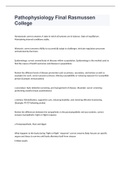
Pathophysiology Final Rasmussen College 2022/2023
Homeostasis o A state in which all systems are in balance. State of equilibrium. Maintaining internal conditions stable. Allostasis: o Ability to successfully adapt to challenges. Intricate regulatory processes orchestrated by the brain. Epidemiology: Study of diseases within a population. Epidemiology is the method used to find the causes of health outcomes and diseases in populations. Review the different levels of disease prevention such as primary, secondary, and tertiary as well as examples for each. o primary: Altering susceptibility or reducing exposure for susceptible person (Example: Immunization) o secondary: Early detection screening, and management of disease. (Example: cancer screening, performing months breast examinations) o tertiary: Rehabilitation, supportive care, reducing disability, and restoring effective functioning. (Example: PT/OT following stroke) Review the differences between the sympathetic vs the parasympathetic nervous systems. o Sympathetic: Fight or Flight response o Parasympathetic: Rest and digest What happens to the body during "fight-or-flight" response? o Body focuses on specific organs and tissue to survive until body alleviates itself from stressor § Dilate pupils § Inhibit salivation § Increase heartbeat § Relax airway § Inhibit activity of stomach § Stimulate relapse of glucose; inhibit gallbladder § vii.Inhibit activity of intestine § viii.Secrete epi and norepinephrine § Relax bladder § Promote ejaculation and vaginal contraction What is a hypersensitivity? Review the four different types of hypersensitivities: Antigenic response beyond what is considered normal Response to antigens (allergens) leading to damage: Type I :Anaphylaxtic Type II: Cytotoxic Type III: Immune complex hypersensitivity Type Iv: Delayed cell mediated Review the difference between active and passive immunity, know examples for each type. o Active immunity: When the body creates antibodies when coming into contact with a virus. Ex: Vaccination o Passive immunity: Passing on antigens. Ex: Breast feeding Review the difference between active and passive immunity, know examples for each type. vActive - when the body creates a antibodies once coming into contact with specific virus Passive - when passed from mother to child through breast milk or blood stream
Written for
- Institution
-
Rasmussen College
- Course
-
Pathophysiology
Document information
- Uploaded on
- November 9, 2022
- Number of pages
- 18
- Written in
- 2022/2023
- Type
- Exam (elaborations)
- Contains
- Questions & answers
Subjects
-
pathophysiology final rasmussen college 20222023

Also available in package deal