
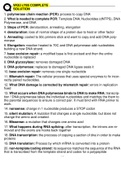
Wgu C785 Complete Solution
WGU c785 COMPLETE SOLUTION 1. polymerase chain reaction (PCR): process to copy DNA 2. What is needed to complete PCR: Template DNA, Nucleotides (dNTPS), DNA Polymerase, and DNA 3. Steps of PCR: denaturation, annealing, elongation 4. denaturation: loss of normal shape of a protein due to heat or other factor 5. Annealing: cooled to 50c primers stick and want to copy and add DNA poly- merase 6. Elongation: reaction heated to 70C and DNA polymerase add nucleotides building a new DNA strand. 7. base excision repair: a modified base is first excised and then the entire nucleotide is replaced 8. DNA glycosylase: removes damaged DNA 9. DNA polymerase: replaces to damaged DNA ligase seals it 10. base excision repair: removes one single nucleotide 11. MIsmatch repair: The cellular process that uses special enzymes to fix incor- rectly paired nucleotides. 12. What DNA damage is corrected by mismatch repair: errors in replication fixed 13. What occurs when DNA polymerase binds to DNA to make RNA: transcrip- tion ! DNA polymerase takes the individual nucleotides and matches the them to the parental sequences to ensure a correct pair. It must bind with RNA primer to work. 14. nonsense: change in 1 nucleotide produces a STOP codon 15. silent mutation: A mutation that changes a single nucleotide, but does not change the amino acid created. 16. Missense: a mutation that changes one amino acid 17. What happens during RNA splicing: after transcription, the introns are re- moved and the exons are hooks back together 18. DNA transcription: the proccess of copying a section of dna in order to make proteins 19. DNA translation: Process by which mRNA is converted into a protein 20. non-template/coding strand: its sequence matches the sequence of the RNA that is transcribed from the template strand and codes for a polypeptide 21. complementary strand: A strand of DNA or RNA that has complementary bases to another strand of DNA or RNA. For instance, during DNA replication, the new strand that is formed is a complementary strand. (Complementary bases: A-T, C-G) 22. DNA template to mRNA is
Document information
- Uploaded on
- November 9, 2022
- Number of pages
- 8
- Written in
- 2022/2023
- Type
- Exam (elaborations)
- Contains
- Questions & answers


