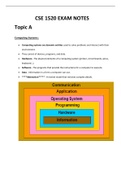
CSE 1520 EXAM NOTES
Topic A
Computing Systems:
Computing systems are dynamic entities used to solve problems and interact with their
environment.
They consist of devices, programs, and data.
Hardware - The physical elements of a computing system (printer, circuit boards, wires,
keyboard…).
Software - The programs that provide the instructions for a computer to execute.
Data - Information in a form a computer can use.
****Abstraction***** - A mental model that removes complex details.
,Early History of Computing:
o Abacus (2400 BC)
An early device to record numeric values.
o Blaise Pascal (1623-1662)
Created a mechanical device to add, subtract, divide & multiply.
o Gottfried Wilhelm von Leibniz (1646-1716)
Created a mechanical device to perform all four whole number operations.
o Joseph Jacquard
Jacquard’s Loom (1801), the punched card
o Charles Babbage (1792-1871)
Difference Engine, Analytical Engine
o Augusta Ada Byron (Lovelace)
Babage’s assistant
Considered to be the first Programmer, Invented the concept of the loop
o William Burroughs (1857-1898)
Adding Machine
o Herman Hollerith (1860-1929)
Electro-mechanical Tabulator
o Alan Turing (1912-1954)
Turing Machine - an abstract mathematical model
Artificial Intelligence Testing
Early computers launch new era in mathematics, physics, engineering and
economics.
Harvard Mark I (1939)
ENIAC - Electronic Numerical Integrator and Calculator
EDVAC - Electronic Discrete Variable Automatic Computer
first machine with a stored program
,UNIVAC I - Universal Automatic Computer (1951)
First Generation Hardware (1951-1959)
o Vacuum Tubes
Large, not very reliable, generated a lot of heat
o Magnetic Drum
Memory device that rotated under a read/write head
o Card Readers Magnetic Tape Drives
Sequential auxiliary storage devices
Second Generation Hardware (1959-1965)
o Transistor
Replaced vacuum tube fast, small, durable, cheap
o Magnetic Cores
Replaced magnetic drums information available instantly
o Magnetic Disks
Replaced magnetic tape data can be accessed directly
Third Generation Hardware (1965-1971)
o Integrated Circuits
Replaced circuit boards smaller, cheaper, faster, more reliable
o Transistors
Now used for memory construction
o Terminal
An input/output device with a keyboard and screen
Fourth Generation Hardware (1971-?)
o Large-scale Integration
Great advances in chip technology
o PCs, the Commercial Market, Workstations
Personal Computers were developed as new companies like Apple and Atari
came into being. Workstations emerged.
Parallel Computing and Networking
Parallel Computing
o Computers rely on interconnected central processing units that increase
processing speed.
, Networking
o With the Ethernet small computers could be connected and share resources. A
file server connected PCs in the late 1980s.
ARPANET and LANs Internet
First Generation Software (1951-1959)
o Machine Language
Computer programs were written in binary (1s and 0s).
o Assembly Languages and translators
Programs were written in artificial programming languages and were then
translated into machine language.
o Programmer Changes
Programmers divide into application programmers and systems programmers.
Second Generation Software (1959-1965)
o High Level Languages
English-like statements make programming easier. Fortran, COBOL, Lisp are
examples.
Third Generation Software (1965-1971)
o Systems Software
utility programs,
language translators,
and the operating system, which decides which
programs to run and when.
o Separation between Users and Hardware
Computer programmers began to write programs to be used by people who did
not know how to program.
Topic A
Computing Systems:
Computing systems are dynamic entities used to solve problems and interact with their
environment.
They consist of devices, programs, and data.
Hardware - The physical elements of a computing system (printer, circuit boards, wires,
keyboard…).
Software - The programs that provide the instructions for a computer to execute.
Data - Information in a form a computer can use.
****Abstraction***** - A mental model that removes complex details.
,Early History of Computing:
o Abacus (2400 BC)
An early device to record numeric values.
o Blaise Pascal (1623-1662)
Created a mechanical device to add, subtract, divide & multiply.
o Gottfried Wilhelm von Leibniz (1646-1716)
Created a mechanical device to perform all four whole number operations.
o Joseph Jacquard
Jacquard’s Loom (1801), the punched card
o Charles Babbage (1792-1871)
Difference Engine, Analytical Engine
o Augusta Ada Byron (Lovelace)
Babage’s assistant
Considered to be the first Programmer, Invented the concept of the loop
o William Burroughs (1857-1898)
Adding Machine
o Herman Hollerith (1860-1929)
Electro-mechanical Tabulator
o Alan Turing (1912-1954)
Turing Machine - an abstract mathematical model
Artificial Intelligence Testing
Early computers launch new era in mathematics, physics, engineering and
economics.
Harvard Mark I (1939)
ENIAC - Electronic Numerical Integrator and Calculator
EDVAC - Electronic Discrete Variable Automatic Computer
first machine with a stored program
,UNIVAC I - Universal Automatic Computer (1951)
First Generation Hardware (1951-1959)
o Vacuum Tubes
Large, not very reliable, generated a lot of heat
o Magnetic Drum
Memory device that rotated under a read/write head
o Card Readers Magnetic Tape Drives
Sequential auxiliary storage devices
Second Generation Hardware (1959-1965)
o Transistor
Replaced vacuum tube fast, small, durable, cheap
o Magnetic Cores
Replaced magnetic drums information available instantly
o Magnetic Disks
Replaced magnetic tape data can be accessed directly
Third Generation Hardware (1965-1971)
o Integrated Circuits
Replaced circuit boards smaller, cheaper, faster, more reliable
o Transistors
Now used for memory construction
o Terminal
An input/output device with a keyboard and screen
Fourth Generation Hardware (1971-?)
o Large-scale Integration
Great advances in chip technology
o PCs, the Commercial Market, Workstations
Personal Computers were developed as new companies like Apple and Atari
came into being. Workstations emerged.
Parallel Computing and Networking
Parallel Computing
o Computers rely on interconnected central processing units that increase
processing speed.
, Networking
o With the Ethernet small computers could be connected and share resources. A
file server connected PCs in the late 1980s.
ARPANET and LANs Internet
First Generation Software (1951-1959)
o Machine Language
Computer programs were written in binary (1s and 0s).
o Assembly Languages and translators
Programs were written in artificial programming languages and were then
translated into machine language.
o Programmer Changes
Programmers divide into application programmers and systems programmers.
Second Generation Software (1959-1965)
o High Level Languages
English-like statements make programming easier. Fortran, COBOL, Lisp are
examples.
Third Generation Software (1965-1971)
o Systems Software
utility programs,
language translators,
and the operating system, which decides which
programs to run and when.
o Separation between Users and Hardware
Computer programmers began to write programs to be used by people who did
not know how to program.