Interdisciplinary themes in food
and sustainability
Session 1: Introduction
Lecture
What is the difference between Disciplinary, Interdisciplinary and
Transdisciplinary?
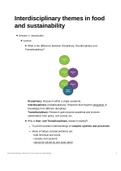
Disciplinary: Research within a single academia
Interdisciplinary (multidisciplinary): Research that requires integration of
knowledge from different disciplines
Transdisciplinary: Research goes beyond academia and involves
stakeholders from policy, civil society, etc.
Why is Inter- and Transdisciplinary research needed?
To prevent partial understandings of complex systems and processes
Many of todays societal problems are
- both technical and social
- complex and systemic
- cannot be solved by one actor alone
Interdisciplinary themes in food and sustainability 1
, To enable realization of the SDG's:
- World leaders gathered in New York in sept 2015 to endors the
Sustainable Development Goals; 'paradigm shift for people and the
planet'.
- Businesses, government an civil society actors are equally
responsible for progressing a more sustainable path forward
What are different forms of incorporating scientific knowledge?
What are barriers and risks of interdisciplinary research?
1. Ontological and epistemological differences
- Difference research paradigms may limit the understanding of the
other thus common ground may be lacking
2. Institutional and personal incentive-structures
- individuals have different drives and values which could come in
contrast!
3. Loss of disciplinary innovation and depth
- a combination of various academia could result in that a certain
subject may not be researched to a specific extent
4. Sliding in safe modus of multi-disciplinary research
What are barriers and risks of transdisciplinary research?
1. Open or hidden controversy over primacy (=groter belang) of science
vs primacy of practitioners
Interdisciplinary themes in food and sustainability 2
, 2. Different drivers and incentives between academics and practitioners:
- Scientists want to produce articles and PhD projects, practitioners
want to solve problems
- Scientists are interested in theory development, practitioners in
transforming society
- Scientists want to understand complexity, practitioners want to find
solutions
3. Differences in terms of input and time for research
4. Lack of trust or time to build trust and develop common understandings
What are the three major principles for interdisciplinary and transdisciplinary
research and development to succeed?
Recognition and respect for different knowledge systems is required
Some kind of umbrella or bridging concept is needed to guide
process of knowledge co-creation
Institutional and personal incentive structures need to be (made)
compatible
(Waarschijnlijk niet nodig om te leren, want staat bij 'three major principles'):
More specific for interdisciplinairy
1. Recognizing and respecting different ideas on the nature of things
and the kind of knowledge that is needed to understand the nature
of things
2. Time, willingness + incentives to engage in process of co-creation
and new generation of knowledge
3. Shared ideas on value and use of disciplinary knowledge in
interdisciplinary research (T- shape)?
4. Identifying umbrella concepts that ring a bell with both natural and
social sciences: systems, flows, pathways is crucial in order to find
common ground!!
More specific for transdisciplinairy
Interdisciplinary themes in food and sustainability 3
, 1. Time, willingness and incentives to engage in a process of co-
creating knowledge throughout all phases of research
2. Identifying bridging concepts, like:
● Value chains, value propositions, shared value creation?
● Socio-Ecological Systems (SES) thinking and concepts:
- Resilience?
- Risk and risk assessment?
- Triggers, game-changers or leverages towards transformational
change
● Small wins towards systemic change? (the concrete steps
towards change!)
Why focus on Responsible Business Conduct (RBC)?
1. It is about assessing the impact of business on people and planet,
which requires input from natural sciences, social sciences and
stakeholders
2. RBC is based on the core notion that sustainability is core business,
which implies that;
- interdisciplinary and transdisciplinary knowledge generation is key
- business can be seen as key players and part of broader social and
ecological systems
How focus on RBC?
We are going to study how business:
1. Assess impact: key in RBC is knowing and showing whether business
is doing no harm but is doing good
2. Understand risk: the risk of impacting the environment and society, the
relationships between financial and non-financial risks
3. Use scientific and stakeholder knowledge: how business are using
scientific knowledge of stakeholders to assess actual and possible
impacts
4. Use tools, standards, processes and agreements: as triggers or
leverages to contribute to transformational change
Interdisciplinary themes in food and sustainability 4
and sustainability
Session 1: Introduction
Lecture
What is the difference between Disciplinary, Interdisciplinary and
Transdisciplinary?
Disciplinary: Research within a single academia
Interdisciplinary (multidisciplinary): Research that requires integration of
knowledge from different disciplines
Transdisciplinary: Research goes beyond academia and involves
stakeholders from policy, civil society, etc.
Why is Inter- and Transdisciplinary research needed?
To prevent partial understandings of complex systems and processes
Many of todays societal problems are
- both technical and social
- complex and systemic
- cannot be solved by one actor alone
Interdisciplinary themes in food and sustainability 1
, To enable realization of the SDG's:
- World leaders gathered in New York in sept 2015 to endors the
Sustainable Development Goals; 'paradigm shift for people and the
planet'.
- Businesses, government an civil society actors are equally
responsible for progressing a more sustainable path forward
What are different forms of incorporating scientific knowledge?
What are barriers and risks of interdisciplinary research?
1. Ontological and epistemological differences
- Difference research paradigms may limit the understanding of the
other thus common ground may be lacking
2. Institutional and personal incentive-structures
- individuals have different drives and values which could come in
contrast!
3. Loss of disciplinary innovation and depth
- a combination of various academia could result in that a certain
subject may not be researched to a specific extent
4. Sliding in safe modus of multi-disciplinary research
What are barriers and risks of transdisciplinary research?
1. Open or hidden controversy over primacy (=groter belang) of science
vs primacy of practitioners
Interdisciplinary themes in food and sustainability 2
, 2. Different drivers and incentives between academics and practitioners:
- Scientists want to produce articles and PhD projects, practitioners
want to solve problems
- Scientists are interested in theory development, practitioners in
transforming society
- Scientists want to understand complexity, practitioners want to find
solutions
3. Differences in terms of input and time for research
4. Lack of trust or time to build trust and develop common understandings
What are the three major principles for interdisciplinary and transdisciplinary
research and development to succeed?
Recognition and respect for different knowledge systems is required
Some kind of umbrella or bridging concept is needed to guide
process of knowledge co-creation
Institutional and personal incentive structures need to be (made)
compatible
(Waarschijnlijk niet nodig om te leren, want staat bij 'three major principles'):
More specific for interdisciplinairy
1. Recognizing and respecting different ideas on the nature of things
and the kind of knowledge that is needed to understand the nature
of things
2. Time, willingness + incentives to engage in process of co-creation
and new generation of knowledge
3. Shared ideas on value and use of disciplinary knowledge in
interdisciplinary research (T- shape)?
4. Identifying umbrella concepts that ring a bell with both natural and
social sciences: systems, flows, pathways is crucial in order to find
common ground!!
More specific for transdisciplinairy
Interdisciplinary themes in food and sustainability 3
, 1. Time, willingness and incentives to engage in a process of co-
creating knowledge throughout all phases of research
2. Identifying bridging concepts, like:
● Value chains, value propositions, shared value creation?
● Socio-Ecological Systems (SES) thinking and concepts:
- Resilience?
- Risk and risk assessment?
- Triggers, game-changers or leverages towards transformational
change
● Small wins towards systemic change? (the concrete steps
towards change!)
Why focus on Responsible Business Conduct (RBC)?
1. It is about assessing the impact of business on people and planet,
which requires input from natural sciences, social sciences and
stakeholders
2. RBC is based on the core notion that sustainability is core business,
which implies that;
- interdisciplinary and transdisciplinary knowledge generation is key
- business can be seen as key players and part of broader social and
ecological systems
How focus on RBC?
We are going to study how business:
1. Assess impact: key in RBC is knowing and showing whether business
is doing no harm but is doing good
2. Understand risk: the risk of impacting the environment and society, the
relationships between financial and non-financial risks
3. Use scientific and stakeholder knowledge: how business are using
scientific knowledge of stakeholders to assess actual and possible
impacts
4. Use tools, standards, processes and agreements: as triggers or
leverages to contribute to transformational change
Interdisciplinary themes in food and sustainability 4