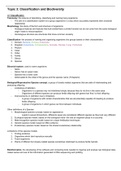
Topic 3: Classification and Biodiversity
3.1 Classification
Taxonomy: the science of describing, classifying and naming living organisms
- The aim of a classification system is to group organisms in a way which accurately represents their ancestral
relationship
Morphology: the study of the form and structure of organisms
- Analogous features are features that look similar/have a similar function but do not come from the same biological
origin- leads to misconceptions
- Homologous structure are structures that show common ancestry
Classification: the process of naming and organising organisms into groups based on their characteristics
1. Domain; Bacteria, Archaea, Eukaryota
2. Kingdom; Eubacteria, Archaebacteria, Animalia, Plantae, Fungi, Protoctista
3. Phylum
4. Class
5. Order
6. Family
7. Genus
8. Species
Binomial system; used to name organisms
- Italics
- Genus has an upper case
- Species has a lower case
- Abbreviated to the initial of the genus and the species name (H.Sapiens)
Biological/Reproductive Species concept; a group of closely related organisms that are able of interbreeding and
producing offspring
- Limitations of definition
- Organisms in a species may not interbreed simply because they do not live in the same area
- Organisms of different species can produce fertile offspring with genes that ‘flow’ to their offspring
- Improvements on definition due to limitations
- A group of organisms with similar characteristics that are all potentially capable of breeding to produce
fertile offspring
- A group of organisms in which genes can flow between individuals
Other definitions of a Species
1. Morphological species concept; based on appearance
- Leads to sexual dimorphism- differents sexes are considered different species as they look very different
2. Ecological species model; based on the ecological niche- the role an organism plays in a occumity
3. Mate-recognition species model; based on unique fertilisation techniques
4. Genetic species model; based on DNA evidence
5. Evolutionary species model; based on the shared evolutionary relationship
Limitations of the species models
1. Finding evidence
2. Organisms which dont reproduce sexually
3. Fossil organisms
4. Plants of different but closely related species sometimes interbreed to produce fertile hybrids
Bioinformatics: the developing of the software and computing tools needed to organise and analyse raw biological data-
makes sense and use of the information generated in DNA sequencing and profiling
, - Helps to distinguish between species and determine evolutionary relationships
1. DNA sequencing is the process by which the base sequences of all/part of a genome of an organism is
worked out
2. DNA profiling is the process by which the non-coding areas of DNA are analysed to identify patterns-
these patterns are unique to individuals but have similarities between species
DNA barcoding
- It supports traditional taxonomy
- Scientific organisations develop DNA barcoding as a global standard for species identification
- Involves looking at short genetic sequences form a part of the genome common to particular groups of organisms
- It is important to look for evidence of traditional studies as well- based on appearance,behaviour or fossils
Role of the scientific community
- Validate new evidence
- When a research produces useful results and conclusions- submitted to a scientific journal
- Goes through peer review
- Published in the paper so other scientists can carry out similar investigations
- Idea is discussed in a scientific conference
- This promotes the development of new techniques and provides opportunities to challenge the validity of
results
- Facilitates the exchange of ideas, data and techniques between scientists
Gel electrophoresis
- A variation of chromatography
- Used to separate DNA and RNA fragments, proteins or amino acids according to their size and charge
- Helps to distinguish between species and determine evolutionary relationships
1. Placed in wells in a gel medium in a buffering solution (maintain constant pH) jelly
2. DNA fragments with restriction endonuclease enzymes
3. Dye with fluorescence
4. Turn on current- DNA will move towards anode
5. Turn off current
6. Turn on UV light
7. Different bands represents different amino acids- compared to known fragments
Evidence
1. Five-kingdom classification
- Based on morphology
- All prokaryotes are put together in Monera
2. Three-domain model
3.2 Natural selection
3.1 Classification
Taxonomy: the science of describing, classifying and naming living organisms
- The aim of a classification system is to group organisms in a way which accurately represents their ancestral
relationship
Morphology: the study of the form and structure of organisms
- Analogous features are features that look similar/have a similar function but do not come from the same biological
origin- leads to misconceptions
- Homologous structure are structures that show common ancestry
Classification: the process of naming and organising organisms into groups based on their characteristics
1. Domain; Bacteria, Archaea, Eukaryota
2. Kingdom; Eubacteria, Archaebacteria, Animalia, Plantae, Fungi, Protoctista
3. Phylum
4. Class
5. Order
6. Family
7. Genus
8. Species
Binomial system; used to name organisms
- Italics
- Genus has an upper case
- Species has a lower case
- Abbreviated to the initial of the genus and the species name (H.Sapiens)
Biological/Reproductive Species concept; a group of closely related organisms that are able of interbreeding and
producing offspring
- Limitations of definition
- Organisms in a species may not interbreed simply because they do not live in the same area
- Organisms of different species can produce fertile offspring with genes that ‘flow’ to their offspring
- Improvements on definition due to limitations
- A group of organisms with similar characteristics that are all potentially capable of breeding to produce
fertile offspring
- A group of organisms in which genes can flow between individuals
Other definitions of a Species
1. Morphological species concept; based on appearance
- Leads to sexual dimorphism- differents sexes are considered different species as they look very different
2. Ecological species model; based on the ecological niche- the role an organism plays in a occumity
3. Mate-recognition species model; based on unique fertilisation techniques
4. Genetic species model; based on DNA evidence
5. Evolutionary species model; based on the shared evolutionary relationship
Limitations of the species models
1. Finding evidence
2. Organisms which dont reproduce sexually
3. Fossil organisms
4. Plants of different but closely related species sometimes interbreed to produce fertile hybrids
Bioinformatics: the developing of the software and computing tools needed to organise and analyse raw biological data-
makes sense and use of the information generated in DNA sequencing and profiling
, - Helps to distinguish between species and determine evolutionary relationships
1. DNA sequencing is the process by which the base sequences of all/part of a genome of an organism is
worked out
2. DNA profiling is the process by which the non-coding areas of DNA are analysed to identify patterns-
these patterns are unique to individuals but have similarities between species
DNA barcoding
- It supports traditional taxonomy
- Scientific organisations develop DNA barcoding as a global standard for species identification
- Involves looking at short genetic sequences form a part of the genome common to particular groups of organisms
- It is important to look for evidence of traditional studies as well- based on appearance,behaviour or fossils
Role of the scientific community
- Validate new evidence
- When a research produces useful results and conclusions- submitted to a scientific journal
- Goes through peer review
- Published in the paper so other scientists can carry out similar investigations
- Idea is discussed in a scientific conference
- This promotes the development of new techniques and provides opportunities to challenge the validity of
results
- Facilitates the exchange of ideas, data and techniques between scientists
Gel electrophoresis
- A variation of chromatography
- Used to separate DNA and RNA fragments, proteins or amino acids according to their size and charge
- Helps to distinguish between species and determine evolutionary relationships
1. Placed in wells in a gel medium in a buffering solution (maintain constant pH) jelly
2. DNA fragments with restriction endonuclease enzymes
3. Dye with fluorescence
4. Turn on current- DNA will move towards anode
5. Turn off current
6. Turn on UV light
7. Different bands represents different amino acids- compared to known fragments
Evidence
1. Five-kingdom classification
- Based on morphology
- All prokaryotes are put together in Monera
2. Three-domain model
3.2 Natural selection