SUMMARY INTERGROUP RELATIONS
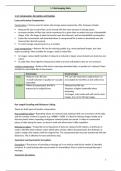
Lecture 1
Social groups and categories
• Social groups common goals, interdependence (e.g. sports, class, workgroup)
• Social categories common identity (common features; white, women, psychologists)
• Common bond groups affective bond (e.g. friends and family)
Perspectives
• Individual-level approaches
– Processes “within the person” (personal goals, values etc.)
– General and relatively stable processes
– Examples • Personality perspective
• Social cognition (like stereotyping)
individual-level approaches don’t change a lot over time.
• Group-level approaches
– Social processes (group goals, norms, values etc.)
– Social context
– Sharedness within culture and society
– Examples • Realistic conflict theory (RCT)
• Social identity theory (SIT)
group-level approaches influenced by environment, change over time.
Group approaches
• Realistic conflict theory (Sherif & Sherif, 1969)
– Intergroup conflict stems from real conflict between groups over scarce material resources
E.g. Polish people, coming here taking our jobs.
– “Robber’s cave experiment”
– Common goals
• Social identity theory (Tajfel & Turner, 1986)
– Minimal group paradigm: the minimal conditions required for discrimination to occur between
groups e.g. colours of paintings can already determine this.
– Social categorization
– Social comparison
– Social identity (meaning, certainty, self-esteem)
Describing concrete can be situational, whereas abstract is more personal.
Lecture 1
Social groups and categories
• Social groups common goals, interdependence (e.g. sports, class, workgroup)
• Social categories common identity (common features; white, women, psychologists)
• Common bond groups affective bond (e.g. friends and family)
Perspectives
• Individual-level approaches
– Processes “within the person” (personal goals, values etc.)
– General and relatively stable processes
– Examples • Personality perspective
• Social cognition (like stereotyping)
individual-level approaches don’t change a lot over time.
• Group-level approaches
– Social processes (group goals, norms, values etc.)
– Social context
– Sharedness within culture and society
– Examples • Realistic conflict theory (RCT)
• Social identity theory (SIT)
group-level approaches influenced by environment, change over time.
Group approaches
• Realistic conflict theory (Sherif & Sherif, 1969)
– Intergroup conflict stems from real conflict between groups over scarce material resources
E.g. Polish people, coming here taking our jobs.
– “Robber’s cave experiment”
– Common goals
• Social identity theory (Tajfel & Turner, 1986)
– Minimal group paradigm: the minimal conditions required for discrimination to occur between
groups e.g. colours of paintings can already determine this.
– Social categorization
– Social comparison
– Social identity (meaning, certainty, self-esteem)
Describing concrete can be situational, whereas abstract is more personal.