ABCTE- PTK (Assessment & Writing)
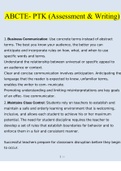
1. Business Communication: Use concrete terms instead of abstract
terms. The best you know your audience, the better you can
anticipate and incorporate rules on how, what, and when to use
specific words and terms.
Understand the relationship between universal or specific appeal to
an audience or context.
Clear and concise communication involves anticipation. Anticipating the
language that the reader is expected to know, unfamiliar terms,
enables the writer to com- municate.
Promoting understanding and limiting misinterpretations are key goals
of an effec- tive communicator.
2. Maintains Class Control: Students rely on teachers to establish and
maintain a safe and orderly learning environment that is welcoming,
inclusive, and allows each student to achieve his or her maximum
potential. The need for student discipline requires the teacher to
develop a set of rules that establish boundaries for behavior and to
enforce them in a fair and consistent manner.
Successful teachers prepare for classroom disruption before they begin
to occur.
,Alongside creating a list, teacher should include consequences as
part of the introductory events that occur during the first week of
school.
A well constructed, student-centered lesson plan is the best tactic
that a teacher can employ to avert student discipline situations.
3. Classroom Managment:
4. Productive Writing: Know when you are most productive
(mornings, after- noons, evenings...)
If you cannot choose your timing, then dedication and perseverance
is required. To be productive:
1.You need to be alert.
2. Ready to work
3. Accomplish task with relative ease.
4.Write everyday
5. Develop an habit of concentrating while you write.
6.Critical thinking self-directed, self-disciplined, self-monitored, and
self-corrective thinking (attention to detail).
7. Have a positive attitude about writing in general.
Reading and writing from an audience-centered view means
acknowledging your
,confirmation bias and moving beyond it to consider multiple frames of
references, points of view, perspectives as you read, research, and
write.
Break down writing in small manageable steps, that in turn, will
provide you with a platform for success.
Your rough draft as a purpose but its not your final
product. Let go of fear of failure.
Your desire for perfection should come in place when it comes to
polishing your finished product.
To eliminate fear of writing, make the unknown known. If we take out
the mystery out of the product and and process, we can see it for its
essential components. We see how our finished product should look.
Examine successful papers to get a better feel for what you have to
produce.
5. Planning Checklist: 1. Determine your general purpose: are you trying
to inform, persuade, entertain, facilitate interaction, or motivate a
reader? (who, what, when, how, and why(optional)) Identifying "why"
something happened or why a certain decision is advantageous will be
the essence of the communication.
2. Determine your specific purpose: the desired outcome.
, 3. Credibility, Timing, and Audience
6. Which question below is MOST likely to generate the widest range of
answers and discussions among students✔✔✔ A: Why would the
author have ended the book this way?
This question allows for both a wide range of answers and
discussion of those answers. The discussion is likely to be
interesting because there are so many possible answers to the
question.
Why questions tend to be the most open-ended.
7. Why should a teacher always spend time explaining classroom rules
during the first few days of class✔✔✔ A: To establish clear
expectations for per- formance and behavior.
Students benefit from clear, firm guidelines from the outset. The rules
should be changed only when necessary, not casually or according to
students demands.
1. Business Communication: Use concrete terms instead of abstract
terms. The best you know your audience, the better you can
anticipate and incorporate rules on how, what, and when to use
specific words and terms.
Understand the relationship between universal or specific appeal to
an audience or context.
Clear and concise communication involves anticipation. Anticipating the
language that the reader is expected to know, unfamiliar terms,
enables the writer to com- municate.
Promoting understanding and limiting misinterpretations are key goals
of an effec- tive communicator.
2. Maintains Class Control: Students rely on teachers to establish and
maintain a safe and orderly learning environment that is welcoming,
inclusive, and allows each student to achieve his or her maximum
potential. The need for student discipline requires the teacher to
develop a set of rules that establish boundaries for behavior and to
enforce them in a fair and consistent manner.
Successful teachers prepare for classroom disruption before they begin
to occur.
,Alongside creating a list, teacher should include consequences as
part of the introductory events that occur during the first week of
school.
A well constructed, student-centered lesson plan is the best tactic
that a teacher can employ to avert student discipline situations.
3. Classroom Managment:
4. Productive Writing: Know when you are most productive
(mornings, after- noons, evenings...)
If you cannot choose your timing, then dedication and perseverance
is required. To be productive:
1.You need to be alert.
2. Ready to work
3. Accomplish task with relative ease.
4.Write everyday
5. Develop an habit of concentrating while you write.
6.Critical thinking self-directed, self-disciplined, self-monitored, and
self-corrective thinking (attention to detail).
7. Have a positive attitude about writing in general.
Reading and writing from an audience-centered view means
acknowledging your
,confirmation bias and moving beyond it to consider multiple frames of
references, points of view, perspectives as you read, research, and
write.
Break down writing in small manageable steps, that in turn, will
provide you with a platform for success.
Your rough draft as a purpose but its not your final
product. Let go of fear of failure.
Your desire for perfection should come in place when it comes to
polishing your finished product.
To eliminate fear of writing, make the unknown known. If we take out
the mystery out of the product and and process, we can see it for its
essential components. We see how our finished product should look.
Examine successful papers to get a better feel for what you have to
produce.
5. Planning Checklist: 1. Determine your general purpose: are you trying
to inform, persuade, entertain, facilitate interaction, or motivate a
reader? (who, what, when, how, and why(optional)) Identifying "why"
something happened or why a certain decision is advantageous will be
the essence of the communication.
2. Determine your specific purpose: the desired outcome.
, 3. Credibility, Timing, and Audience
6. Which question below is MOST likely to generate the widest range of
answers and discussions among students✔✔✔ A: Why would the
author have ended the book this way?
This question allows for both a wide range of answers and
discussion of those answers. The discussion is likely to be
interesting because there are so many possible answers to the
question.
Why questions tend to be the most open-ended.
7. Why should a teacher always spend time explaining classroom rules
during the first few days of class✔✔✔ A: To establish clear
expectations for per- formance and behavior.
Students benefit from clear, firm guidelines from the outset. The rules
should be changed only when necessary, not casually or according to
students demands.