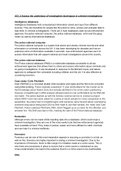
AC1.2 Assess the usefulness of investigative techniques in criminal investigations
Intelligence databases
Intelligence databases hold computerised information stored and input from different
sources. They are beneficial for people like the police to store, access and evaluate data to
help them in criminal investigations. There are 4 main databases used by law enforcement
agencies: the police national computer, the police national database, crimit and the gang
matrix as well as international databases.
The police national computer
The police national computer is a system that stores and shares criminal records and other
information on criminals across the UK. It has been developing for decades and has an
extensive store of information available in seconds. Law enforcement agencies use it to
access information that will support national and local investigations around the country.
The police national database
The Police national database (PND) is a nationwide database accessible to all law
enforcement agencies that allows them to share and access information about criminals and
on-going investigations. It was developed in response to the Bichard inquiry and allows
agencies to safeguard the vulnerable including children and the old. It is also effective at
countering terrorism.
Case study- Colin Pitchfork
Colin Pitchfork is a convicted double child murderer and rapist and the first to be convicted
using DNA profiling. Police originally suspected 17 year old Burkland for the murder as he
had knowledge about Dawns body and actually admitted to the crime under questioning
however a breakthrough in DNA analysis allowed police to rule out Burkland as his DNA did
not match. The police teamed up with the forensic science service to conduct a project
where 5000+ local men were asked for a saliva or blood sample for cross comparison to the
perpetrator, the police had no breakthroughs until someone came forward about overhearing
someone brag about being paid £200 by their mate to use their sample, the ‘mate’ was Colin
Pitchfork. Police collected Pitchforks DNA, which flagged up as a match for the offender, and
arrested him. His DNA was kept on file, marking the start of the Police National database.
Evaluation
Although errors can be made whilst inputting data into a database, which could erupt a
criminal investigation, they are one of the most useful tools that law enforcement agencies
have available at hand. They make it quicker, easier and more efficient to catch criminals
and can help if a criminal reoffends.
Forensics
Forensics can be one of the most imperative aspects in securing a conviction in a trial, as
well as this, forensics are highly important to aiding a criminal investigation. Due to the
importance of forensics, there is little margin for mistakes made at a crime scene. This is
why there are procedures in place to ensure that a crime scene is maintained as any
cross-contamination can lead to the evidence found in a crime scene to be inadmissible.
DNA
Intelligence databases
Intelligence databases hold computerised information stored and input from different
sources. They are beneficial for people like the police to store, access and evaluate data to
help them in criminal investigations. There are 4 main databases used by law enforcement
agencies: the police national computer, the police national database, crimit and the gang
matrix as well as international databases.
The police national computer
The police national computer is a system that stores and shares criminal records and other
information on criminals across the UK. It has been developing for decades and has an
extensive store of information available in seconds. Law enforcement agencies use it to
access information that will support national and local investigations around the country.
The police national database
The Police national database (PND) is a nationwide database accessible to all law
enforcement agencies that allows them to share and access information about criminals and
on-going investigations. It was developed in response to the Bichard inquiry and allows
agencies to safeguard the vulnerable including children and the old. It is also effective at
countering terrorism.
Case study- Colin Pitchfork
Colin Pitchfork is a convicted double child murderer and rapist and the first to be convicted
using DNA profiling. Police originally suspected 17 year old Burkland for the murder as he
had knowledge about Dawns body and actually admitted to the crime under questioning
however a breakthrough in DNA analysis allowed police to rule out Burkland as his DNA did
not match. The police teamed up with the forensic science service to conduct a project
where 5000+ local men were asked for a saliva or blood sample for cross comparison to the
perpetrator, the police had no breakthroughs until someone came forward about overhearing
someone brag about being paid £200 by their mate to use their sample, the ‘mate’ was Colin
Pitchfork. Police collected Pitchforks DNA, which flagged up as a match for the offender, and
arrested him. His DNA was kept on file, marking the start of the Police National database.
Evaluation
Although errors can be made whilst inputting data into a database, which could erupt a
criminal investigation, they are one of the most useful tools that law enforcement agencies
have available at hand. They make it quicker, easier and more efficient to catch criminals
and can help if a criminal reoffends.
Forensics
Forensics can be one of the most imperative aspects in securing a conviction in a trial, as
well as this, forensics are highly important to aiding a criminal investigation. Due to the
importance of forensics, there is little margin for mistakes made at a crime scene. This is
why there are procedures in place to ensure that a crime scene is maintained as any
cross-contamination can lead to the evidence found in a crime scene to be inadmissible.
DNA