

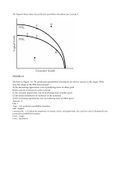
The diagram below shows two production possibilities boundaries for Country X.
FIGURE 1-4
55) Refer to Figure 1-4. The production possibilities boundaries are drawn concave to the origin. What
does this shape of the PPB demonstrate?
A) the decreasing opportunity cost of producing more of either good
B) the scarcity of resources in the economy
C) the constant opportunity cost of producing more of either good
D) the unfair distribution of resources in the economy
E) the increasing opportunity cost of producing more of either good
Answer: E
Diff: 3
Topic: 1.1d. production possibilities boundary
Skill: Applied
Learning Obj.: 1-1 Explain the importance of scarcity, choice, and opportunity cost, and how each is illustrated by the
production possibilities boundary.
User1: Graph
User2: Qualitative
, 56) Refer to Figure 1-4. If Country X, constrained by the production possibilities boundary PPB1, is
producing the combination of goods indicated at point F, it can produce more consumer goods by moving
to one of the points
A) A or E.
B) D or E.
C) A, B, or C.
D) A or B, but not C.
E) A, B, C, D, or E.
Answer: C
Diff: 3
Topic: 1.1d. production possibilities boundary
Skill: Applied
Learning Obj.: 1-1 Explain the importance of scarcity, choice, and opportunity cost, and how each is illustrated by the
production possibilities boundary.
User1: Graph
User2: Qualitative
57) Refer to Figure 1-4. If Country X is currently producing at point A, it could move to point B if
A) the cost of producing capital goods were to increase.
B) some resources were switched from the capital goods industries to the consumer goods industries.
C) the cost of producing consumer goods were to increase.
D) some resources were switched from the consumer goods industries to the capital goods industries.
E) Country X is no longer able to produce the quantity of capital goods at point A.
Answer: B
Diff: 2
Topic: 1.1d. production possibilities boundary
Skill: Applied
Learning Obj.: 1-1 Explain the importance of scarcity, choice, and opportunity cost, and how each is illustrated by the
production possibilities boundary.
User1: Graph
User2: Qualitative
58) Refer to Figure 1-4. If Country X were producing at point C,
A) the opportunity cost of moving to point B is to give up some consumption goods.
B) the opportunity cost of moving to point A is zero.
C) the opportunity cost of moving to point A is to give up some capital goods.
D) this is the maximum output possible from given resources.
E) it is not possible to move to any point on PPB1 or PPB2 without technological progress.
Answer: B
Diff: 3
Topic: 1.1d. production possibilities boundary
Skill: Applied
Learning Obj.: 1-1 Explain the importance of scarcity, choice, and opportunity cost, and how each is illustrated by the
production possibilities boundary.
User1: Graph
User2: Qualitative
FIGURE 1-4
55) Refer to Figure 1-4. The production possibilities boundaries are drawn concave to the origin. What
does this shape of the PPB demonstrate?
A) the decreasing opportunity cost of producing more of either good
B) the scarcity of resources in the economy
C) the constant opportunity cost of producing more of either good
D) the unfair distribution of resources in the economy
E) the increasing opportunity cost of producing more of either good
Answer: E
Diff: 3
Topic: 1.1d. production possibilities boundary
Skill: Applied
Learning Obj.: 1-1 Explain the importance of scarcity, choice, and opportunity cost, and how each is illustrated by the
production possibilities boundary.
User1: Graph
User2: Qualitative
, 56) Refer to Figure 1-4. If Country X, constrained by the production possibilities boundary PPB1, is
producing the combination of goods indicated at point F, it can produce more consumer goods by moving
to one of the points
A) A or E.
B) D or E.
C) A, B, or C.
D) A or B, but not C.
E) A, B, C, D, or E.
Answer: C
Diff: 3
Topic: 1.1d. production possibilities boundary
Skill: Applied
Learning Obj.: 1-1 Explain the importance of scarcity, choice, and opportunity cost, and how each is illustrated by the
production possibilities boundary.
User1: Graph
User2: Qualitative
57) Refer to Figure 1-4. If Country X is currently producing at point A, it could move to point B if
A) the cost of producing capital goods were to increase.
B) some resources were switched from the capital goods industries to the consumer goods industries.
C) the cost of producing consumer goods were to increase.
D) some resources were switched from the consumer goods industries to the capital goods industries.
E) Country X is no longer able to produce the quantity of capital goods at point A.
Answer: B
Diff: 2
Topic: 1.1d. production possibilities boundary
Skill: Applied
Learning Obj.: 1-1 Explain the importance of scarcity, choice, and opportunity cost, and how each is illustrated by the
production possibilities boundary.
User1: Graph
User2: Qualitative
58) Refer to Figure 1-4. If Country X were producing at point C,
A) the opportunity cost of moving to point B is to give up some consumption goods.
B) the opportunity cost of moving to point A is zero.
C) the opportunity cost of moving to point A is to give up some capital goods.
D) this is the maximum output possible from given resources.
E) it is not possible to move to any point on PPB1 or PPB2 without technological progress.
Answer: B
Diff: 3
Topic: 1.1d. production possibilities boundary
Skill: Applied
Learning Obj.: 1-1 Explain the importance of scarcity, choice, and opportunity cost, and how each is illustrated by the
production possibilities boundary.
User1: Graph
User2: Qualitative


