LEARNING APPROACH
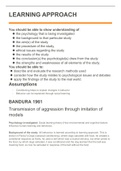
You should be able to show understanding of:
the psychology that is being investigated
the background to that particular study
the aim(s) of the study
the procedure of the study,
ethical issues regarding the study
the results of the study
the conclusion(s) the psychologist(s) drew from the study
the strengths and weaknesses of all elements of the study.
You should be able to:
describe and evaluate the research methods used
consider how the study relates to psychological issues and debates
apply the findings of the study to the real world.
Assumptions
- Conditioning helps to explain changes in behavior
- Behavior can be explained through social learning
BANDURA 1961
Transmission of aggression through imitation of
models
Psychology investigated: Social learning theory (How environmental and cognitive factors
influence human learning and behaviour.
Background of the study: All behaviour is learned according to learning approach, This is
shown in Pavlov’s Dogs (classical conditioning), where dogs salivated with food, he created a
conditional response as firstly, he used a bell which was a neutral stimulus, but when joined to
the food, by which dogs salivated, it was conditioned and the dog learned that the bell was
meaning food, so now he salivated in response of the bell without the food.
, Little albert is another example of Classical conditioning, a baby was used, he was presented
with a rat (neutral response) and presented to a loud noise which scared him (unconditional
response) these two where joined, the rat was presented whilst a loud noise was presented.
When the rat was the presented on its own, Little albert showed fear of the rat (conditional
response)
Aim: The aim of the study was to investigate if children would learn aggression of a model, and
if they would show this aggression without the presence of this aggressive models. The impact
of the Sex of the role model was also investigated.
2
You should be able to show understanding of:
the psychology that is being investigated
the background to that particular study
the aim(s) of the study
the procedure of the study,
ethical issues regarding the study
the results of the study
the conclusion(s) the psychologist(s) drew from the study
the strengths and weaknesses of all elements of the study.
You should be able to:
describe and evaluate the research methods used
consider how the study relates to psychological issues and debates
apply the findings of the study to the real world.
Assumptions
- Conditioning helps to explain changes in behavior
- Behavior can be explained through social learning
BANDURA 1961
Transmission of aggression through imitation of
models
Psychology investigated: Social learning theory (How environmental and cognitive factors
influence human learning and behaviour.
Background of the study: All behaviour is learned according to learning approach, This is
shown in Pavlov’s Dogs (classical conditioning), where dogs salivated with food, he created a
conditional response as firstly, he used a bell which was a neutral stimulus, but when joined to
the food, by which dogs salivated, it was conditioned and the dog learned that the bell was
meaning food, so now he salivated in response of the bell without the food.
, Little albert is another example of Classical conditioning, a baby was used, he was presented
with a rat (neutral response) and presented to a loud noise which scared him (unconditional
response) these two where joined, the rat was presented whilst a loud noise was presented.
When the rat was the presented on its own, Little albert showed fear of the rat (conditional
response)
Aim: The aim of the study was to investigate if children would learn aggression of a model, and
if they would show this aggression without the presence of this aggressive models. The impact
of the Sex of the role model was also investigated.
2