Sport and Performance Psychology Lecture notes
LECTURE 1 14/09/2022
Control the controllables!
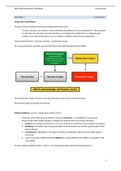
Mental training is typically directed at avoiding performing losses:
- To teach, develop, and maintain mental skills that help athletes to focus exclusively on “How you play”
(i.e. the task at hand) while ignoring distractions, including internal distractors or self-generated
concerns, and external distractors such as weather conditions and actions by opponents.
How you play/perform = how you can play – performance losses
So in any performance situation, you perform below the maximum performance ability.
The mental side of sports focusses on both performance gains and performance losses.
Performance gains: practicing and training.
Mental toughness: we don’t exactly know what it means
- In the late 1970s, Kobasa came with the concept of hardiness: a constellation of personality
characteristics that enables people to mitigate the adverse effects of stressful situations.
1. Control: the capacity to feel and act as if one could exert an influence in the situation in question.
2. Challenge: the habit of perceiving potentially stressful situations as positive opportunities rather
than as threats.
3. Commitment: stickability or the extent to which an individual is likely to persist with a goal or
work task.
4. Some researchers added a fourth: Confidence: a strong belief in one’s ability to complete a task
successfully.
It is not widely accepted, however. There’s a lot of discussion about what mental toughness is.
1
,Sport and Performance Psychology Lecture notes
Different perspectives on performance:
- Mental/Psychological
- Physical
- Technical
- Tactical
“Performance is 90% mental” – agree or disagree?
- Disagree:
o If people lack the competence (fitness, strength, the skills that are required), the mental piece
is completely irrelevant.
o People tend to overestimate the impact of mental factors: amateur athletes tend to explain
their inconsistency or lack of progress to mental factors.
Competence, rather than mental factors, determine (fluctuations in) performance.
- Agree:
o When competing against an opponent of similar ability, mental factors make the difference
because they are more sensitive to pressure situations than physical, technical, and tactical
factors.
o Mental factors determine athlete’s performance losses.
o And mental factors facilitate the development of expertise (i.e. performance gains).
How you play is influenced by:
1. Expertise (the capacity to perform):
o Genetics
o Practice and training
o Anthropometric and physiological factors
o Mindset
o Early specialization versus sampling and play (do you start selecting at an early age, or later in
life?)
2. Opportunity to perform:
o Social support
o Athlete support programs
o Birthdate (in many sports are cohorts; your date of birth determines in which one you are
placed)
o Birthplace (if you’re from Senegal, the chances of you becoming a professional ice skater are
way smaller than if you’re from the Netherlands)
3. The mind to perform:
o Personality traits
o Psychological skills
o Motivational orientations
2
, Sport and Performance Psychology Lecture notes
Successful athletes:
- Display higher levels of motivation;
- Command a wide range of mental skills (e.g. goal-setting, anxiety control, etc.)
- Display higher levels of mental toughness and resilience, including:
o Higher levels of confidence and perceived control;
o Better abilities to cope with adversity (e.g. problem solving and ability to re-focus);
o Greater resistance to “choking”.
Mental practice should focus on:
- Developing mental skills and enhancing sustainable motivation;
o Enhancing the ability and motivation to effectively self-regulate during performance.
- Improving one’s expertise (level and consistency);
o Developing the competencies to utilize when performing.
- Optimizing opportunities to develop and to train.
o Optimizing the opportunities to perform well (e.g. materials, food, sleep).
There are no quick fixes! Always look at it from an individual’s perspective.
Body and mind are strongly related it makes no sense to discuss them separately.
Motivation: the psychological forces that determine the direction of a person’s behaviour, a person’s level of
intensity or effort, and a person’s level of persistence.
Theories focussing on direction:
- Goal Setting Theory
- Achievement Goal Approach
Theories focussing on intensity or effort:
- Achievement Goal Approach
- Self-Determination Theory
Theories focussing on persistence:
- Self-Determination Theory
- Attribution Theory
The Self-Determination Theory (SDT) framework:
- Intrinsic motivation: when an activity is performed for its own sake the behaviour is experienced as
inherently satisfying, because it satisfies the basic needs for autonomy, competence, and relatedness.
- Extrinsic motivation: the activity is perceived as a means to a separable outcome.
- Amotivation: the absence of motivation.
Mini-theory Cognitive Evaluation Theory:
Thwarting people’s basic psychological needs for autonomy, competence, and relatedness, decreases
their intrinsic motivation.
o For example: if athletes believe that their sporting behaviour is controlled by external
rewards, their level of intrinsic motivation may decline.
3
LECTURE 1 14/09/2022
Control the controllables!
Mental training is typically directed at avoiding performing losses:
- To teach, develop, and maintain mental skills that help athletes to focus exclusively on “How you play”
(i.e. the task at hand) while ignoring distractions, including internal distractors or self-generated
concerns, and external distractors such as weather conditions and actions by opponents.
How you play/perform = how you can play – performance losses
So in any performance situation, you perform below the maximum performance ability.
The mental side of sports focusses on both performance gains and performance losses.
Performance gains: practicing and training.
Mental toughness: we don’t exactly know what it means
- In the late 1970s, Kobasa came with the concept of hardiness: a constellation of personality
characteristics that enables people to mitigate the adverse effects of stressful situations.
1. Control: the capacity to feel and act as if one could exert an influence in the situation in question.
2. Challenge: the habit of perceiving potentially stressful situations as positive opportunities rather
than as threats.
3. Commitment: stickability or the extent to which an individual is likely to persist with a goal or
work task.
4. Some researchers added a fourth: Confidence: a strong belief in one’s ability to complete a task
successfully.
It is not widely accepted, however. There’s a lot of discussion about what mental toughness is.
1
,Sport and Performance Psychology Lecture notes
Different perspectives on performance:
- Mental/Psychological
- Physical
- Technical
- Tactical
“Performance is 90% mental” – agree or disagree?
- Disagree:
o If people lack the competence (fitness, strength, the skills that are required), the mental piece
is completely irrelevant.
o People tend to overestimate the impact of mental factors: amateur athletes tend to explain
their inconsistency or lack of progress to mental factors.
Competence, rather than mental factors, determine (fluctuations in) performance.
- Agree:
o When competing against an opponent of similar ability, mental factors make the difference
because they are more sensitive to pressure situations than physical, technical, and tactical
factors.
o Mental factors determine athlete’s performance losses.
o And mental factors facilitate the development of expertise (i.e. performance gains).
How you play is influenced by:
1. Expertise (the capacity to perform):
o Genetics
o Practice and training
o Anthropometric and physiological factors
o Mindset
o Early specialization versus sampling and play (do you start selecting at an early age, or later in
life?)
2. Opportunity to perform:
o Social support
o Athlete support programs
o Birthdate (in many sports are cohorts; your date of birth determines in which one you are
placed)
o Birthplace (if you’re from Senegal, the chances of you becoming a professional ice skater are
way smaller than if you’re from the Netherlands)
3. The mind to perform:
o Personality traits
o Psychological skills
o Motivational orientations
2
, Sport and Performance Psychology Lecture notes
Successful athletes:
- Display higher levels of motivation;
- Command a wide range of mental skills (e.g. goal-setting, anxiety control, etc.)
- Display higher levels of mental toughness and resilience, including:
o Higher levels of confidence and perceived control;
o Better abilities to cope with adversity (e.g. problem solving and ability to re-focus);
o Greater resistance to “choking”.
Mental practice should focus on:
- Developing mental skills and enhancing sustainable motivation;
o Enhancing the ability and motivation to effectively self-regulate during performance.
- Improving one’s expertise (level and consistency);
o Developing the competencies to utilize when performing.
- Optimizing opportunities to develop and to train.
o Optimizing the opportunities to perform well (e.g. materials, food, sleep).
There are no quick fixes! Always look at it from an individual’s perspective.
Body and mind are strongly related it makes no sense to discuss them separately.
Motivation: the psychological forces that determine the direction of a person’s behaviour, a person’s level of
intensity or effort, and a person’s level of persistence.
Theories focussing on direction:
- Goal Setting Theory
- Achievement Goal Approach
Theories focussing on intensity or effort:
- Achievement Goal Approach
- Self-Determination Theory
Theories focussing on persistence:
- Self-Determination Theory
- Attribution Theory
The Self-Determination Theory (SDT) framework:
- Intrinsic motivation: when an activity is performed for its own sake the behaviour is experienced as
inherently satisfying, because it satisfies the basic needs for autonomy, competence, and relatedness.
- Extrinsic motivation: the activity is perceived as a means to a separable outcome.
- Amotivation: the absence of motivation.
Mini-theory Cognitive Evaluation Theory:
Thwarting people’s basic psychological needs for autonomy, competence, and relatedness, decreases
their intrinsic motivation.
o For example: if athletes believe that their sporting behaviour is controlled by external
rewards, their level of intrinsic motivation may decline.
3